video
How to Generate Content for any Topic in IELTS
Generating content and speaking on a topic is a daunting task for many of us. In this video we'll learn some simple tips to create content.
The IELTS Speaking Test is different from all the other sections of the IELTS exam because it includes talking to a person. The purpose of the speaking section is to assess your spoken English. It is only the test of your language, not your ideas or knowledge.
This section is also the most feared round of the IELTS exam because of its format. It is conducted face to face with an examiner in a room.
The IELTS speaking test is the same for Academic and General Training, contrary to the reading and writing formats which are different for IELTS Academic and General Training. It lasts for about 11 to 14 minutes. The test is divided into three parts – IELTS speaking part 1, part 2 and part 3.
Before your test starts, the examiner asks you your name, how you can be addressed and what you do. You are also asked to show your ID.
There are some common problems during the IELTS Speaking exam which our students have reported to us over a period of time. They range from being nervous during the interview session, not knowing how to respond to examiners questions, having difficulty understanding examiners questions and not understanding examiner’s accent. As a result students either start speaking fast, give ill structured answers or just go blank.
The solution to all such and other problems is practise speaking fluently, learn to structure your responses, and pronounce words correctly, but most importantly you need to learn how to generate content in response to the questions that your examiner will ask in speaking part 1, 2 and 3.
Below are some suggestions students can incorporate while preparing:
Sometimes the best thing to do is start with whatever first comes into your mind. And remember to use the right intonation and pace while speaking.
Many students wonder why they are not able to cover up a gap of 6.5 to 7.5 or 8 despite being fluent and coherent while speaking. One of the biggest reasons is the lack of linking words like idioms in speech. Some of the common linking words that you can use are:
To add ideas:
To express opinion:
To explain:
For consequences:
For contrasting situations:
To give an example:
Sign-post language is used by people in order to guide the listener coherently through what is being said. It comprises two main components, namely, Idioms and Phrasal Verbs. Some salient examples of idioms are On Cloud Nine, Over the Moon, and A White Lie. On the other hand, common examples of phrasal verbs include fall apart, hold up, stop over, get through, look up to, etc.
Being able to employ sign-post language whenever necessary, is an important skill to have. Infact, it is one of the most important skills to score high in the IELTS speaking exam.
We all are well aware that all the questions in the IELTS Speaking section are about you and your past, present and future. This just means that when you are giving your speech to the examiner, your conversation shifts from present to past, present to future, present to past to future or in any other order.
You talk about different time frames in the same conversation. Therefore, you get points for the correct usage. On the other hand, if you use it incorrectly, you lose those points.
In each part of the speaking section, the usage of correct grammar, especially tenses, is extremely important. While answering the questions in IELTS Speaking part 1, you must be able to quickly and smoothly shift from your past self to your present self.
Sometimes, it might even require you to move ahead and talk about your future self. Even though you feel that it is an easy task to complete, since you have talked about yourself on multiple occasions before, this assumption is far from true.
Similarly, in IELTS Speaking Part 2 and Part 3, everything revolves around what is happening around you. This is where most people make mistakes. While these mistakes may be small, they can cost you a fortune in marks as they violate the parameters of marking in IELTS Speaking exam.
It is important to note here that grammar is not only a parameter of marking in IELTS Speaking, it is one of the biggest mark pools. It accounts for 25% of your marks in IELTS Speaking Section.
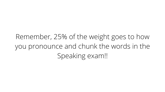
Pronunciation accounts for 25% of the marking criteria in the IELTS Speaking test, along with other criterias like fluency, vocabulary and grammar, making it an essential part of the IELTS Speaking test.
Your pronunciation is tested based on various features like, how much stress you put on words, how well you use intonation to make your speech impactful, how you speak a sentence, etc.
Pronunciation is something that cannot be changed in a day, since it takes time to change your speaking habits and speak like a native speaker. But if you have enough time before your test date, then you can follow some of the below given strategies to improve your pronunciation skills:
Watch the video given below to know more about pronunciation and how you can improve it.
For IELTS speaking part 1, the examiner will introduce him or herself and ask you general questions about common topics such as home, family, work, studies, and your interests.
Part 1 lasts for about 4-5 minutes and the examiner asks questions on common topics such as home, family, work, studies, and your interests. Some sample topics can be - your home town or village, your residence, etc.
While answering these questions, follow these strategies:
These questions in the IELTS Speaking exam are designed to test the candidate on the following skills: fluency, vocabulary, grammar and pronunciation/intonation.
It is important to understand that you should not try to note down and cram the answers. Remember! Our purpose here is to channelise the thinking, be ready for any type of questions and improve the fluency while using correct grammar and vocabulary.
Moreover, the interviewers are smart enough to gauge from your tone and speed that you've crammed. So keep it as natural as possible with a proper flair.
The types of questions that can be asked in IELTS Speaking Part 1 are of the following types:
1. Fashion
Sample IELTS Speaking Part 1 Answer about Fashion
2. Sports
Sample IELTS Speaking Part 1 Answer about Sports
3. Food
Sample IELTS Speaking Part 1 answer about Food
4. Home
Sample IELTS Speaking Part 1 answer about home
5. Flowers
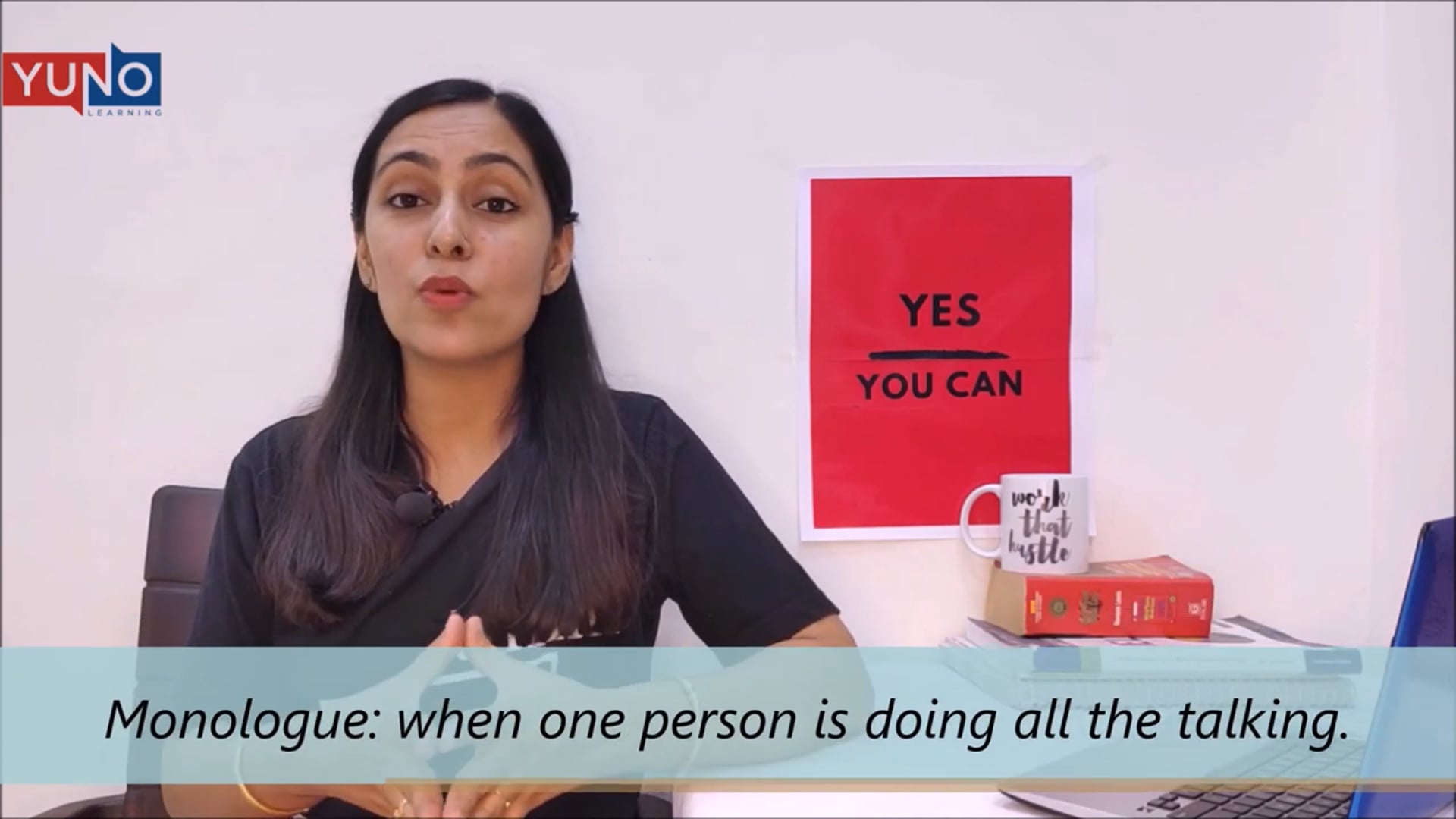
IELTS Speaking Part 2 is a monologue in which you'll talk and the examiner will listen. A monologue is when one person does all the talking. This round lets the examiner know if you can speak for a longer period of time.
This is how the IELTS speaking part 2 round takes place:
There are some important points to keep in mind while attempting the part 2 of the IELTS Speaking exam:
Now, let's discuss the most probable topics that you might witness in your final examination. Since this part is all about you and your life experiences, the topics will revolve around you only. The types of questions that can be asked in IELTS Speaking Part 2 are:
1. Describe a part of the world you would like to visit.
Sample answer for IELTS Speaking Part 2 on Travel
2. Describe a film/movie actor from your country who is very popular.
Sample answer for IELTS Speaking Part 2 on Films
3. Describe an interesting discussion you had about how you spend your money.
Sample answer for IELTS Speaking Part 2 on Talks and Discussion
4. Describe a child that you know.
Sample answer for IELTS Speaking Part 2 on Family
5. Describe a shop or a store you often go to.
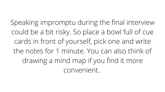
Find the most common IELTS Speaking part 2 topics from the best IELTS online coaching centre.
IELTS Speaking Tutorial by Expert IELTS Instructor. Practice IELTS Real Speaking Section Question to achieve a high band score in the exam.
The IELTS Speaking Part 3 lasts for about 4-5 minutes. The examiner will ask you 4-6 questions related to the topic you spoke about in part 2. These questions are more general or abstract in nature.
For instance, if in Part 2 you spoke about, "Describe an article on health that you read from a magazine or online", then in Part 3 the examiner will almost certainly ask you questions related to the health or reading habits in general.
Such as, "Do you think most people worry more about their health as they get older"? or "Do you think people read more these days"?
Questions asked in IELTS Speaking Part 3 are not straightforward like the ones in Part 1 and 2, where questions are more about YOU, YOUR LIFE and YOUR EXPERIENCES.
Part 3 is not about you. It's about how well you can express your thoughts, feelings and opinions about general or abstract concepts.
This round lets the examiner know if you can talk about more abstract topics, not just about yourself and your life. Well this round is a bit trickier but don't worry, we have got you covered.
In the given video we have covered everything that you need to know about the IELTS Speaking Part 3.
Some of the common types of questions that can be asked in IELTS Speaking Part 3 are:
1. Do you think music has an effect on people’s lives?
Sample answer for IELTS Speaking Part 3 on music
2. Why in your opinion university education is important for us?
Sample answer for IELTS Speaking Part 3 on university education
3. What is the most common way to get a job in your country?
Sample answer for IELTS Speaking Part 3 about a job
4. What kind of gifts would men, women and children like to receive?
Sample answer for IELTS Speaking Part 3 about gifts
5. How can different room colours affect the way people feel?
Sample answer for IELTS Speaking Part 3 about a house
If you are looking for a comprehensive IELTS Preparation course or just want to focus on the speaking section, get in touch with us at www.yunolearning.com . Along with our free study material and practice tests, we have one to one doubt sessions too, so that you can resolve all your doubts and get your desired score. In case of any query, give us a call at 098739 98199.

.png)