Study Heritage Management Abroad: Courses, Careers and Top Universities
TL;DR
- Heritage management is emerging as a specialised global career for students who love history, culture, research and international affairs. Far beyond preserving monuments, the field encompasses museums, archaeology, conservation, digital heritage, cultural policy, heritage tourism and cultural diplomacy.
- For students considering studying abroad, postgraduate options include Heritage Studies, Cultural Heritage Management, Museum Studies, Conservation, Digital Heritage and Cultural Diplomacy. Universities such as Cambridge, York, UCL, Amsterdam and Leiden offer programmes worth exploring.
- Career opportunities span governments, museums, cultural foundations, heritage consultancies and international organisations including UNESCO, ICOMOS and ICCROM.
- With heritage increasingly crossing national borders, this interdisciplinary field could offer students a distinctive pathway from a passion for the past to a career with global opportunities.
Something interesting has been happening around India’s cultural heritage. On 25 July 2026, Sarnath became India’s 45th UNESCO World Heritage Site. The site, where the Buddha is traditionally believed to have delivered his first sermon, received international recognition at the 48th session of the World Heritage Committee in Busan, South Korea.
A few weeks earlier, Indian Prime Minister Narendra Modi and Indonesian President Prabowo Subianto visited the Prambanan Temple Complex in Indonesia, where India and Indonesia launched conservation cooperation involving the Archaeological Survey of India. Prambanan is a UNESCO World Heritage site and an important part of the shared cultural history linking India and Southeast Asia.
And in August, India hosted the BRICS Culture Ministers’ Meeting in Bhopal, with participants visiting the UNESCO World Heritage sites of Sanchi and Bhimbetka and adopting the Bhopal Declaration on cultural cooperation.
What do these apparently unrelated events have in common?
They all involve heritage management. And that is a much bigger profession than many students realise.
Why This Profession Matters
We tend to think of heritage as old buildings, archaeological ruins, paintings and museum objects.
But heritage can also mean:
- Traditional crafts;
- Music and dance;
- Festivals;
- Languages and oral traditions;
- Archives and manuscripts;
- Historic landscapes;
- Religious sites;
- Archaeological remains;
- Museums and collections;
- Traditional knowledge;
- Digital records of cultural material.
UNESCO’s definition of intangible cultural heritage encompasses practices, knowledge, skills, traditions and expressions that communities recognise as part of their cultural heritage.
So the professional problem is not simply: How do we preserve this old building?
It may be:
- Who owns this object?
- Who has the right to tell this story?
- How should a sacred site be opened to tourists?
- How do we preserve a historic city while allowing people to live in it?
- Should an artefact held by a museum be returned to its country or community of origin?
- How do we protect a traditional craft from disappearing?
- How can a heritage site generate tourism revenue without being destroyed by tourism?
And increasingly:
How do we use digital technology to preserve and interpret heritage without turning living cultures into digital museum pieces?
These are questions of history, archaeology, architecture, law, economics, technology, politics and diplomacy. That is why heritage management is a global problem-solving profession.
When the Past Becomes Political
There is an uncomfortable side to heritage that students should understand.
India possesses an extraordinary historical inheritance, yet our relationship with it can sometimes be surprisingly selective. We may enthusiastically repeat spectacular stories about ancient India while knowing very little about the archaeological evidence that is actually available. We walk past centuries-old structures in our cities without asking who built them, why they mattered or what they can tell us about the society that produced them.
And sometimes the problem is not indifference but politics. Archaeological discoveries can challenge comfortable versions of history. Different communities may attach very different meanings to the same monument. Excavations such as those at Keezhadi in Tamil Nadu have acquired significance far beyond archaeology because evidence about the antiquity and character of an ancient civilisation can intersect with modern arguments about identity.
The same problem occurs everywhere.
- Who decides which version of history is displayed in a museum?
- What happens when new evidence contradicts an established narrative?
- Should a monument be restored to the way it supposedly looked centuries ago—or left as evidence of everything that happened to it afterwards?
- Who decides what is authentic?
These are not merely academic questions.
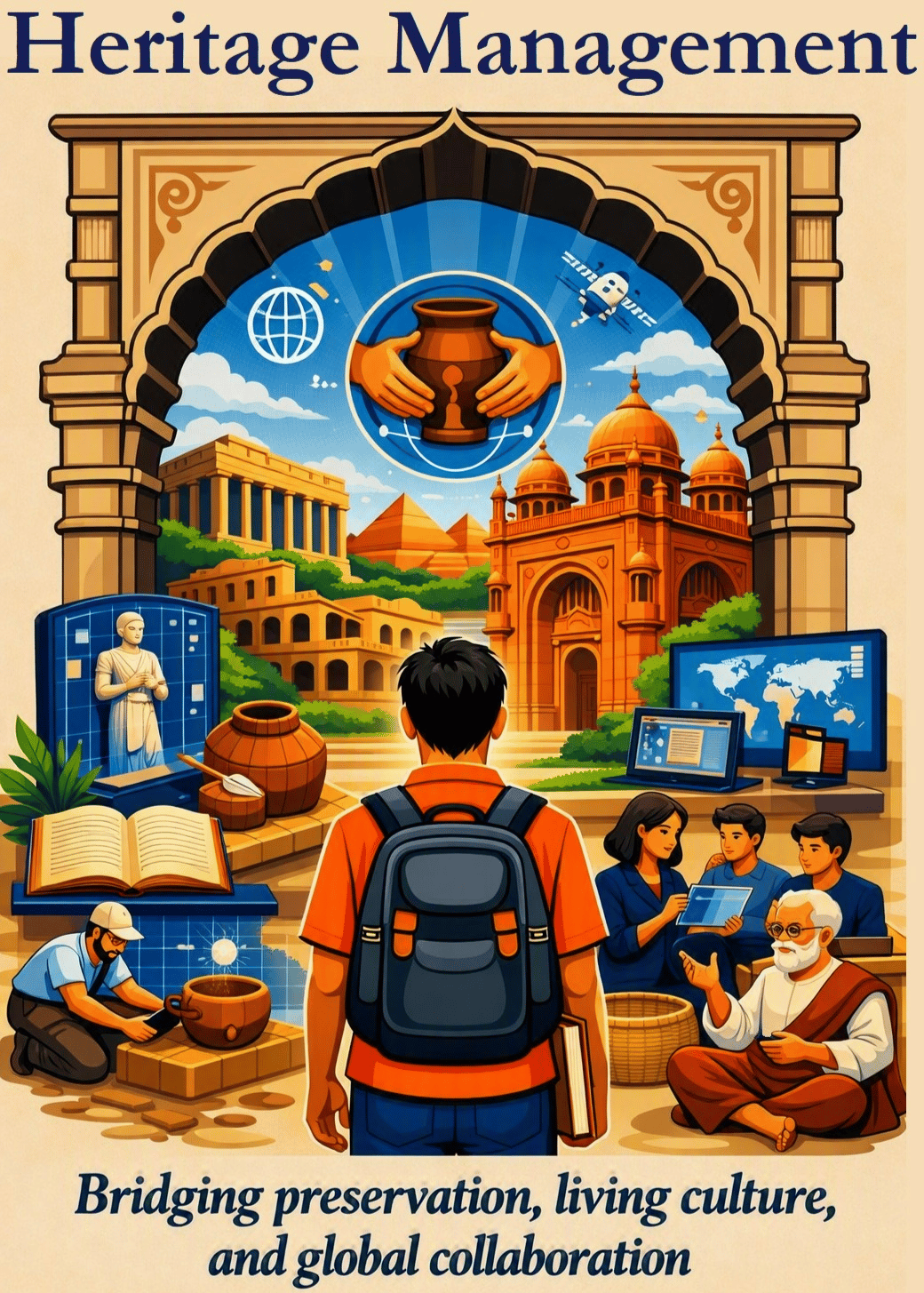
They are precisely the sort of questions that make heritage management a profession rather than simply an exercise in preserving old buildings.
A good heritage professional must be curious about inconvenient evidence as well as flattering evidence. The job is not to manufacture a past that makes the present comfortable. It is to preserve evidence, acknowledge uncertainty and help societies engage intelligently with what actually survives.
The Czech writer Milan Kundera captured something of this tension when he observed that people often want control of the future because they want to change the past.
Heritage professionals confront the opposite challenge: How do we allow the past to remain sufficiently alive, complicated and inconvenient that it cannot simply be rewritten to suit the present?
That is a surprisingly demanding professional responsibility.
Career Roadmap
Academic Pathway
There is no single undergraduate degree called “Heritage Management” that everyone must take. That is good news. Possible undergraduate starting points include:
- History
- Archaeology
- Anthropology
- Art History
- Architecture
- Conservation
- Museum Studies
- Geography
- Sociology
- International Relations
- Cultural Studies
- Tourism
- Public Policy
A student who loves history does not necessarily have to become an academic historian. A student interested in architecture does not necessarily have to become an architect. A student fascinated by museums does not necessarily have to become a curator.
At postgraduate level, look for programmes in:
- Cultural Heritage Management
- Heritage Studies
- Museum Studies
- Conservation
- Public History
- Archaeological Heritage
- Historic Building Conservation
- Digital Heritage
- Cultural Policy
- Heritage and Memory
The best programmes tend to be interdisciplinary and practical rather than purely theoretical.
Universities Worth Investigating
1. University of Cambridge
Cambridge offers an MPhil in Heritage Studies through its Department of Archaeology and Cambridge Heritage Research Centre.
2. University of York
York has a broad heritage ecosystem, including Cultural Heritage Management, Museum Studies, Historic Buildings, International Conservation Studies and Digital Heritage.
3. University College London
UCL’s Institute for Sustainable Heritage is particularly interesting for students who want to combine heritage with technology, sustainability, environmental assessment and management.
4. University of Amsterdam
Amsterdam offers Heritage Studies with specialisations including Heritage and Memory Studies, Museum Studies and Curating Art and Cultures.
5. Leiden University
Leiden has strong expertise at the intersection of archaeology, museums and heritage, combining archaeological perspectives with cultural and landscape studies, politics, cultural theory and environmental questions.
These are NOT rankings. They are places to start looking.
Search Keywords
Cultural Heritage Management • Heritage Studies • Archaeological Heritage
Museum Studies • Conservation Studies • Historic Building Conservation
Digital Heritage • Public History • Cultural Policy
Heritage and Memory • Intangible Cultural Heritage • Cultural Diplomacy
Typical First Jobs
A graduate is unlikely to become “Director of Heritage” immediately.
Entry-level jobs might include:
- Heritage Officer
- Assistant Curator
- Museum Education Officer
- Collections Assistant
- Conservation Assistant
- Archaeological Project Assistant
- Heritage Research Assistant
- Site Management Assistant
- Archive Assistant
- Cultural Programme Officer
- Heritage Consultant
- Community Engagement Officer
Some graduates enter government. Others join museums, heritage organisations, archaeological consultancies, cultural foundations or tourism organisations. Some work on specific projects rather than holding permanent positions.
This is a profession in which experience and networks matter considerably. Internships, fieldwork, volunteering, museum placements and practical conservation experience can therefore be unusually valuable.
Long-Term Career Progression
With experience, a professional might become:
- Heritage Manager
- Museum Curator
- Collections Manager
- Conservation Manager
- Archaeological Project Manager
- Historic Environment Adviser
- Heritage Policy Adviser
- Museum Director
- Cultural Programme Director
- Heritage Consultant
- UNESCO Programme Specialist
- Cultural Diplomacy Adviser
There is also a research and academic route through a PhD. And there is an increasingly interesting international route into cultural diplomacy.
Major Employers
Governments
In India, the Archaeological Survey of India (ASI) is the country’s principal organisation for archaeological research and protection of cultural heritage.
Other employers can include:
- Ministry of Culture
- State departments of archaeology and culture
- Museums
- Archives
- Municipal heritage authorities
- Tourism departments
- Cultural foundations
- International Organisations
- The obvious name is UNESCO.
But UNESCO is only part of the international ecosystem.
Other organisations include:
- International Council of Museums (ICOM)
- International Council on Monuments and Sites (ICOMOS)
- ICCROM
- World Heritage organisations and national heritage agencies
- Private and Non-Government Sector
There are also opportunities in:
- Heritage consultancies
- Architecture and conservation practices
- Museums and galleries
- Cultural foundations
- Tourism organisations
- Exhibition companies
- Documentary and media organisations
- Digital heritage companies
- Cultural technology firms
India Connection
India is a particularly interesting country in which to study or build a career in heritage.
It possesses an enormous archaeological and cultural inheritance—and that inheritance is increasingly being treated as an international resource as well as something to be preserved domestically. The Sarnath inscription is the latest example. India now has 45 UNESCO World Heritage Sites, following the July 2026 inscription of the Ancient Buddhist Site of Sarnath.
But heritage is not confined to monuments. India also has numerous UNESCO-recognised elements of intangible cultural heritage, reflecting traditions, festivals, crafts and forms of cultural expression. This creates an unusually broad professional landscape.
A student might work with:
Archaeological sites
or
Museums
or
Archives
or
Living traditions
or
Historic cities
or
Cultural tourism
or
Digital preservation.
India’s Indira Gandhi National Centre for the Arts (IGNCA) is an especially interesting example of this expanding field. Its postgraduate offerings include areas such as Cultural Management, Preventive Conservation, Applied Museology, Cultural Informatics, Manuscriptology and Palaeography, and Rock Art and Ethno-Archaeological Studies. In other words, India itself is developing a professional ecosystem around heritage.
When Heritage Becomes Diplomacy
This is where the field becomes particularly interesting for students who enjoy international affairs.
Consider Prambanan.The temple is in Indonesia. It belongs to Indonesia’s heritage. Yet its history is deeply connected to the wider Hindu-Buddhist civilisation of Asia, including India.
India’s conservation partnership with Indonesia at the UNESCO World Heritage site demonstrates how heritage can become an instrument of international cooperation. This is more than conservation. It is cultural diplomacy.
Heritage can create relationships where political negotiations may be difficult. It can remind countries of historical connections that existed long before modern borders. And it can provide opportunities for cooperation around something that is not a military alliance, trade agreement or political treaty. For an Indian student interested in both history and international relations, this is a particularly intriguing career direction.
Will AI Take My Job?
Low risk—but with an important qualification. AI is already becoming useful in heritage.
It can help:
- Digitise collections;
- Recognise objects and images;
- Translate texts;
- Catalogue archives;
- Reconstruct damaged material;
- Create virtual exhibitions;
- Analyse enormous collections of documents;
- Produce 3D models;
- Make heritage more accessible.
Digital heritage is therefore likely to grow. But heritage management is not simply the preservation of information.
Someone still has to decide:
- What should be preserved?
- How should it be interpreted?
- Whose interpretation should be heard?
- How should sacred or sensitive material be handled?
- Should an object be returned to its community of origin?
- How much tourism is too much?
- How should a historic building be adapted for modern use?
- How should competing communities’ claims to a site be reconciled?
These involve judgement, ethics, cultural sensitivity and negotiation. AI can provide information. It cannot easily provide the legitimacy required to make a difficult cultural decision. That is why the profession is likely to change rather than disappear.
Is This Profession for You?
- You may enjoy this field if…
- You love history but don’t necessarily want to become an academic historian.
- You enjoy museums, architecture, archaeology or cultural traditions.
- You like working with people as well as information.
- You are interested in different cultures.
- You enjoy research and interpretation.
- You are comfortable with ambiguity.
- You like the idea of international work.
- You are interested in the relationship between culture and diplomacy.
Think twice if…
- You want a career with a very large number of predictable entry-level jobs.
- You dislike project-based work.
- You want purely technical work with little public interaction.
- You are uncomfortable with debates about identity, ownership and cultural interpretation.
- You expect an immediate high salary simply because you have a postgraduate degree.
Heritage is a specialist profession. Its rewards are often intellectual, cultural and international as much as financial.
Quick Verdict
Category | Rating |
| Global demand | ★★★☆☆ |
| International mobility | ★★★★☆ |
| AI resilience | ★★★★☆ |
| Competition | ★★★★☆ |
| Long-term outlook | ★★★★☆ |
The employment market is smaller than that for technology policy or climate governance. But it is also highly specialised. For the right student, that can be an advantage.
Research Box
Official Organisations
- UNESCO – World Heritage
The place to begin understanding the World Heritage Convention, World Heritage List and international heritage framework. - UNESCO – Intangible Cultural Heritage
Useful for understanding living traditions, crafts, rituals, performing arts and community heritage. - Archaeological Survey of India
India’s principal government organisation for archaeological research and protection of cultural heritage. - Indira Gandhi National Centre for the Arts
- International Council of Museums
- ICCROM
Universities Worth Investigating
- University of Cambridge — Heritage Studies
- University of York — Heritage programmes
- UCL Institute for Sustainable Heritage
- University of Amsterdam — Heritage Studies
- Leiden University — Heritage and Museum Studies
Suggested Journals and Publications
- International Journal of Heritage Studies
- Journal of Cultural Heritage
- International Journal of Intangible Heritage
- Museum Management and Curatorship
- Public Archaeology
Useful Search Terms
Cultural Heritage Management Heritage Studies Museum Studies
Archaeological Heritage Heritage Conservation Digital Heritage
Public History Intangible Cultural Heritage Cultural Diplomacy
Heritage Tourism Repatriation Cultural Property Heritage Policy
Profession Snapshot
- Typical age entering profession: 23–30
- Typical first salary: Highly country- and employer-dependent; entry salaries are generally more modest than in technology or corporate finance.
- Main employers: Governments, museums, heritage agencies, UNESCO and other international organisations, archaeological organisations, conservation practices, cultural foundations and heritage consultancies.
- Works mostly: Office + museums/sites/archives + fieldwork; international travel varies considerably by role.
- Best suited to: Students who enjoy history, culture, research, people and solving problems involving preservation, interpretation and competing interests.
If You Remember Only One Thing…
Heritage is not simply about looking after old things. It is about deciding what a society chooses to remember, how it preserves that inheritance, who gets to interpret it and how it is shared with future generations.
And increasingly, heritage crosses national borders. An Indian conservation team can work on an Indonesian temple. A UNESCO designation can transform the international importance of an Indian archaeological site. A museum can become involved in a debate about ownership that reaches across continents.
That is why Heritage Management belongs in a series about global problem-solving professions. If you love history, culture and people—and would like a career that can take you beyond the classroom into museums, archaeological sites, international organisations and even diplomacy—Heritage Management may be a profession worth discovering.