Study Abroad Beyond STEM: High-Potential Careers Students Are Ignoring in 2026
TL;DR
- For years, Indian students planning to study abroad have focused heavily on engineering, computer science, AI, and data science. While these fields remain highly valuable, the global economy is creating new opportunities in specialised areas beyond traditional STEM.
- From maritime law and climate policy to technology governance, international arbitration, cybersecurity, and geopolitical studies, emerging careers are addressing some of the world’s biggest challenges. As countries navigate climate risks, digital regulation, global trade conflicts, and technological change, demand is growing for professionals who can combine expertise across multiple disciplines.
- The future of international careers is not limited to coding and engineering—it belongs to specialists who can solve complex global problems through law, policy, strategy, and innovation.
Every year, thousands of Indian students sit down with their parents, counsellors and consultants to discuss one question:
“What should I study if I want to go abroad?”
The answer, almost invariably, is some variation of the same thing.
- Computer science.
- Artificial intelligence.
- Data science.
- Engineering.
- Perhaps biotechnology.
The assumption behind these conversations is simple: foreign universities want STEM students, governments want STEM graduates, and employers want technical talent. There is, of course, a great deal of truth in this.
Advanced economies genuinely need engineers, programmers, scientists and technology specialists. Governments from Canada to Australia have repeatedly adjusted immigration policies to favour skills shortages in technical fields.
But somewhere along the way, another assumption quietly took hold:
If your interests lie outside STEM, your opportunities abroad are necessarily limited.
That assumption is WRONG.
The world is changing in ways that are creating demand for entirely different kinds of expertise. Some of the fastest-growing and most internationally relevant fields today are not traditional STEM disciplines at all. They are fields that sit at the intersection of law, policy, business, technology, environment and geopolitics.
The better question for students may no longer be:
“Am I a STEM student or a non-STEM student?”
The more useful question may be:
“Does my field address a problem that the world increasingly needs solved?”
Look at the headlines of the past few years.
- Wars have disrupted shipping routes.
- Climate change has become an economic issue as much as an environmental one.
- Artificial intelligence has created new legal and ethical questions.
- Global trade disputes have multiplied.
- Governments are struggling to regulate digital technologies.
- Companies are grappling with sustainability requirements and geopolitical risks.
Each of these challenges requires expertise. And not all of that expertise comes from engineering schools.
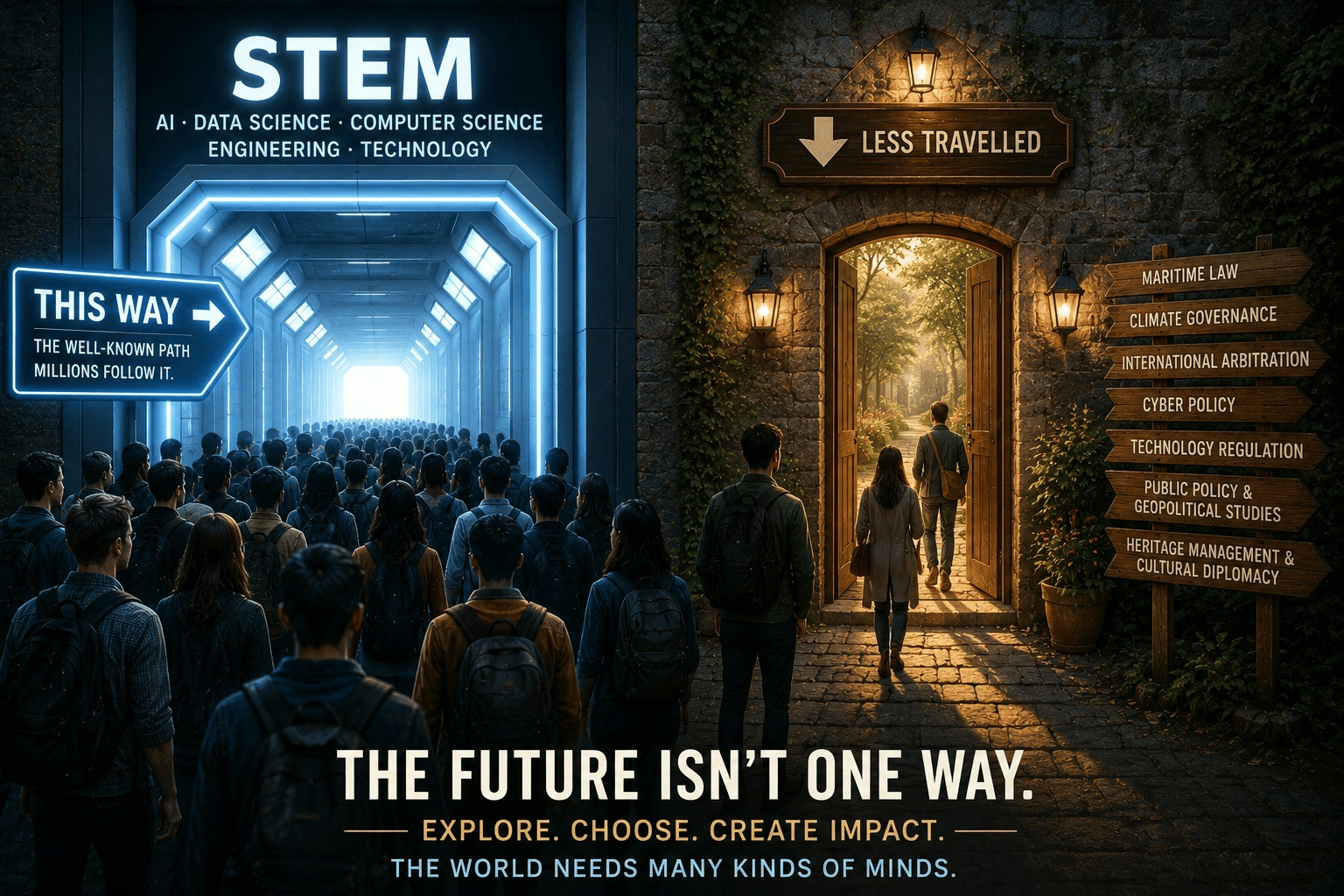 Here are seven specialised fields that deserve far more attention from Indian students.
1. Maritime Law and the Law of the Sea
At first glance, this sounds like a subject from an old geography textbook. In reality, it may be one of the most strategically important legal fields of the coming decades. Consider what has happened in recent years. Attacks on shipping in the Red Sea have disrupted global trade. Competition for Arctic shipping routes is intensifying. Countries are arguing over maritime boundaries and offshore resources. Interest in deep-sea mining is growing. The sea, quite literally, has become a geopolitical battleground.
- Who resolves disputes over maritime boundaries?
- Who advises shipping companies, insurers and governments?
- Who develops the legal frameworks governing offshore energy and seabed resources?
Specialists in maritime law.
This is a highly international field with relatively few experts. Universities in Britain, Malta, Sweden and Singapore have developed strong programmes in maritime law and ocean governance. International organisations, shipping companies, insurers and law firms all require specialists in this area. India itself is a major maritime nation with ambitious plans for port development and increased participation in global trade.
This is a niche field, but one whose importance is growing rapidly.
2. Climate Policy and Environmental Governance
For years, environmental studies were viewed by many people as a worthy but somewhat peripheral subject. Not anymore. Climate change is now reshaping economics, finance and public policy.
- Governments are creating carbon markets.
- Companies are producing sustainability reports.
- Banks are evaluating climate risks.
- Industries are adapting to new environmental regulations.
- The energy transition alone is generating entirely new areas of policy and governance.
None of this can be managed by engineers alone. It requires lawyers, economists, policy specialists and environmental managers. Countries around the world are trying to answer difficult questions.
- How should carbon be priced?
- How should industries adapt to environmental regulations?
- How should cities prepare for extreme weather?
- How should climate finance be allocated?
These are not scientific questions alone. They are legal, economic and governance questions. As India itself pursues ambitious renewable-energy targets and faces growing environmental challenges, expertise in this field is likely to become increasingly valuable.
3. International Arbitration and Dispute Resolution
Globalisation has created enormous opportunities. It has also created disagreements.
- Companies enter cross-border partnerships.
- Governments sign investment treaties.
- Businesses negotiate international contracts.
Sometimes things go wrong.
Increasingly, these disputes are resolved through international arbitration rather than traditional courts. This has created demand for lawyers and specialists who understand international commercial law, investment treaties and dispute resolution. Major arbitration centres such as London, Singapore, Paris and Dubai have become important global hubs. For Indian students with legal backgrounds, this is a particularly interesting field.
India is seeking to attract international business and position itself as a major economic power. Expertise in international dispute resolution will become increasingly important. The field combines law, commerce and international affairs in ways that few students appreciate.
4. Technology Policy and Digital Governance
Artificial intelligence has changed the world. But coding is only part of the story. Governments are struggling with questions that have little to do with programming itself.
- Who owns data?
- How should artificial intelligence be regulated?
- What are the responsibilities of technology companies?
- How should privacy be protected?
- How should countries manage cybersecurity risks?
These are policy questions. They require people who understand law, governance, ethics and international relations. Technology policy is becoming one of the fastest-growing areas of public policy. Governments, international organisations, consulting firms and technology companies increasingly need professionals who can bridge the gap between technical innovation and public regulation. For students interested in public affairs but also fascinated by technology, this field offers exciting possibilities.
5. Public Policy and Geopolitical Studies
The world has become considerably more complicated.
- Trade wars.
- Economic sanctions.
- Energy security.
- Migration.
- Supply-chain disruptions.
- Great-power competition.
These developments have created demand for people who understand how governments and international systems work. Think tanks, international organisations, multinational corporations and consulting firms increasingly employ specialists in public policy and international affairs. Companies now need geopolitical analysis almost as much as governments do.
Businesses want to know:
- Will sanctions affect supply chains?
- Will political tensions disrupt trade?
- Will changes in regulation affect investments?
These are not abstract academic questions. They are practical business concerns. For students interested in history, economics, politics or international relations, this is an area of growing importance.
6. Cyber Policy and Digital Security Governance
This field is one of the most interesting hybrids to emerge in recent years. Cybersecurity itself is often associated with computer science.
Cyber policy is something different. Countries are increasingly concerned about cyber warfare, data sovereignty, digital espionage and international norms governing behaviour in cyberspace. Questions that once belonged to science fiction are now part of everyday policymaking.
- Can governments restrict cross-border data flows?
- How should countries respond to cyberattacks?
- Who is responsible when critical infrastructure is disrupted?
- What rules should govern the digital world?
Experts who understand these issues are increasingly valuable. The field sits at the intersection of law, international relations, security studies and technology. As digital technologies become more central to modern life, demand for such expertise is likely to grow.
7. Heritage Management and Cultural Diplomacy
This may seem an unusual addition to the list. Yet it deserves attention. Countries increasingly recognise the economic and diplomatic importance of cultural heritage.
Museums, archives, heritage conservation projects and cultural institutions require professionals with specialised knowledge.
- Digital technologies are transforming preservation methods.
- Tourism strategies increasingly rely upon heritage assets.
- Governments are using cultural diplomacy as an instrument of international engagement.
India possesses one of the richest civilisational heritages in the world. Managing, preserving and presenting that heritage requires expertise. This is undoubtedly a niche field. But it is one with international dimensions and opportunities that many students never consider.
The Real Lesson
The purpose of this article is not to argue that every non-STEM field offers abundant opportunities abroad. That would be misleading. Some disciplines remain difficult in terms of employment and immigration pathways.
Nor is the argument that STEM has somehow become less important. It has not.
The point is something different.
The world does not only need coders and engineers. It also needs specialists who can resolve maritime disputes, regulate artificial intelligence, manage climate risks, analyse geopolitical developments and govern the increasingly complex systems upon which modern societies depend.
The international labour market is becoming more specialised, not less. And specialisation increasingly occurs in areas that sit outside traditional STEM disciplines.
For students, therefore, the crucial question is not:
“Am I a science student or an arts student?”
The more useful question is:
“What global problem am I preparing myself to solve?”
Students who can answer that question clearly may discover that the world has room for many kinds of expertise. Including some that nobody at the coaching centre is talking about.