How Visa Restrictions Are Reshaping Global Higher Education in 2026
TL;DR
- For several years, major study destinations such as Canada, Australia, and the United Kingdom have tightened international student policies in response to housing, migration, and political pressures.
- While these measures may be politically popular, universities are increasingly questioning their long-term impact. Declining international enrolments are creating financial strain, weakening STEM talent pipelines, and raising concerns about future research capacity.
- International students contribute far more than tuition revenue—they support innovation, entrepreneurship, and scientific advancement.
- As governments pursue ambitious goals in artificial intelligence, advanced manufacturing, and technology, a critical question emerges: can countries reduce international student inflows while maintaining global competitiveness?
- This article explores the growing tension between immigration control and talent attraction, and what it means for students planning to study abroad.
For nearly three years, governments across the major English-speaking study destinations have been moving in the same direction.
- Canada has capped international student permits and reduced allocations for new international students
- Australia has tightened visa requirements and imposed additional integrity measures on international education providers
- The United Kingdom has introduced restrictions affecting international student recruitment and universities are preparing for further declines in overseas enrolments
The wisdom of these policies can certainly be debated, but they are politically understandable. What is less clear is whether they are actually achieving their broader objectives.
A growing body of evidence suggests that governments may be discovering something unexpected: international students were contributing far more to their host countries than many politicians realised.
Universities Are Beginning to Provide an Answer
Across Britain, Canada and Australia, universities are reporting declining international enrolments and growing financial pressure
In Britain, recent sector analyses indicate that 22 universities now receive more than half their total income from international student fees
Britain’s Office for Students has warned that universities may be relying on overly optimistic assumptions about future international recruitment and modelled sector-wide losses running into billions of pounds if enrolments continue to weaken
Financial pressures are no longer theoretical. Reporting by the Financial Times described universities with dangerously low cash reserves, while some institutions have announced staffing cuts, hiring freezes and programme reviews.
The proposed merger between King’s College London and Cranfield University was widely interpreted as evidence of growing financial stress within the sector
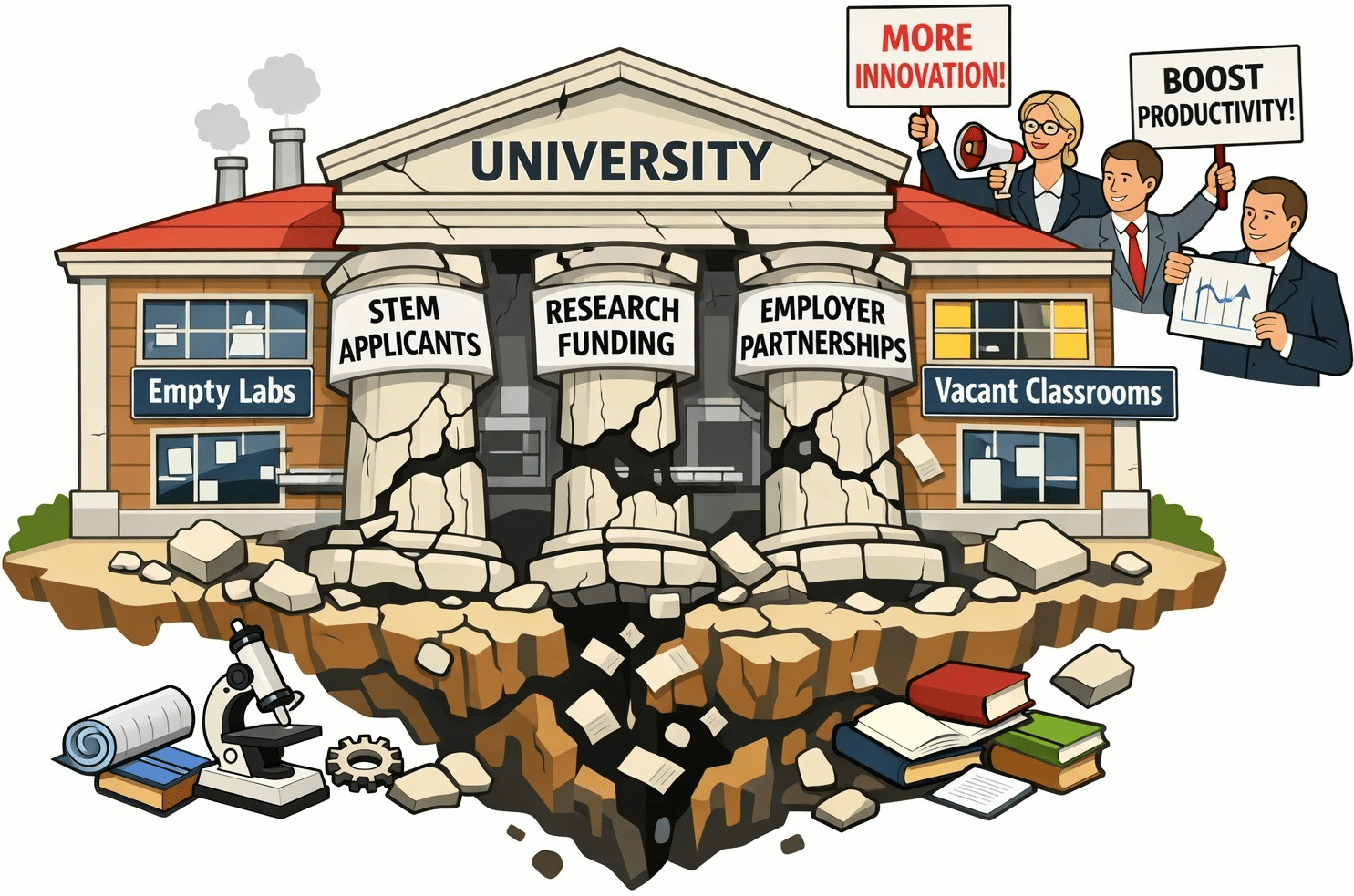
International Students Are Not Just Customers. Much of the political discussion treats international students as consumers. Students pay fees. Universities provide education. Transaction complete. Research universities see the situation differently. International students are often participants in the production of knowledge itself.
In May 2026, Massachusetts Institute of Technology President Sally Kornbluth warned that policy changes were contributing to lower graduate enrolments and reduced research activity, highlighting the role that international students play within the research ecosystem itself.
A graduate student is frequently a researcher, laboratory worker, teaching assistant and future doctoral candidate. When universities express concern about falling international enrolments, they are often talking about talent pipelines rather than tuition revenue.
Why Indian and Chinese Students Matter
Students from India and China are disproportionately represented in disciplines such as engineering, computer science, artificial intelligence, mathematics and data science.
These are precisely the areas in which many advanced economies are seeking to expand their capabilities.
A May 2026 international survey found universities increasingly worried about declines in international postgraduate enrolments, particularly in STEM disciplines
Similarly, EAB reported that graduate STEM programmes had historically depended upon strong international demand and were now facing significant recruitment challenges
The Innovation Question
The issue extends beyond universities.
- A substantial body of research has found that immigrants and former international students are disproportionately represented among technology entrepreneurs, patent holders and scientific researchers.
- For example, the National Foundation for American Policy has documented the outsized role played by immigrants in founding high-growth American companies
- Numerous studies published through the National Bureau of Economic Research have linked high-skilled immigration to increased innovation and patent production
This helps explain why many university leaders increasingly frame international student restrictions as an innovation issue rather than merely an education issue.
Are Domestic Students Ready to Replace Them?
A common assumption in political discussions is that domestic students will simply fill places vacated by international students. Many universities are not convinced.
In advanced STEM programmes, domestic demand is often insufficient to replace the scale of international enrolment.
At the same time, governments are pursuing ambitious goals in areas such as artificial intelligence, advanced manufacturing and semiconductor production.
Recent workforce analyses have highlighted concerns about future shortages of highly skilled technical personnel, particularly in semiconductor engineering and related fields
The question therefore becomes obvious:
Can countries simultaneously reduce international student inflows while expanding their research and technology ambitions? The answer remains uncertain.
The Rest of the World Is Watching. Students increasingly have alternatives. Universities in parts of continental Europe have reported growing interest from international applicants as traditional English-speaking destinations become more restrictive
Talent rarely disappears. It simply moves. If highly capable students decide to study elsewhere, the consequences may extend beyond university finances. Research capability, entrepreneurial activity and innovation capacity may gradually shift as well.
The ‘solution’ that wasn’t. Governments introduced these restrictions believing they were solving a problem. The evidence increasingly suggests that international students were contributing much more than tuition revenue. They contributed …
- Talent.
- Research capacity.
- Entrepreneurial energy.
- Innovation.
The question facing policymakers is therefore NOT whether international education should be regulated.
It should. The question is whether countries can afford to make themselves less attractive to some of the world’s most ambitious and capable young people. Universities, employers and research leaders are increasingly suggesting that the answer may be NO.
What are we seeing now?
- Universities reporting financial stress,
- Research leaders expressing concern,
- STEM programmes losing applicants,
- Employers warning about talent shortages,
- Policymakers simultaneously demanding more innovation.
Five years ago, university officials were writing about “international student recruitment.” Today they are writing about “talent pipelines.”
That change in vocabulary is significant. It suggests that universities are starting to frame the issue less as education and more as national capability.
And what of the policy-makers, the political leaders?
We see countries voluntarily reducing imports of human capital at the very moment they are worried about innovation, ageing populations and global competitiveness. This is a contradiction and governments will have to deal with it. Very probably, sooner rather than later.
What does it mean for Indian students?
In the present climate, should Indian students should abandon plans to study abroad? Not at all. Quite the opposite. The world’s leading universities still want talented students, and talented students are still being admitted.
What has changed is that students are now caught in the middle of a political debate taking place in countries that once regarded international education almost entirely as a benefit.
The irony is that while politicians argue about reducing numbers, many universities are quietly worrying about losing precisely the people they most want to attract.
For students with talent and drive, the path forward is not to wait for policies to change but to map their own route toward universities that actively seek global capability. The world’s leading institutions are still competing for minds that can think, build, and innovate. The challenge now is to identify where your skills are valued — and to present yourself not merely as an applicant, but as a contributor to research, enterprise, and discovery.
That means looking beyond glossy brochures and asking: Where is the evidence of real opportunity? Go beyond university websites. Check out reports, rankings, alumni data, and press releases that show whether the university is genuinely investing in talent pipelines. You want …
- University and faculty websites that list industry partnerships, innovation hubs, and active research centers.
- Annual reports and strategic plans that reveal whether “industry engagement” and “applied research” are core priorities.
- Alumni networks and LinkedIn profiles that show where graduates actually go — into labs, startups, or major companies.
- Research rankings and databases that highlight joint patents, spin‑offs, and collaboration indicators.
- Student and faculty testimonials that provide firsthand accounts of lab access, internships, and mentorship culture.
Follow the signals of opportunity, not the noise of restriction.
The universities that truly want your talent are the ones already investing in the future — and they are waiting to hear from you.
Here’s the ‘map’ from YUNO LEARNING
How does a student find out whether a university has strong industry partnerships, active research labs, and clear graduate pathways? Sleuth the internet! The trick is to use keywords that surface the right evidence rather than just marketing pages. Here’s a practical set of search terms:
Core Keywords
“University name + industry partnerships”
“University name + research labs”
“University name + innovation hub”
“University name + graduate outcomes”
“University name + alumni employment”
STEM / Research Focus
“University name + STEM collaborations”
“University name + joint patents”
“University name + startup incubator”
“University name + corporate research center”
Career Pathways
“University name + employer partnerships”
“University name + internship programs”
“University name + career services report”
“University name + placement statistics”
Broader Signals
“University name + strategic plan PDF” (often reveals priorities)
“University name + annual report”
“University name + QS ranking industry collaboration”
“University name + alumni LinkedIn outcomes”