
PTE Speaking Tips and Practice Tests

The PTE Speaking section is an integral part of the PTE Academic test, and it plays a vital role in assessing your English language proficiency. To succeed in this section, diligent PTE Speaking practice is essential.

The PTE Speaking test consists of several parts, each designed to evaluate different aspects of your spoken English. It’s crucial to understand the dynamics of each PTE Speaking module.

Let’s explore these PTE speaking parts.

  • ‘Read Aloud’: In this task, you’ll encounter a written passage that you must read aloud. PTE Speaking practice sessions for ‘Read Aloud’ will help enhance your pronunciation, fluency, and vocabulary.
  • ‘Repeat Sentence’: To perform well in this PTE Speaking module, you need to repeat sentences you hear accurately. Regular PTE Speaking mock tests can help refine your listening and speaking skills.
  • ‘Describe Image’: This part requires you to provide spoken descriptions of visual content. Engaging in PTE Speaking practice sessions for ‘Describe Image’ will improve your ability to convey information effectively.
  • ‘Re-tell Lecture’: For this segment, you must listen to academic lectures and summarize them in your own words. PTE Speaking practice will help sharpen your listening, speaking, and note-taking abilities.
  • ‘Answer Short Questions’: Here, you need to respond briefly to various questions. It tests your ability to provide concise and accurate answers, which can be honed through PTE Speaking mock tests.

A robust PTE Speaking practice regimen can prepare you to excel in all these PTE speaking parts. Take advantage of this collection of PTE Speaking study material where you will find PTE mock tests which simulate real test conditions and boost your confidence. Along with it you will also find more details about the PTE speaking module and PTE free practice tests. 

Show more expand_more

Personal Introduction

Personal introduction in the PTE test is not categorized within a specific section but serves as a self-introductory video that you record at the outset of the exam. This self-introductory video essentially acts as your personal introduction.

During this segment, you are allotted 30 seconds to present your introduction. Even though it does not contribute to your overall score, it can significantly impact the initial impression you make. Furthermore, this introduction video is shared with educational institutions in conjunction with your test score report.

Here are some valuable tips:

  • Prepare your introduction in advance.
  • A well-delivered introduction can boost your overall test-taking confidence.
  • Include essential elements in your introduction, such as your name, age, city or hometown, educational qualifications, and any relevant information about your hobbies or personal background.

Learn more about the personal introduction video in this article. You will also find a template to follow for this video.  
 

PTE Read Aloud

In the 'Read Aloud' section of the PTE exam, you are presented with text on the screen, and you are given 40 seconds to read it aloud. This section typically contains 6-7 questions, with each text spanning about 50-65 words.

To perform well, consider these valuable tips:

  • Read the text naturally and clearly.
  • Official PTE samples indicate that recordings are typically completed in 23-28 seconds.
  • Pay close attention to pronunciation and fluency.
  • Utilize the initial 35 seconds to familiarize yourself with the text.
  • Add appropriate pauses at punctuation marks like commas, full stops, semicolons, and more.
  • Enhance your delivery by emphasizing keywords in each sentence.
  • Approach this section with confidence, as it is one of the highest-scoring parts of the test.

For extra practice and guidance, you can explore 'PTE Read Aloud Practice' and ‘Read Aloud PTE PDF' resources to improve your speaking skills.

You can also read the attached article with important information and strategies to perform well in this section. 

PTE Repeat Sentence

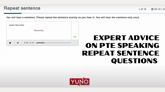
In the 'PTE Speaking Repeat Sentence' section, you will encounter a series of sentences played through computer audio. Your task is to repeat each sentence as accurately as possible. This section typically comprises 10-12 questions, with each sentence lasting 4-10 seconds and consisting of 8-15 words.

To excel in this segment, consider the following tips:

  • Make an effort to comprehend the sentence during its playback to aid in easier recall.
  • Break the sentence into manageable chunks or phrases to facilitate memorization.
  • Pay attention to the stress points in the speaker's delivery and emphasize the same keywords when repeating.
  • While you needn't mimic the speaker's accent, observe their voice modulation for effective delivery.

For comprehensive preparation, explore ‘PTE Speaking Practice’ resources to hone your speaking skills.
 

Describe Image

In the PTE Speaking section, one of the tasks you might encounter involves describing diagrams. These diagrams can take various forms, such as graphs, maps, charts, tables, flowcharts, or even pictures. You will be given 25 seconds to carefully observe the provided illustration, and then you have to describe the image within a timeframe of 30 to 40 seconds. This particular task aims to evaluate your ability to both comprehend visual information and express it clearly in spoken English. Let's delve into the types of diagrams you might encounter and some tips on how to effectively describe them:

  1. Graphs: Graphs come in various formats, such as bar graphs, line graphs, pie charts, or scatter plots. When describing a graph, it's essential to identify and articulate key trends, significant peaks, drops, or patterns. Focus on the data that stands out the most and convey that information concisely.
  2. Maps: Maps are often used to test your spatial awareness. They can be location maps, route maps, or building floor plans. Begin by introducing the map – what it represents and its main components. Then, highlight important landmarks, routes, distances, or specific locations as clearly as possible.
  3. Tables: Tables usually present data in a tabular format, featuring rows and columns. Start by explaining what the table contains – whether it's numerical data, statistics, or other information. Then, discuss noteworthy figures or trends and how they relate to each other.
  4. Flowcharts: Flowcharts depict a series of steps or processes. You should begin by describing the purpose of the flowchart and its main stages or decision points. Sequentially go through the steps, highlighting the connections between them.
  5. Pictures: Sometimes, a picture might be used for this task. In this case, you should first provide a brief overview of what the image depicts. Then, describe the elements, objects, or activities within the picture in a logical order. Make sure your description is structured and coherent.

Now, for effective description, here are some tips to keep in mind:

  • Introduction: Start by briefly introducing the diagram. Explain its type and purpose. For example, "This is a bar chart illustrating..." or "This map depicts the layout of...".
  • Main Points: Identify the key elements or trends in the diagram. In a graph, these could be the highest or lowest points. In a map, they might be crucial locations. For tables, focus on significant figures. For flowcharts, highlight important stages.
  • Sequentially: When describing a sequence or process, make sure to follow a logical order. You could use connectors like "First," "Next," "Then," "After that," and "Finally" to guide your description.
  • Clarity and Pronunciation: Speak clearly and at a steady pace. Pay attention to pronunciation. Stress important words and use appropriate pauses, especially at the end of sentences or on punctuation marks.

Remember, the key to success in this task is concise and structured descriptions. Practice is essential to refine your skills, and if you follow these guidelines, you can confidently tackle diagram-based questions in the PTE Speaking section.
 

PTE Speaking Retell Lecture Questions

In the PTE Speaking section, you'll encounter the "Lecture Retell" task, which tests your ability to comprehend and reproduce the main points of a lecture. Here's how this task works:

  1. Audio Content: In this task, you'll listen to a lecture that lasts between 1 to 1.5 minutes. The lecture typically covers a specific topic or concept, providing detailed information on it. The key challenge is to remember the lecture content effectively, as you'll need to retell it shortly.
  2. Response Time: After listening to the lecture, you're given 40 seconds to retell the information. Your goal is to summarize the lecture coherently and accurately within this time frame.
  3. Frequency: You can expect to find 1 to 2 questions of this type in the speaking section.

Tips for Success:

  • Effective Time Management: To make the most of your 40 seconds, aim to speak for about 35-40 seconds without any long pauses or breaks. This is crucial because it demonstrates your ability to express a substantial amount of information in a concise manner.
  • Grammar and Clarity: It's vital that your response is grammatically correct and clear. Your sentences should be well-structured to convey the key points of the lecture effectively.
  • Note-Taking: During the lecture, take notes. You can jot down key points, important keywords, facts and figures, or the name of any specific person mentioned. These notes will serve as your reference points when retelling the information.
  • Selective Retelling: Keep in mind that the lecture you hear is usually longer than the time allocated for your response. Don't worry if you miss out on some details. Focus on summarizing the most significant and relevant aspects you've noted in your transcript.
  • Stay on Topic: Your retelling should remain focused on the topic and cover relevant information from the lecture. Avoid straying into unrelated details or making general statements.

The "Lecture Retell" task aims to assess your listening comprehension, note-taking, and verbal communication skills. With practice and by applying these tips, you can effectively tackle this question type in the PTE Speaking section and present a well-structured and coherent summary of the lecture content.
 

Answer Short Questions

In the PTE Speaking section, one of the task types you'll encounter is the "Short Answer Questions." This task assesses your ability to provide concise and accurate responses to questions. Here's how it works:

  1. Audio Prompt: You'll hear a question spoken aloud. These questions are typically straightforward and have short answers consisting of one or a few words.
  2. Response Time: Your task is to respond to the question promptly with a short and precise answer. The questions are designed to elicit succinct responses.
  3. Frequency: In this section, you can expect to come across 5 to 6 questions of this nature.

Tips for Success:

  • Conciseness is Key: Keep your responses brief and to the point. There's no need to elaborate or provide additional information unless the question specifically asks for it.
  • Promptness: Start your response as soon as you see that the microphone recording has been initiated. This helps ensure your answer is captured effectively and also demonstrates your ability to respond quickly and efficiently.
  • Stress on Accuracy: While brevity is essential, accuracy should not be compromised. Make sure your answers are correct and directly address the question.
  • Avoid Prolonged Pauses: If you pause for more than 3 seconds, the recording will automatically stop. So, it's important to maintain a steady flow of speech within the given time frame.

Short Answer Questions are designed to evaluate your ability to provide concise and precise responses. Practice responding to straightforward questions with short answers to become comfortable with this task type. Remember that in this section, brevity and accuracy are the keys to success.