PTE Reading: What is a Multiple-choice, single answer question?
Find the most important PTE reading tips to score high in single choice questions in PTE reading.
About the article
A lot of students find the PTE reading section difficult because they are not avid readers. They do not know how to comprehend text to convert it into useful information which one needs to answer questions and understand what is asked. It is one skill that is hard to learn at short notice. It is not something one can memorize; it is a muscle in the brain; it is a skill one develops over a period of time. But there are still things that one can do, to be able to perform where one is required to understand and answer.
Whether it is a single-choice question answer, read-aloud PTE question, or PTE reading fill-in-the-blank question, students need to use the same strategies.
Skimming and scanning are two very useful tools, which students are taught in most coaching centers. These skills help students spot keywords, key phrases, pronouns, connectors, and linking words to help them find the central idea and other important information they need to answer correctly.
Another useful technique is PTE reading practice questions which is working on the actual PTE questions that come in the PTE exams. Most PTE coaching centers collect recent questions or create PTE question banks for students to have access to questions.
How to find correct answers in PTE Reading Single Answer
In this article, we will discuss more about the PTE Multiple Choice Single Answer (MCSA) and the PTE reading tips that you can follow to score high in this category.
In all, students get up to 3 to 4 questions of this type.
A text of around 80 to 100 words appears on the screen, followed by one question with four to five answer options. However, only one option is correct.
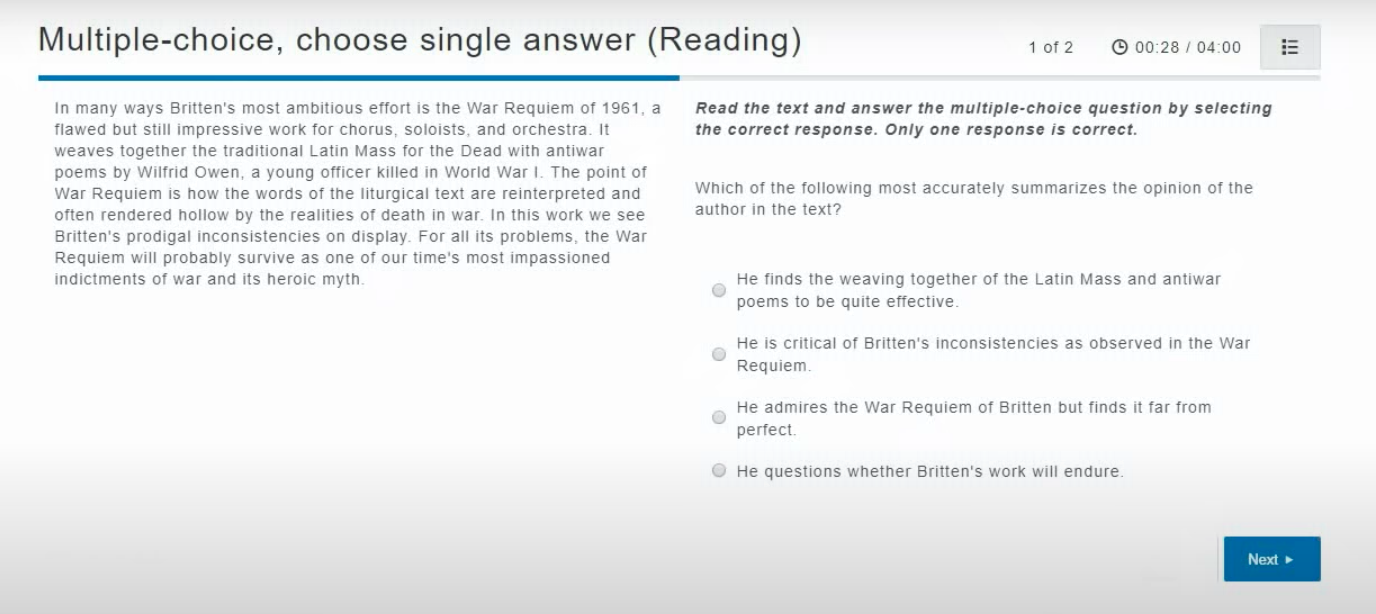
The main purpose of this section is to determine your ability to comprehend written English text and understand the meaning and the overall theme or idea of the passage.
It is different from PTE read aloud, PTE reading fill in the blanks questions and other types of questions are that this is a simpler question, you only have to find the correct answer out of the options given to you.
The texts are usually from books, journals, or magazines and the topics are mostly based on humanities, sciences, or social studies. One of the best ways to score well in this section is to develop the habit of reading so that you learn new words every day.
Strategies to Score High in PTE Single-Answer Questions
The most important part is to learn how to locate the right information when reading a passage. Here are some tips to follow:
Tips to read:
- Skim for Theme and Organization: Begin by quickly skimming through the passage to gain a general understanding of its theme and how information is structured within the text. This initial step will provide you with a roadmap for comprehending the content more deeply.
- Identify the Theme: While skimming, attempt to discern the central theme or topic of the passage. Understanding the overarching subject matter will help you focus your reading and locate relevant information more efficiently.
- Specify Your Information Needs: Be clear about the type of information you are seeking in the passage. Determine whether you need specific details or if your goal is to grasp the author's viewpoint or argument. This clarity will guide your reading strategy.
- Note Content and Structure: Pay attention to the passage's content and structure. Recognize how the information is organized and whether there are any key points, examples, or supporting details that stand out. This will aid in identifying essential information later when answering questions.
- Question Words: Keep an eye out for question words such as "when," "where," "which," "why," and "how" as you read. These words often signal the type of information required to answer questions accurately. Noting them down can help you quickly locate relevant passages when needed.
- Nouns, Dates, Adjectives, and Repetition: While reading, focus on nouns, dates, adjectives, and any repeated words or phrases within the passage. These elements often carry important information and can be crucial when answering questions.
- Contextual Understanding of Unknown Words: If you encounter unfamiliar words in the text, try to deduce their meanings based on the context in which they appear. However, don't dwell excessively on unknown words, as they may not always be necessary for answering questions. Time management is crucial.
Let us understand how to find the correct answer, and what words you should look for in the options given to you.
Tips for choosing the correct answer:
- Read the Question Prompt: Before diving into the passage, it's crucial to read the question prompt carefully. This initial step serves multiple purposes. Firstly, it helps you remain focused on the specific information you need to find. Secondly, it can save you valuable time by giving you a clear sense of what the question is asking. Finally, understanding the question type (whether it's about the main idea, detail, inference, purpose, or organization of the text) is vital, as it dictates your approach to finding the answer.
- Set a Specific Goal: As you begin reading the passage, keep your specific goal in mind. What kind of information are you exactly looking for? Whether it's a main idea, specific details, or an inference, having a clear objective will streamline your search. While scanning the text, pay particular attention to content cues such as sub-headings or subtitles, as they can guide you to words or phrases that match the highlighted keywords in the question.
- Rely on Passage Information: It's crucial to emphasize that PTE reading questions are designed to test your ability to extract information directly from the passage. Avoid relying on your general knowledge or preconceived notions. Base your answers solely on the information provided within the passage.
- Avoid Guesswork: Refrain from making assumptions or guessing the answer before you've read the passage. Ensure that the information in the passage aligns with the option you choose. Jumping to conclusions without reading the passage can lead to incorrect answers.
- Eliminate Wrong Options: Don't rush to select the first option that appears correct. Instead, systematically eliminate incorrect options. Look for words or phrases in the answer choices that don't match the passage's content or may seem irrelevant. By narrowing down your choices, you increase your chances of selecting the correct answer.
- Final Check: Before submitting your answer, take a moment to review all the options one more time. Confirm that your chosen answer aligns with the passage information and the question's requirements. This quick review can help you catch any potential errors.
- Effective Time Management: Managing your time efficiently is essential in the PTE reading section. Allocate approximately 1.5 to 2 minutes per question. Avoid spending excessive time reevaluating options repeatedly, as this can lead to time constraints. Staying within the recommended time frame ensures you have ample time for all questions.
These tips can be used in all other PTE reading questions like PTE read-aloud questions, PTE reading fill-in-the-blank questions, and so on.
Last but not least, it is very important to manage your time well. When answering these questions, do not take more than 1.5 – 2 minutes to read and answer each question. Spending more time on one question will leave you with less time for the rest of the questions.
Keep an eye on the clock. This is a useful tool for your own time management. Practice skimming and scanning under timed conditions, before you appear for the exam. PTE practice tests can help you when answering questions like these. If you want to prepare for the PTE reading section and all other modules, enroll in PTE Academic Live Classes and learn from the top instructors.