video
IELTS Reading Academic: Introduction
The IELTS Academic Reading test assesses your comprehension skills covering skimming, scanning and reading for details.
The IELTS Reading test is the second part of the IELTS test and lasts for 60 minutes. In this test, you are required to answer 40 questions. Thes questions range from from multiple choice to identifying information or a writer’s view, matching headings, features, and sentence endings, as well as sentence, note, summary, table, and flow-chart completions, and short-answer questions.
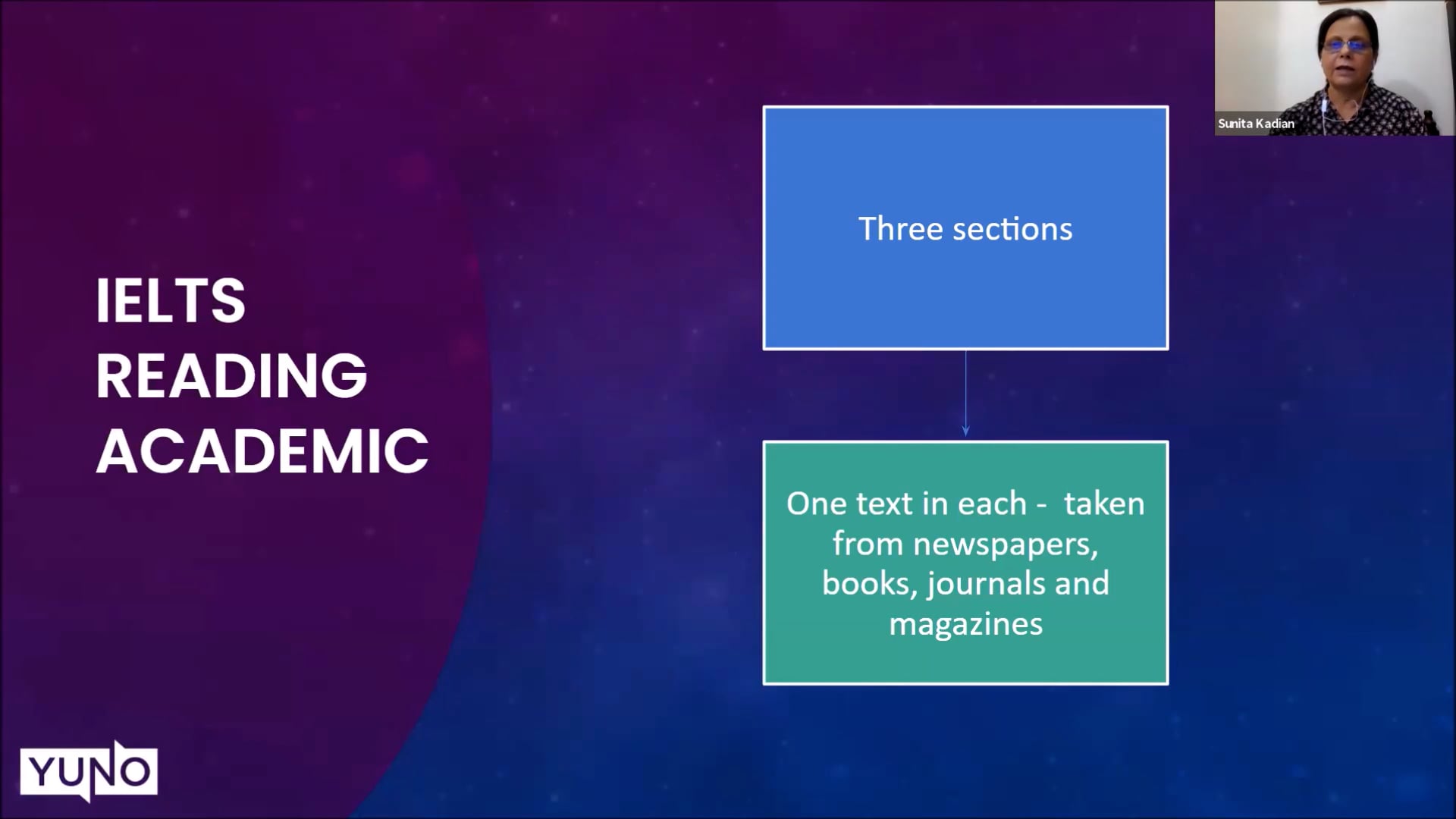
The IELTS Academic Reading test consists of 3 long texts which are extracted from current books, newspapers, journals, and magazines. The texts are academic in nature which means they are related to topics you might face if you were to study at an undergraduate or postgraduate level in an English-speaking environment.
The 3 long texts used in IELTS General Training Reading are taken from notices, advertisements, company handbooks, books, magazines, and newspapers. The IELTS Reading test is no different for IELTS Academic and IELTS General Training, except that there are minor differences between the two. While the reading in IELTS Academic is a bit complex, the questions in IELTS General are quite straightforward and easy to attempt.
The IELTS Academic Reading test is designed to assess a wide range of skills related to reading such as your ability to follow an argument, and identify a writer's opinion or purpose. You should be able to understand the main idea, opinion, intended meaning, and locate information in the passage. To be able to do all of this successfully and score high marks in IELTS Reading one must master the skill to skim, scan and paraphrase.
The three sections in the IELTS Academic Reading test are divided as follows.
You can practice and improve your reading skills by reading journals, books, news articles, science, fiction, etc or follow our tips for IELTS Academic reading. The earlier you get into the habit of reading, the better it will be for you.
If you are preparing for IELTS academic, then you must watch this video for more relevant information about the test.
Similar to the IELTS Academic, the IELTS General Training Reading Test requires you to answer 40 questions. Each passage usually has about 3 or 4 different types of questions like diagram label completion, identifying writer's views or claims, identifying information, matching features, matching sentence endings, etc.
The three sections in the IELTS General Training Reading test are divided as follows.
In the IELTS Reading section, one is required to answer 40 questions in a 1-hour duration. You are given plus one for every correct answer and zero for every incorrect answer.
In case you were wondering if there is any negative marking for incorrect answers, then you would be relieved to know that there isn't any. So, make sure that you attempt all the questions. If you are confused with a specific question, instead of leaving it blank, go with the most appropriate option since there is no negative marking.
Depending on the type of IELTS Exam you will be giving, your reading section score will be different, since the marking range for both IELTS Academic and IELTS General Training is different.
For example, if you score 36 out of 40 in the IELTS Academic Reading, then your band score will be 8. But if you get 36 out of 40 in IELTS General Training, then you will receive a band score of 7.5.

To know more about the marking criteria of the IELTS Reading section and how you can prepare for the IELTS Reading test, watch the given video where our expert instructor explains how you can achieve your desired scores in the IELTS Reading section and what are the important points to be kept in mind.
IELTS Reading can be challenging and intimidating for you if you are not in the habit of reading on a regular basis. Also, you may find it tough if your reading speed is not good as you are required to answer 40 questions in 60 minutes. Furthermore, the difficulty level of the passages increases towards the end, when you may have to work against the clock - less time and more questions. By reading a variety of articles, you will be able to comprehend different types of passages.
You are wrong if you think that you have to understand the IELTS Reading text to score a good band. Instead, you should be able to identify the different points covered by the author in that particular text and get a good general view of the entire text to answer the questions based on it. One skill that you need to acquire for this is the skill of skimming.
Skimming is a common reading technique that is used by a lot of individuals to read a series of lengthy texts.
Since it becomes difficult to read every word and sentence carefully in a short span of time, practising skimming allows you to infer the main meaning of the text without taking much time.
In the IELTS Reading section, you usually get reading passages from Academic resources like research papers or articles, hence using the skimming technique can help you immensely in understanding the gist of the content.
In order to skim a text, you should follow the given steps:
Well, this is what you do daily when you read a newspaper or a novel, or an interesting article. Your focus is on just the main points, and you want to read those points as quickly as you can without wasting any time.
To overcome the impediments that stop you from doing well in the IELTS Reading, here are some tips to ace the IELTS Reading test:
To increase your IELTS Reading score, you must get enough practice for each type of question. Take different types of practice tests to master them all.
Your reading skills for IELTS will improve if you understand the strategy of locating information in the passage. The passages may be lengthy and you might forget the content. So, make notes of the key points in each paragraph without wasting any time. Paraphrase the questions and locate information in the passage on the basis of your notes. With regular practice, you will improve your IELTS Reading Score.
One of the best ways is to start with shorter articles of different types given in newspapers, journals, and magazines. Always note down the main points. Cross-check your points with the original article. Also, note down the words that you do not understand. Find their meanings and summarize the article.
To get access to more tips and tricks related to IELTS Reading, you can check out our various articles and videos given below.
IELTS Reading can be challenging and intimidating for you if you are not in the habit of reading on a regular basis. This article is your helper.
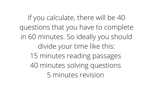
Find it hard to finish the IELTS Reading exam in 60 mins? Use these tips to find answers quickly. Enjoy expert curated IELTS reading material!
Since the IELTS Reading section can be very time consuming, it becomes important to know how one can manage time in the IELTS Reading test.
Speed reading has been considered as a highly useful technique for IELTS aspirants, because it helps them in understanding more in less time.
When you read faster, you are more absorbed in what you read. You get so engrossed in reading that your mind becomes logical, leading to active reading and stopping you from getting stuck on hard and unimportant words.
Make sure you avoid the following things while you practise speed reading:
Watch the given video to get more knowledge regarding the speed reading technique.
You will be given 3 paragraphs and 7 headings in questions like these, making it somewhat difficult for you to understand which one belongs to the other. To attempt such questions, it's important that you should have a look at the headings first and then read the paragraphs, since it gives you a better idea of which heading can be most suitable.
In this task, you have to capture the main idea of each paragraph. For this:
You are supposed to identify the information given in the passage. For this type of question, focus on affirmative and negative information. When we read about a process or a description of any kind, we find the sentences either affirmative or negative. Separate such information under two headings in your mind or on a piece of paper.
This helps in answering questions that ask you to tell whether the given statements are "True, False, or Not Given. Make sure that you read the instructions carefully. If you mark the question as true but you were supposed to write in yes/no format then even if your answer is correct in the terms of affirmative/negative still it will be regarded as incorrect.
These questions are regarded as the toughest ones in the IELTS Reading section since they contain factual statements that need to be proved True or False by you after reading the text.
In addition to both these options, we have an additional option called 'Not Given', which states that the information given in the question does not exist in the text.
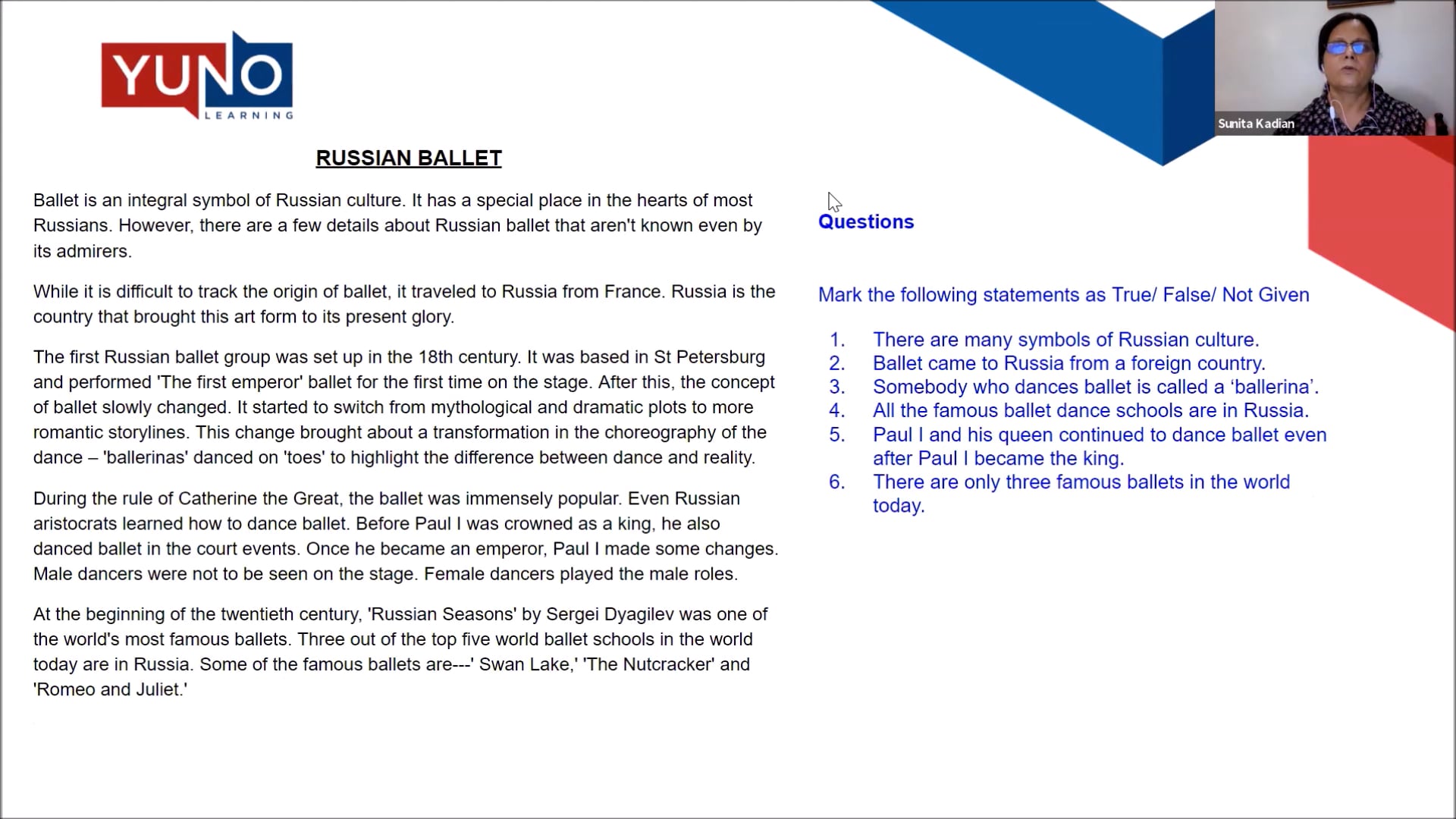
Learn Tricks and Strategies on how to effectively answer True, False and Not given type questions in the IELTS General Training Reading Test.
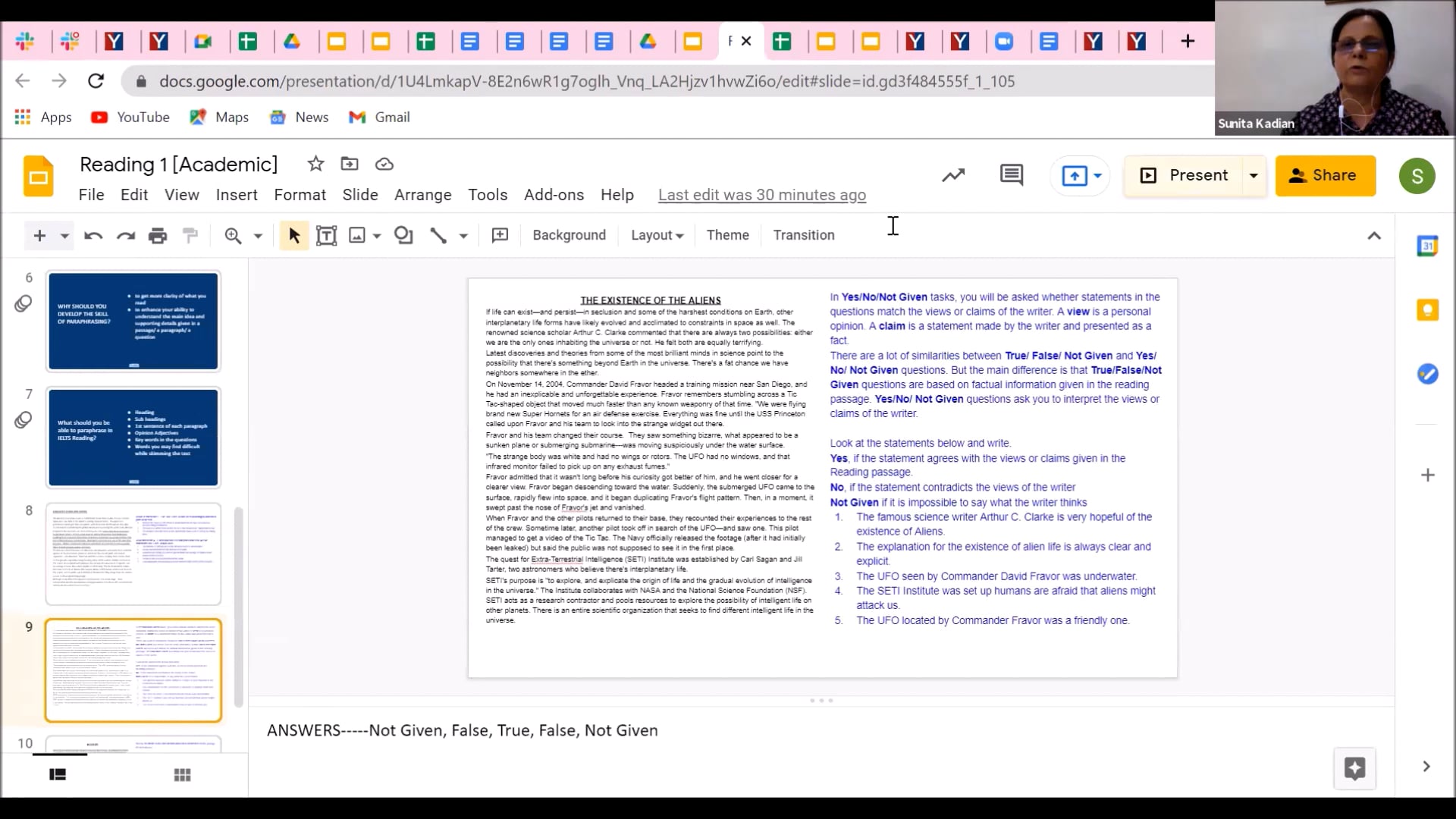
Our Expert IELTS instructor shares strategies to effectively answer Yes, No and Not given type questions in the IELTS Academic Reading Test.
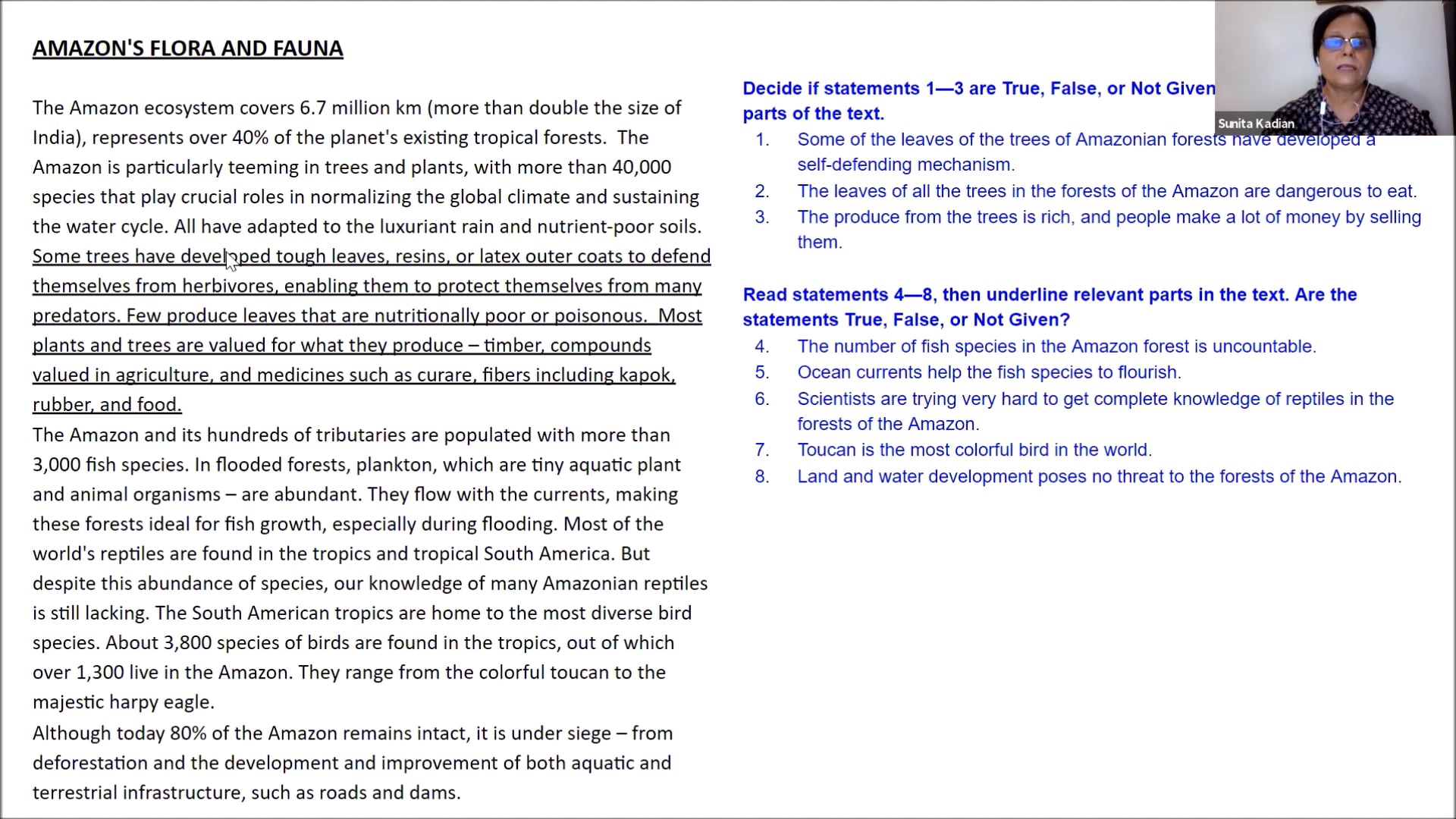
Practice IELTS Academic Reading Test with Sample Question and Answer. Our expert instructor explains the concepts in an engaging and simple way.
Such questions paraphrase the words and ideas given in the passage. You must read the text that is given before and after the words you identify while scanning the passage for your answer. Make sure you fill the blanks with appropriate words from the passage, and ensure they are grammatically correct.
In these questions, you need to scan the text and locate the particular sentence which includes the keywords and relate it to your question statement. Here are some tips to enhance your skill of scanning:
In these questions, you must highlight different points while reading the passage. You can be asked to complete the flowchart/notes or diagram based on the information given in one or two paragraphs of the passage. The information for this type of question is located in just one or two paragraphs, but the answers do not mostly come in order. Identify the paragraphs where the information is given, and make sure to use the correct form of the word to answer such questions.
These questions revolve around a particular set of paragraphs. You should use the skill of scanning to locate the particular paragraphs from which the description of diagrams or notes are taken. In addition, make sure that you are following the instructions and using the correct word limit as mentioned in the question. The followings tips can help you attempt these questions correctly:
In both IELTS Academic and General, you will get several Multiple Choice Questions to answer. You can get any of the three types of questions:
But usually, the first option is the most common.
Now, these questions can demand two things from you - either choose an option to answer a question or choose an option to complete a sentence.
Multiple Choice Questions in IELTS Reading Test your ability to understand the main idea of the text and locate the right answer. Remember to use our tips for Multiple Choice Questions in IELTS Reading, since it will help you understand how to use the method of eliminating an option when you know that it is incorrect.
These questions require you to match the information given in questions with the paragraphs that are given to you. You must remember that all paragraphs may not be used. Therefore, paraphrase the information in the question and scan the passage for the matching paragraph. They test your scanning skills and how well you can paraphrase the statements.
In these questions, you are provided with statements and you have to mention in which paragraph this information is presented.

Attempt our free IELTS Reading practice test including matching paragraph information questions.

Learn how to attempt the matching paragraph information questions in IELTS Reading from our expert instructor.
These questions require you to fill the gaps in summary by choosing the right words from the passage. Therefore, scan the passage for the information and choose the right word. Sometimes, the words are given in a box, so make sure you attempt it accordingly. Remember that all the sentences must be grammatically correct, and should include the right use of nouns, adjectives, adverbs, etc.
The summary can be taken from a few paragraphs or from the whole passage. You need to scan the passage and locate the paragraphs from which the summary is taken.

Attempt our free IELTS Reading practice test including summary completion questions.
Learn how to attempt the summary completion questions in IELTS Reading with the help of our expert instructor.
In these questions, you can choose the correct answer if you have understood what the passage is about. While skim reading the passage, always conjecture the main idea of the passage and understand the difference between main idea and extra information.
In these questions, you have to capture the main idea of the whole passage, you can find this out by keeping the following questions in your mind:
For this type of question, you must read the column headings in the table and scan the passage for information. Understand the details and also how many words you can use to complete the table.
These questions test your ability to understand details and locate specific information in the passage. To attempt these questions, make sure you follow the below given tips:
These questions require you to locate answers in the passage. In IELTS short answer questions you should use words from the text rather than your own, and don't change the words. For this type of question, you must paraphrase the vocabulary used in the question. Answers come in sequential order. Identify the words from the passage and also the type of words you need - noun, verb, adjective, etc. In addition to that, you should also identify the number of words. Instructions can be in the form- of one word only, two words only, etc.
Here’s how to solve these questions efficiently:
Step 1: Understand the question well and highlight your main keywords in the question.
Step 2: Paraphrase the keywords in your mind to understand what exactly you have to look for in the text.
Step 3: Skim through the text and locate the specific paragraph or sentence where the same topic/idea is being discussed.
Step 4: Pay attention to this sentence and find the word that answers the given question. take care of the instruction as well as how many words you have to complete the answer.

IELTS Reading Short Answer question Explanation with Sample Question and Answer. Includes tips and strategies to handle Short Answer Questions
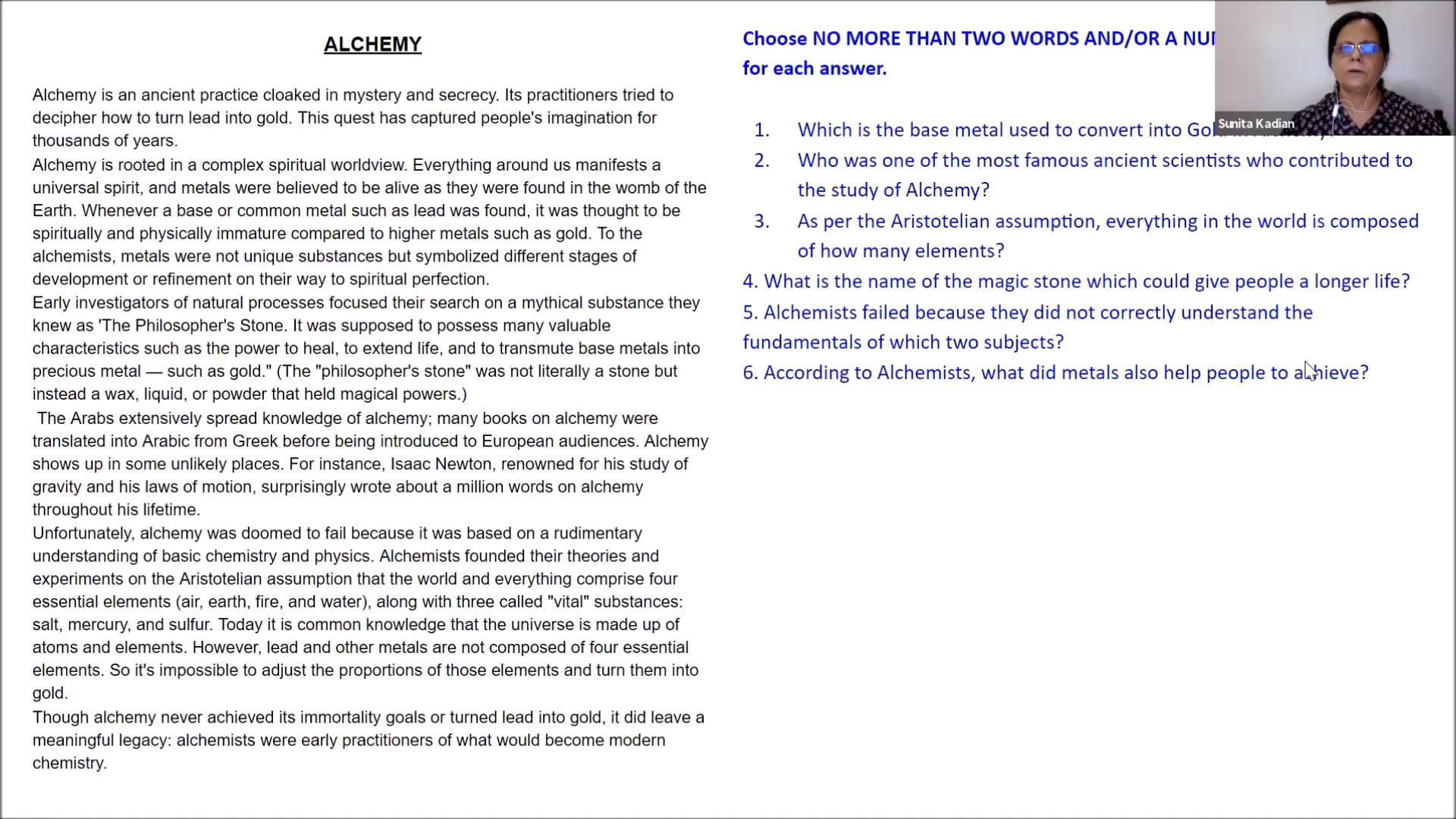
Learn the essential techniques to tackle Short Answer Question type in the IELTS Academic Reading Test in order to score high band in Reading.
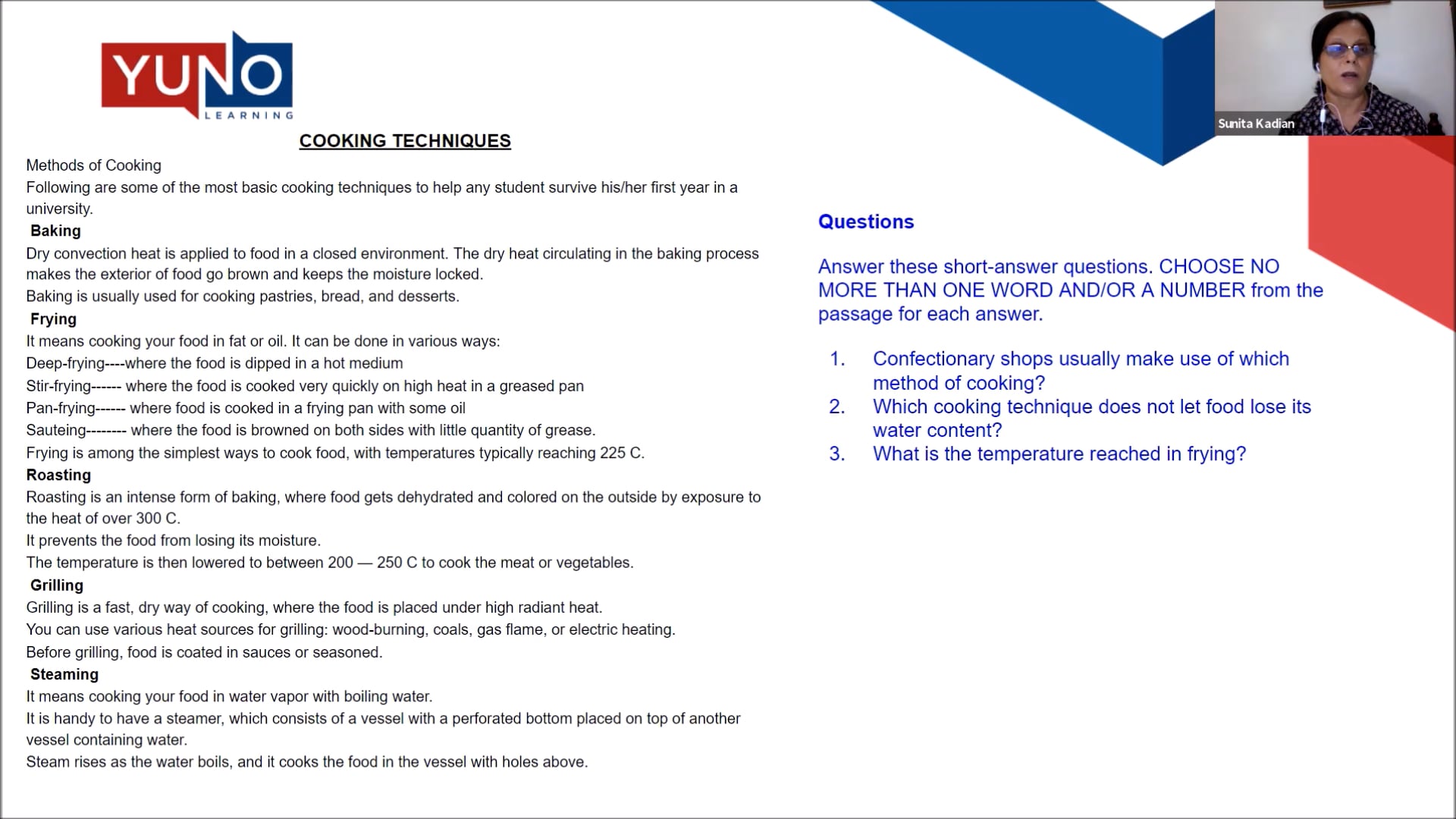
Learn to tackle Short Answer Question type in the IELTS General Reading Test. These questions require you to locate answers in the passage.
In such questions, you have to complete the sentence by matching the starting part with the ending part of the same sentence. For this, you must read both parts and paraphrase them in the right manner. You must follow these tips when answering such a question:
The List selection questions in IELTS Reading require you to match the correct ideas from the given list to the correct topic/ author’s name. Since you will be given a lot of options to choose from, it might become difficult for you to find the right answer.
Though skills like paraphrasing might help to some extent, skimming and scanning the text helps you find the answers more easily, since it requires keen attention to detail. Always remember that the answers will come in order, and you need to eliminate the wrong ones very carefully. Use the following tips to attempt these questions rightly:
If you are looking for a comprehensive IELTS Preparation course or just want to focus on the reading section, get in touch with us at www.yunolearning.com.
Find our free IELTS Reading Practice Test 1 and IELTS Reading Practice Test 2 to prepare yourself and get your desired band score.
Along with our free study material and practice tests, we have one to one doubt sessions too, so that you can resolve all your doubts and get your desired score. In case of any query, give us a call at +91-8847251466.