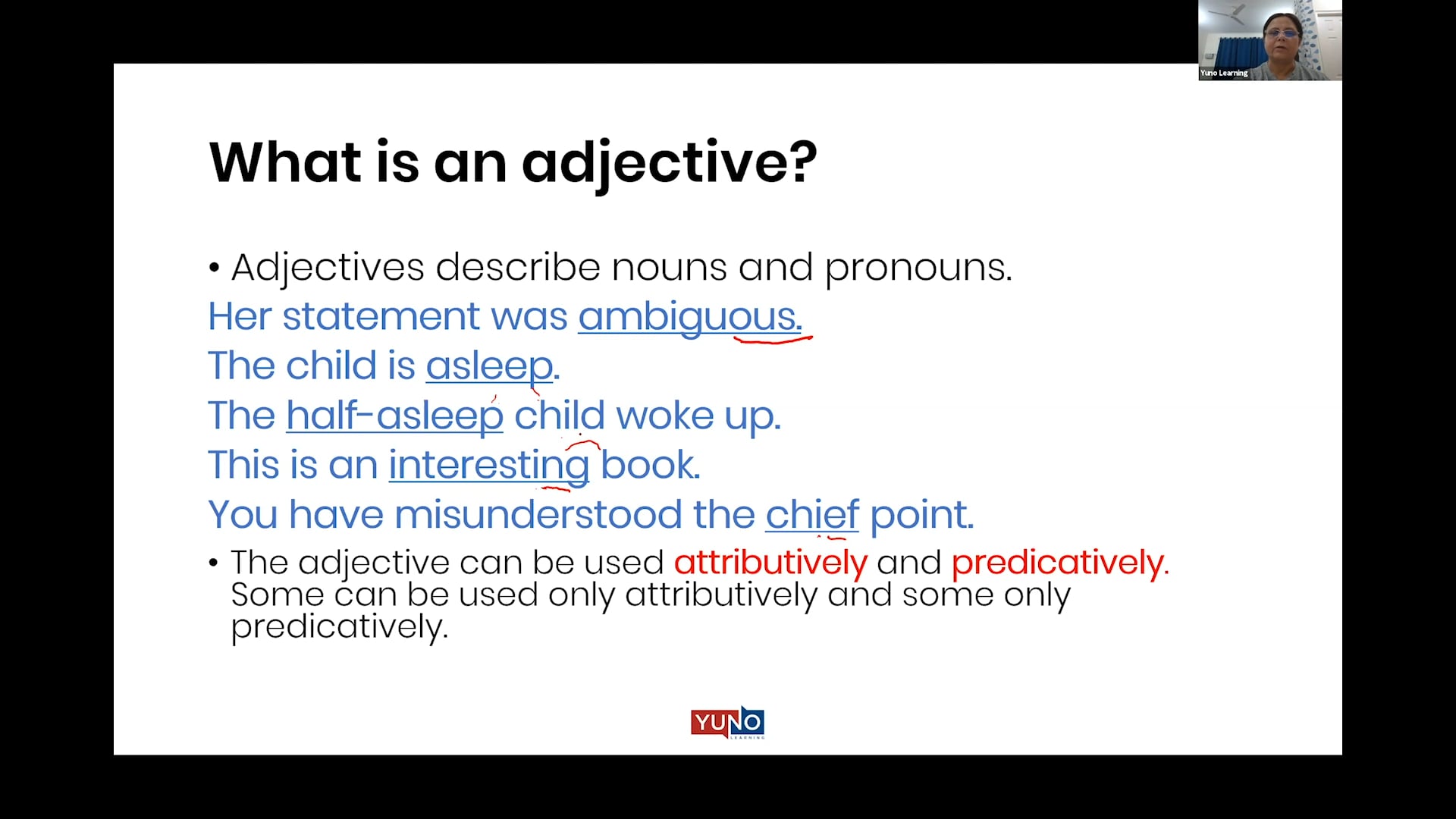
video
Learn to use Modal Verbs with real IELTS exercises
Learn from an expert about modal verbs through examples derived from real IELTS exams in this insightful video.
In the IELTS exam, both Speaking and Writing tests have 25% marks for grammatical range and accuracy. The range of grammar includes different types of sentence structures in different tenses in both active and passive voice.
Even in the Reading and Listening tests, some accuracy of grammar is needed as there are certain questions in which incomplete sentences or notes have to be completed. If you do not understand the sentence structure, you will make a mistake and write the wrong word.
The main areas of grammar that you should be well versed with if you plan to take the IELTS exam are:
Comparatives: In IELTS Speaking, you have to talk about people, things or places, and no description can be complete without adjectives. These are the words through which you can demonstrate your wide range of vocabulary. The comparatives help you in showing your preference.
This learning resource will focus on all these areas in grammar that are most important to you. Read on!
The Verb is an action or existence word that expresses what somebody or something (SUBJECT) is and what the subject does or what is done to somebody or something.
Example:
Verbs can be Main verbs & Helping Verbs.
Main verbs have four forms:
| Present V1 | Past V2 | Past Participle V3 | Present Participle V4 |
Write Accept | Wrote Accepted | Written Accepted | Writing Accepting |
Some verbs that have different past and past participle forms are irregular verbs, and some have ‘ed’ ending in past and past participle forms are regular verbs.
Present or V1 form of the verb is used with ‘s’ when we refer to a 3rd person singular subject.
Example:
When we talk about somebody or something, we can have a third person singular as well as plural subject.
Example:
This is called the Subject Verb agreement in grammar and it is an important area in speech.
The subject and verb in a sentence must agree to make sense. In the present tenses the subject can take the verb with or without ‘s’ ending. The base form is used with ‘s’ ending for third person singular subjects.
For example:
However, it’s not that simple. It can get tricky depending on the complexity of the sentence.
For example, Sometimes there are two subjects joined by words such as along with, as well as, besides, etc. In such cases the verb agrees with the first subject.
For example:
1. Have
2. Be
3. Do
Have (has) He/she/ it has... | had | had | having |
Do (does) He/she/it does... | did | done | doing |
Be - is/ am/ are I am…, He/ she/ it is…, we/ they/ you are….. | was/ were | been | being |
Other helping verbs are Modals - can, could, shall, should, may, might, will, would, have to, must, ought to, need to, used to.
Modal verbs are helping verbs that are used with the main verbs to change their meaning slightly. they cannot be used independently. The most frequently used ones are:
https://www.yunolearning.com/english-speaking/videos/modal-verbs/
If a verb form is used as a verb, it is called a Finite verb and if it is used as a noun/ adjective/ adverb, it is called non- Finite (gerund/ infinitive/ participle).
Example: I write articles. [finite verb]
I like writing articles. / I like to write articles. / I want written proof. [non-finite verb]
A non-finite verb is a form of the verb that does not show the tense. Therefore, it can never stand alone as the main verb in a sentence.
There are three types of non-finite verbs: gerunds, participles, and infinitives.
Gerund: When the …ing form of the verb is used as a noun, it is called a Gerund. Like a noun, it can be used as the subject, subject complement, object of the verb and object of the preposition in a sentence.
For example:
The words in bold - dancing, swimming and driving are gerunds.
Participle: When the present and past participle form of the verb is used as an adjective, it is called a Participle.
For example:
Infinitive: The infinitive is the base form of a verb, usually preceded by to. For example: “to go” is an infinitive. Itcan be used as a noun, adjective and adverb.
For example:
IELTS Grammar Tutorial! Learn All about Non-Finite Verbs - Gerund, Infinite, Participle. Conducted by the expert IELTS instructor.
IELTS Grammar Tutorial! Watch this video to learn how to use Infinitives and Gerunds. Conducted by expert IELTS instructor.
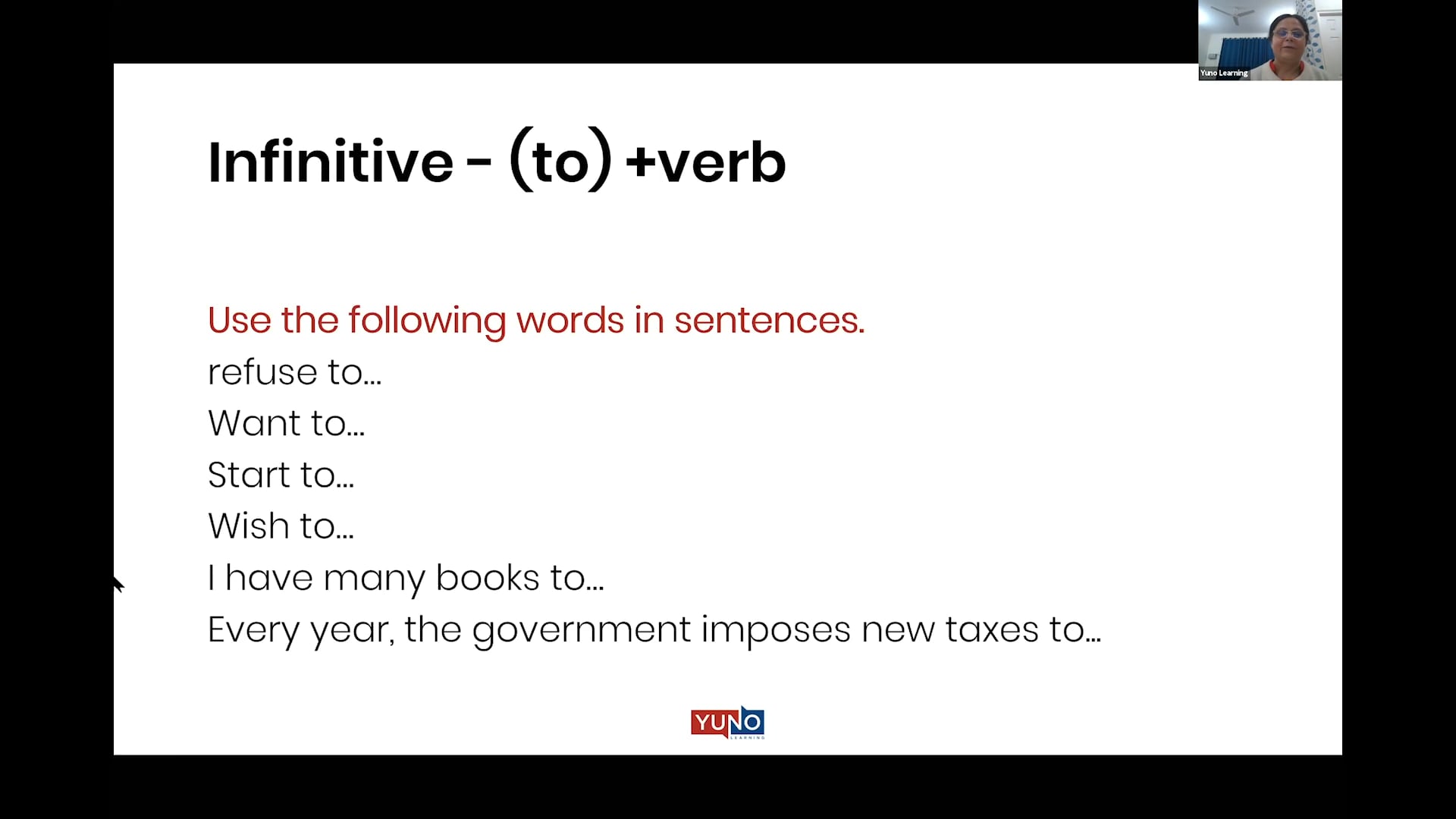
IELTS Grammar Tutorial by expert IELTS instructor! Watch this video to understand what infinitives are. Includes practice exercises.
This tense is used to talk about present habits, daily routine, general facts and scheduled things. It is also used in if clauses while talking about future events.
I exercise daily.
Chennai is the capital of Tamil Nadu.
Monday comes after Sunday.
This tense is used to talk about an action momentarily in progress, temporary habit or routine. It is also used to refer to future time if it is based on present planning or situation.
We are discussing the tenses now.
These days, I'm working on a new project.
I'm leaving for Delhi tomorrow.
This tense is used to talk about a state or happening which was in the past and is present even now, or about an indefinite or recent past.
I have been in India since my birth.
He has sung in this manner since the launch of his first album.
I have seen the Taj Mahal.
This tense is used to talk about an activity or state that has continued from the past till present or to suggest that the results of an activity started in the past remain in the present.
He has been working for GASCO since May 2012.
I have been teaching since 1990.
What have you been doing throughout this month?
This tense is used to talk about past fact/ habit/ one time or a series of completed actions in the past. It is also used in if clauses while talking about hypothetical future events.
He was always late for the classes in his college.
He was very naughty in his childhood.
India got independence on 15th Aug 1947.
This tense is used to talk about activities in progress at a particular time in the past.
Yesterday, at this time, I was exercising at the gym.
I got hurt when I was trying to replace the bulb.
This tense is used to talk about an activity or state that got over by a certain time in the past or one event following another in the past. It is also used in if clauses while talking about hypothetical past events.
By the time I reached the office, the meeting had started.
I had finished my work by 5:00 PM.
I would have finished my work by 5:00 PM if they had helped me.
This tense is used for an activity or state which continued for some time till something else happened.
The loud music woke up the child who had been sleeping peacefully till then.
This tense is used to talk about future predictions or events which are seen as absolutely certain or things that we think or suppose or things we decide at the time of speaking.
This year, Diwali will be in November.
Mahesh will be 25 next year.
I think India will win this match.
This tense is used to talk about a future event which will take place as a matter of fact in the near future or an activity in the near future based on present planning.
I will be leaving for Delhi next week.
This tense is used to talk about an event or state that will be over by a particular time in the future.
I will have finished this work by tomorrow.
Drive fast otherwise by the time we reach the station, the train will have left.
This tense is used to talk about an event that started in the past - is in progress now - and will continue even at a certain time in the future:
If he continues to work here, he will have been working here for ten years next year.
Learn Grammar Tenses in an easy way. This video talks about the Future Time Reference. Best IELTS Grammar Tutorials.
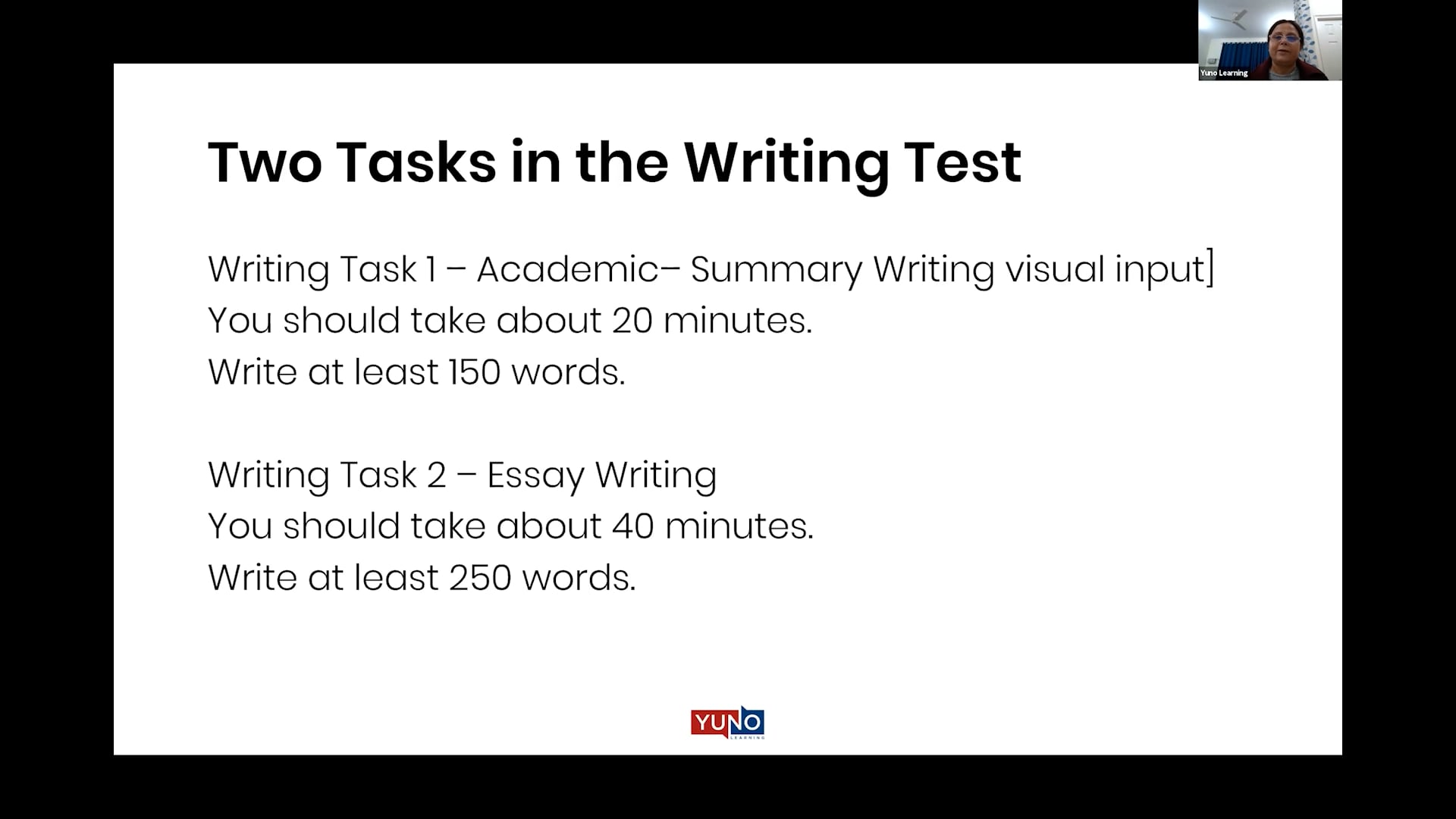
Learn essential Strategies from our expert instructor to answer Pie Chart Question that one can get in the IELTS Academic Writing Task 1.
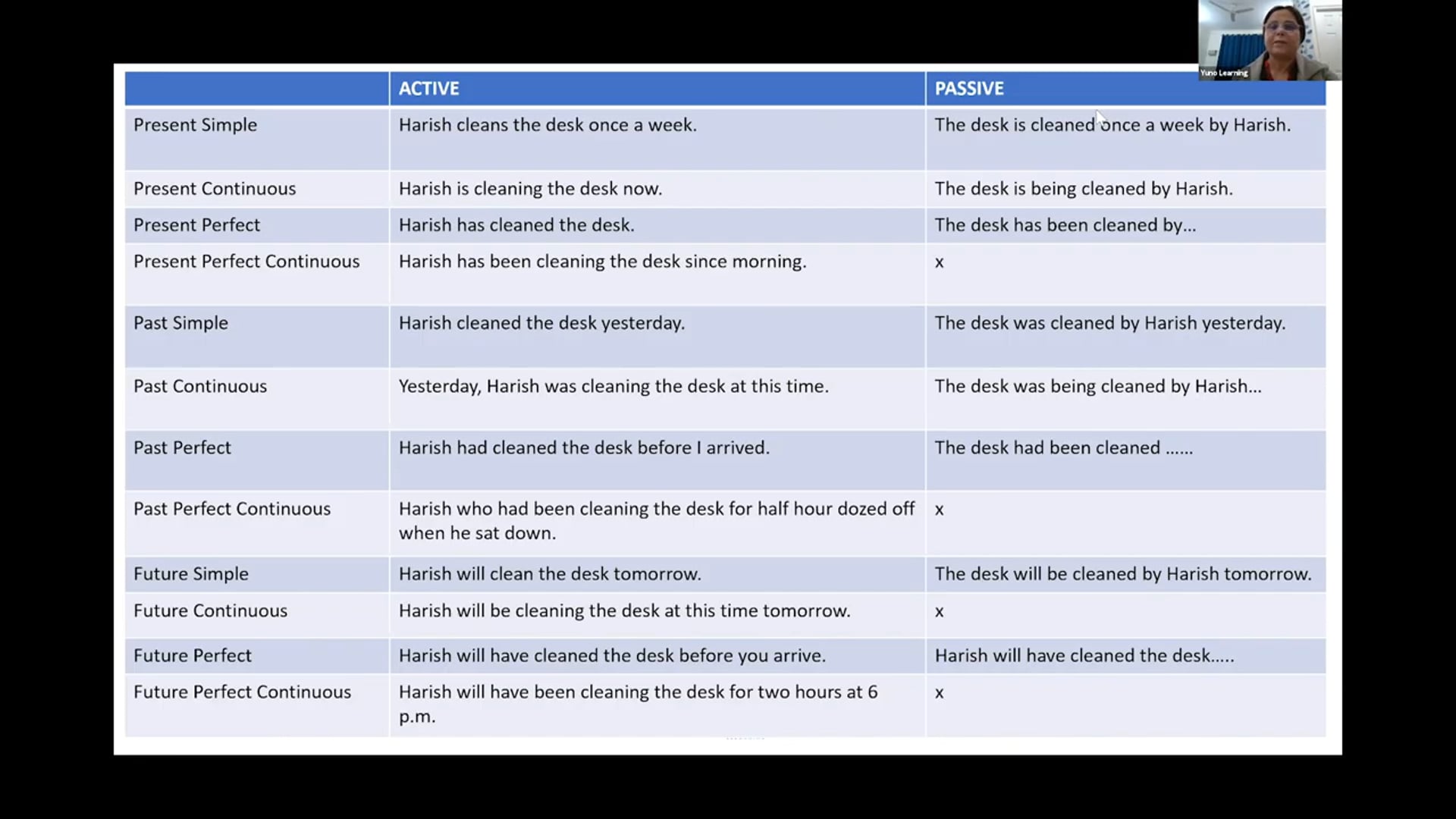
A sentence is in active voice when its subject performs the action. The active voice emphasizes the performer of the action which makes the sentences in active voice clear, direct and concise.
Active voice follows a clear structure: Subject + Verb + Object
For example:
The cat chased the mouse. (Subject - Cat, Verb - chased, Object - mouse)
A sentence is in passive voice when the subject receives the action. The passive voice emphasizes the receiver of the action which makes the sentences impersonal, indirect and wordy.
In passive voice, the object of active voice becomes the subject. Only those sentences, which have an object, can be changed into passive voice.
For example:
Therefore, transforming from active to passive flips the sentence structure and also necessitates the usage of preposition “by” in some cases.
A sentence can be mainly of three types depending on the number and type of clauses it contains: Simple, Compound and Complex.
A simple sentence consists of only one clause, more specifically, an independent clause.
For example:
A compound sentence consists of two or more independent clauses joined by a coordinating conjunction, also known as the FANBOYS (for, and, nor, but, or, yet, so). A conjunctive adverb (however, therefore), or a semicolon alone.
For example:
A complex sentence is formed by adding one or more subordinate (dependent) clauses to the main (independent) clause using conjunctions and/or relative pronouns.
For example:
A clause is a group of words including both a subject and a predicate.
Example:
Subject - It
Predicate - is raining heavily.
Subject - I
Predicate - look forward to hearing from you
There are two types of clauses: Independent and Dependent clauses.
An Independent clause contains a subject and a verb and expresses a complete thought. It can stand alone as a simple sentence.
For example:
In contrast, a dependent clause is a group of words that contains a subject and verb but does not express a complete thought. A dependent clause cannot be a sentence. They are also called subordinate clauses.
To turn a dependent clause into a full sentence, it needs to be combined with an independent clause.
Dependent Clauses can perform three main functions: They can function as adverbs, adjectives, or nouns.
Punctuation refers to the system of symbols that we use to separate sentences and parts of sentences while writing. Each symbol is called a "punctuation mark".
While speaking, we make use of pauses and the tone of the voice to express the intended meaning. Punctuation plays the same role in writing. It helps us to make our writing coherent which makes it easier to read and understand. Without punctuation one’s writing wouldn’t make any sense.
The most common punctuation marks in English are: capital letters and full stops, question marks, commas, colons and semicolons, exclamation marks and quotation marks.
Full stops, Question marks, and Exclamation points are used to end sentences.
Commas are one of the most common punctuation marks. A comma indicates a pause in a sentence, either between phrases, clauses, or items in a list.
A colon helps us to introduce information and give it context in a sentence. A colon can also separate a sentence into two independent clauses.
A semicolon is also an appropriate choice if you want to separate a sentence into two independent clauses.
Conjunctions are parts of speech that link words, phrases or clauses together such as words “and”, “but”, “although”, “because” etc. Conjunctions allow you to form complex and elegant sentences. Without them you’d have to express every idea in a series of simple sentences.
There are three kinds of conjunctions: coordinating, subordinating and correlative.
They help you to connect words, phrases and clauses that are grammatically equal or similar. There are seven main coordinating conjunctions in English, which form the acronym FANBOYS: for, and, nor, but, or, yet, and so.
They are used to join independent and dependent clauses. Common subordinating conjunctions are because, since, as, although, though, while, and whereas.
They are pairs of conjunctions that work together. Some examples are either/or, neither/nor, and not only/but also. These pairs of conjunctions require equal (parallel) structures after each one.
Articles are words that modify nouns and show whether that noun is specific or unspecific.
In the English language, there are two types of articles: Definite & Indefinite.
There are two indefinite articles - ‘a’ and ‘an’. They are used to modify non-specific or non-particular nouns. They refer to any member of a group. ‘A’ is used before the words starting with a consonant sound, and ‘An’ is used before the words starting with a vowel sound.
For example:
The is used to refer to specific or particular nouns.
For example:
Comparative adjectives are used to make or show comparisons between two objects. They help us to describe the differences.
For example:
There are two ways to form a comparative adjective.
For example:
Parallelism refers to the repetition of the same grammatical form in two or more similar words, phrases or clauses of a sentence. It is also known as parallel structure or parallel construction. Sentences with parallel structure are easier to read and add a sense of balance to writing.
For instance:
To avoid faulty parallelism, the above sentence can be corrected as:
Words, phrases, and clauses in a series should be parallel in grammatical construction.
Words, phrases, and clauses joined by a coordinating conjunction (and, but, or, nor, for, so, yet) need to have parallel grammatical construction.
Words, phrases, and clauses joined by a correlative conjunction (not only... but also, both... and, either... or, neither... nor) need to have parallel grammatical construction.
Words, phrases, and clauses joined by a comparative expression (as much as, more than, less than) need to have parallel grammatical construction.
![Grammar Basics: How to use Articles [a, an, the]?](https://i.vimeocdn.com/video/1048091926-ed8fae84282d18f36bbc0237af093cdf4a979ad577802ef8799d25281ac93395-d_1920x1080?r=pad)