video
Business Email: Structure and Format
Learn how to Structure and Format your Business Emails for clear and effective communication.
Anyone who has been working in the corporate world, they know quite well that the language used in Business settings is sophisticated, formal, and concise. The main purpose of verbal and written communication is the effectiveness with utmost clarity. Though a lot of people master the art of business writing through experience, for those who don’t, conveying messages can be an ordeal.
This is why learning business writing is crucial for everyone who has stepped into the business domain. Most business writing revolves around emails, reports, client proposals, memos, and notices. Hence, understanding how you can write each one of them is necessary. This is a collection of videos and articles that are created by our in-house instructors to help professionals not just overcome the fear of writing but also learn effective style, format, and ways to impress clients, bosses, and stakeholders. These days effective communication is a necessity to rise the career ladder.
This collection will also help digital marketing professionals understand the format and style of writing impressive long and short posts to connect with larger audiences via social media platforms.
In the collection, you will also find grammar lessons, which are curated to help one understand basic grammar rules.
The logical order of points in an email, the opening and closing can get the interest of the reader or put off the reader. You should first brainstorm to note down all your points for the email. Then segregate the points. If there are too many - consider enlisting them. Otherwise, have different paragraphs for different points.
A well-structured email will convey your message with clarity. Here’s how you can start your email:
This collection of videos will help you understand the style, structure, and format of different types of emails that you write every day at work. You will also learn how to avoid mistakes, write crispy subject lines, and other important things about business emails.
Learn how to Structure and Format your Business Emails for clear and effective communication.
Learn how to write clear and convincing business emails. Improve your Email writing skills.
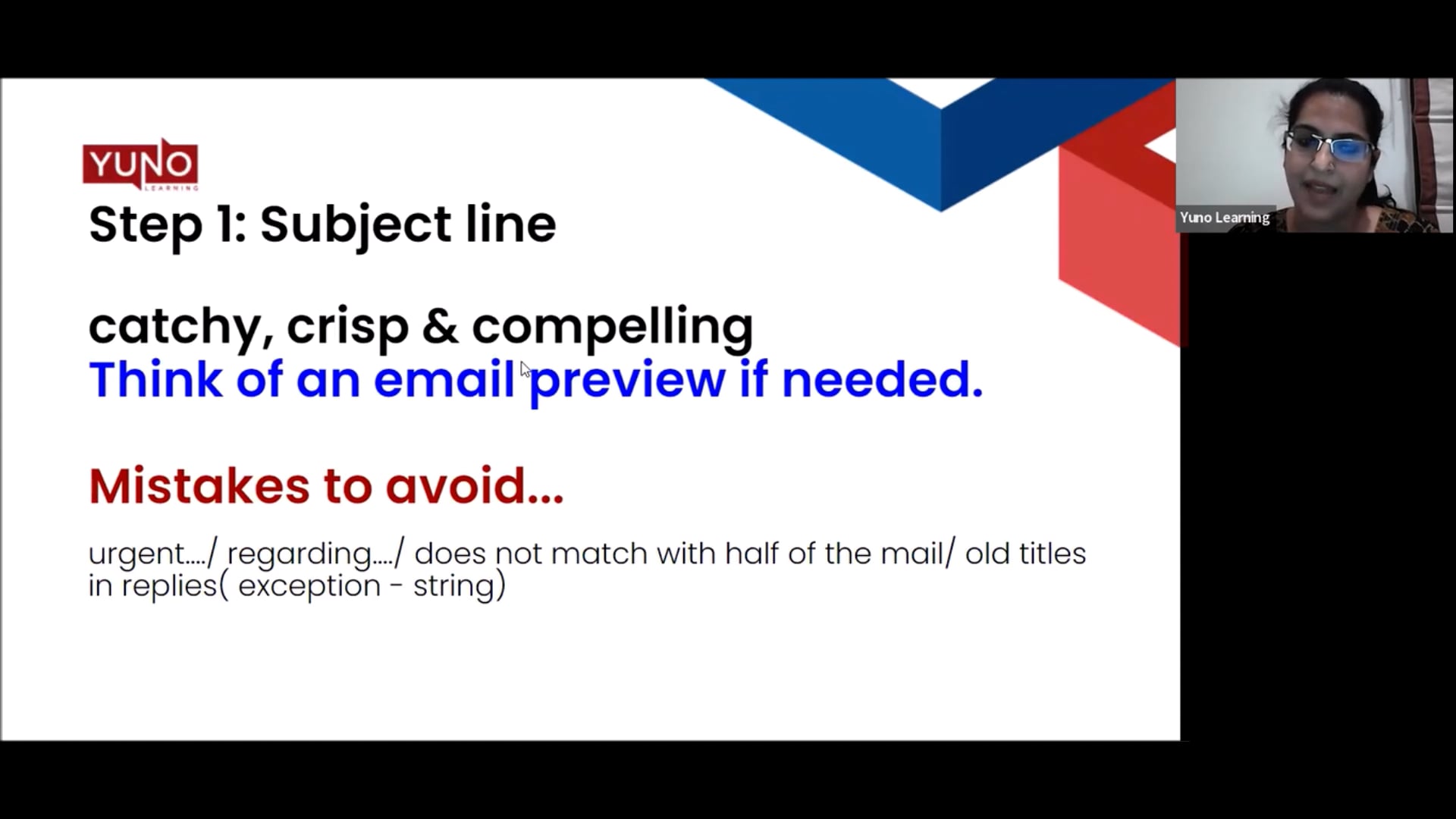
The first 5 words of the subject line are the ones that catch the maximum attention and compel the reader to read the email.
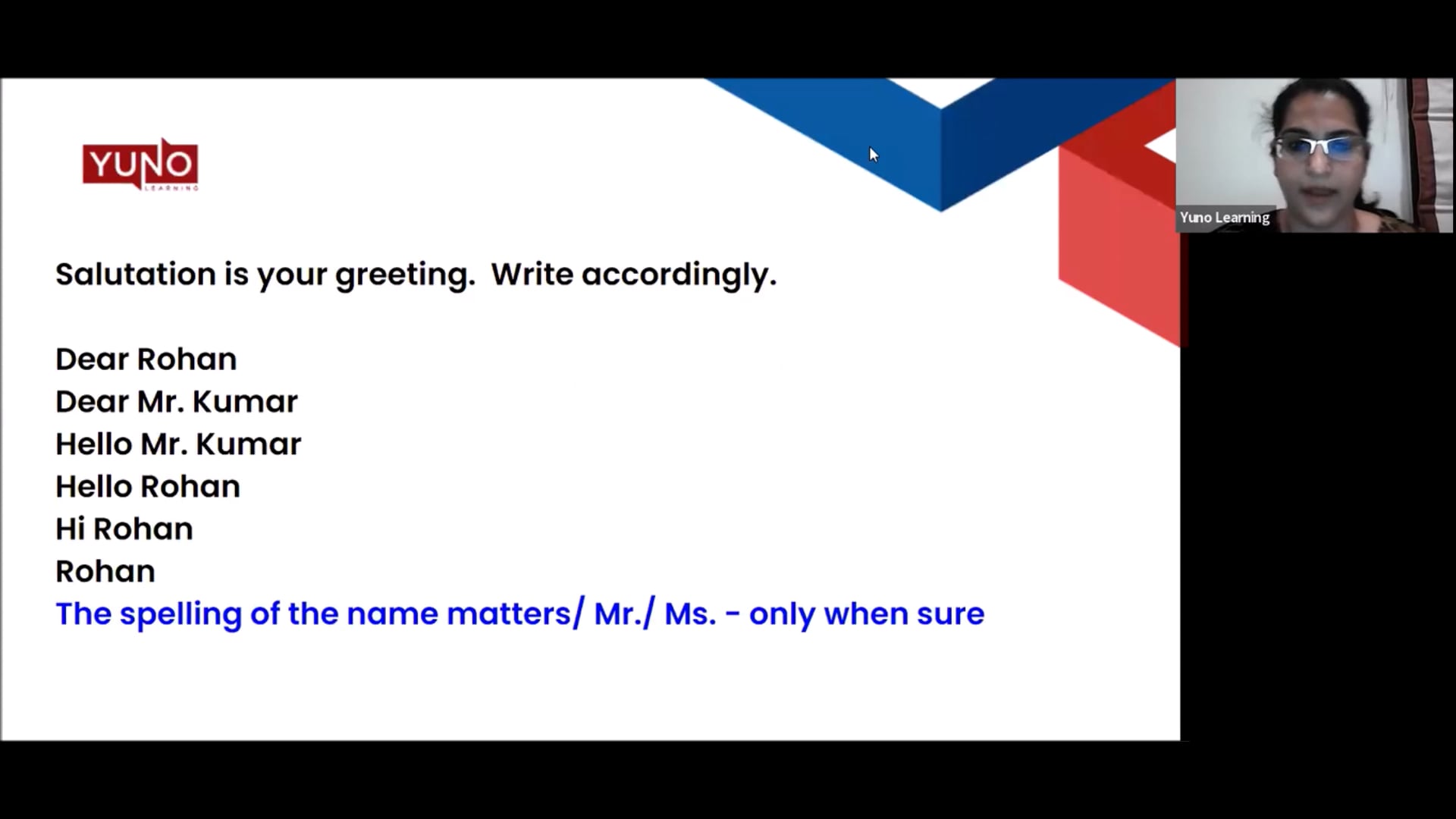
Professional Email Salutation tips and strategies. Learn Email Etiquette tips to write better emails at work.

CTA means Call to Action. In a business email, CTA is a button or text that prompts the receiver to take some action.
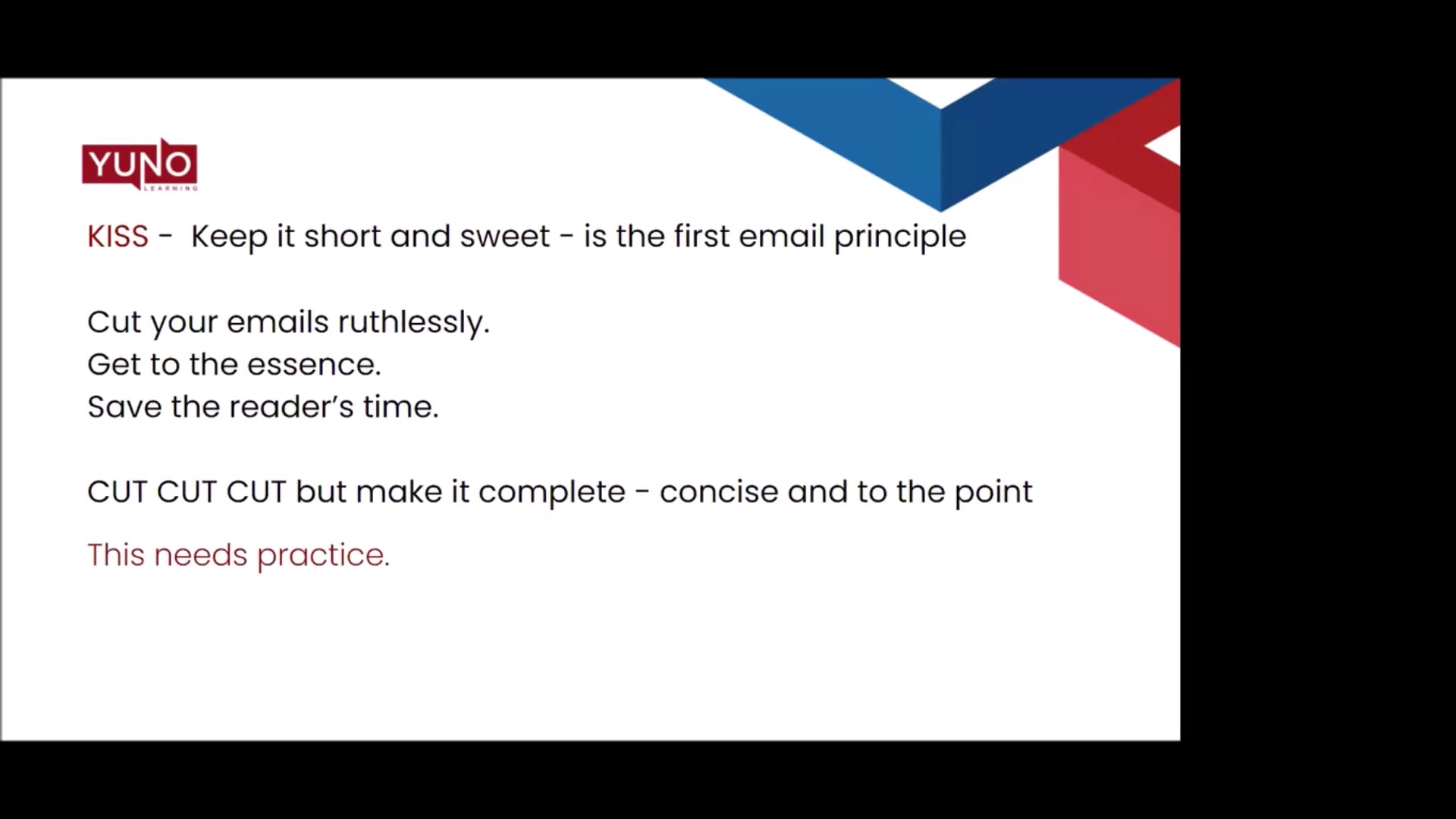
What should be the Ideal length of your Business Email? There is absolutely no need to write long emails. Watch this video to know more!
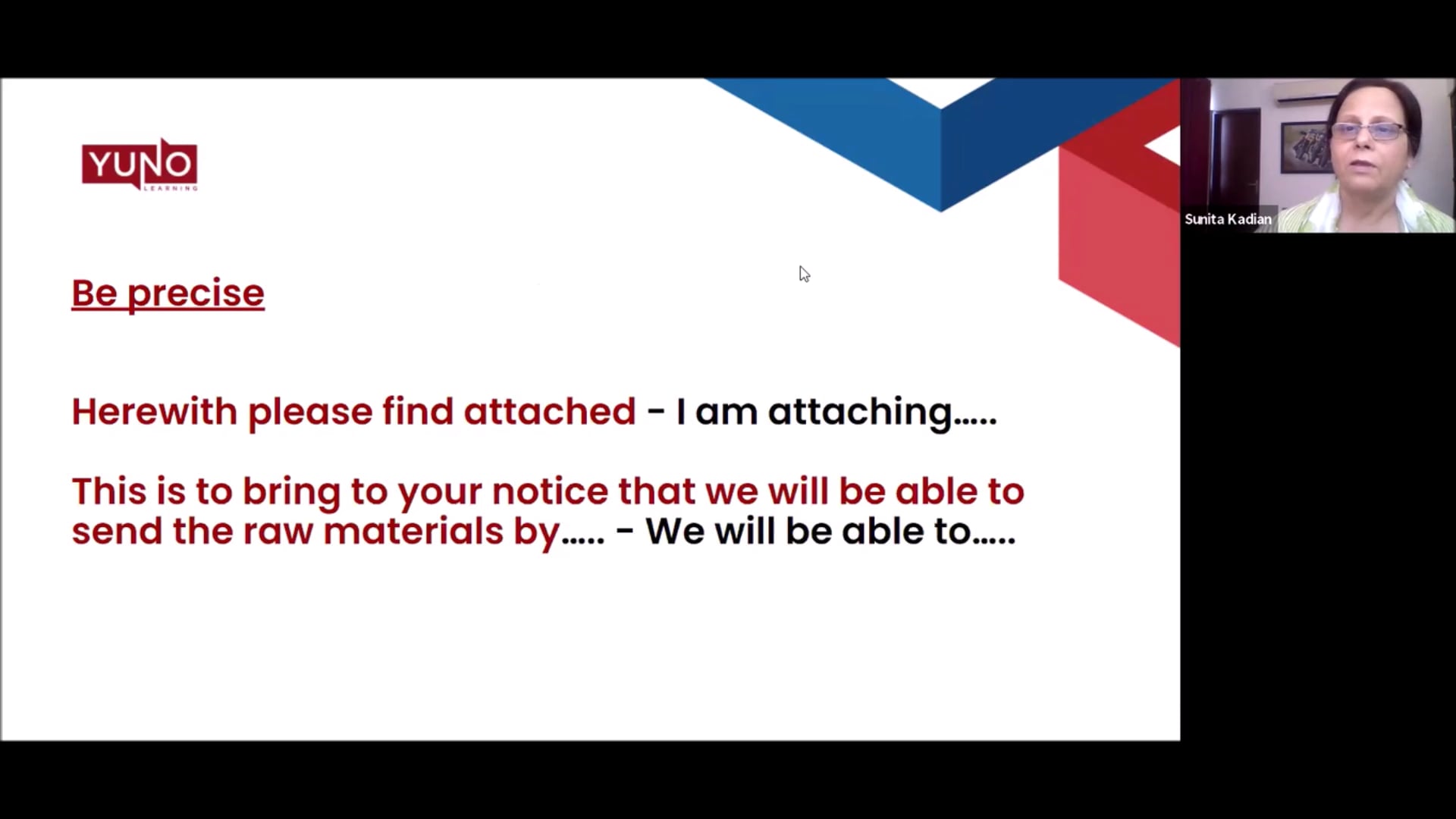
Avoid Prolixity while writing Business emails! Using too many or unnecessary words in Business emails can put off the reader.
In simple words, conjunctions are words that are used to join words, phrases, and sentences.
For instance: It rained yesterday, so she couldn't go out. Here, "so" is the conjunction.
Some commonly used conjunctions are: but, because, since, yet, although, and because.
Conjunctions are the different adhesives that we use to join the clauses. Even though they are simple, we get confused when we have to decide between 'even if' and 'even though' or between 'unless' and 'until'.
For example, Lucknow and Mumbai are in India. Here, "and" is the coordinating conjunction.
2. Subordinating conjunctions: Introduce a dependent clause and indicate the nature of the relationship between the independent and dependent clause(s).
For example, He wanted to know whether there was a hotel nearby. Here, whether is the subordinating conjunction.
3. Correlative conjunctions: Appear in pairs and are used to link equivalent sentence elements.
For example, It was not only complicated but also difficult. Here, not only...but also are correlative conjunctions.
A clause is a group of words including both a subject and a predicate. A sentence can have just one clause or it can have multiple clauses. There are two types of clauses: Independent clauses and dependent clauses.
An independent clause is one that can stand on its own as a complete sentence. For example:
A dependent clause, on the other hand, depends on an independent clause to express meaning clearly. For example:
To turn a dependent clause into a full sentence, it needs to be combined with an independent clause. For example:
In the given articles and videos, you will learn not only how to structure compound and complex sentences but also how to avoid the most commonly made errors while using conjunctions and clauses in compound and complex sentences.
Conjunctions are the different adhesives that we use to join the clauses. Some common conjunctions are - but, and, although, since, because etc.

Conjunctions allow you to form long and complex sentences. Without them you’d have to express every idea in a series of simple sentences.
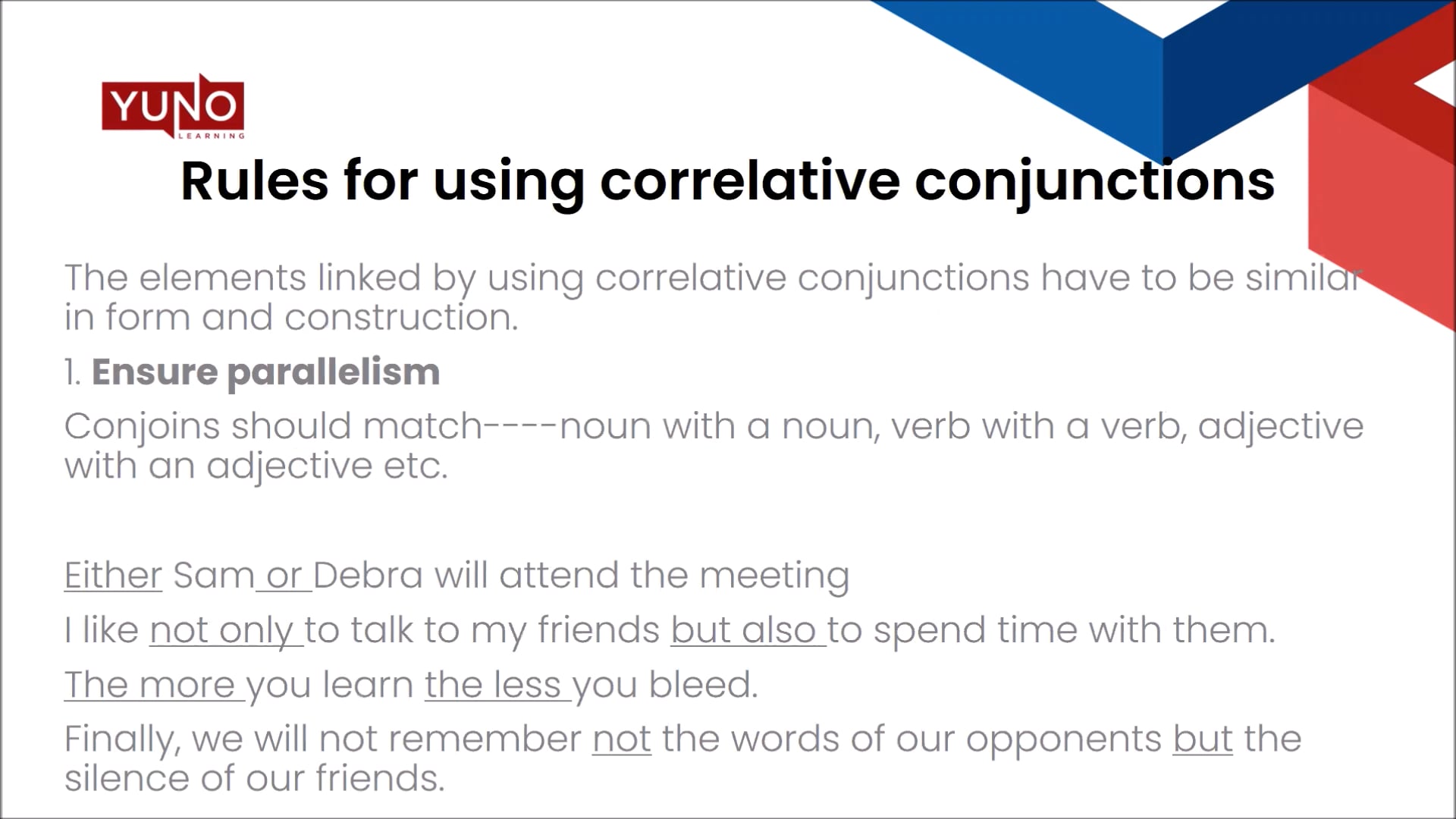
Correlative conjunctions are word pairs like either...or, neither…nor, not only…but also etc. which are usually used in pairs.

A clause is a group of words including both a subject and a predicate. A sentence can have just one clause or it can have multiple clauses.

An adjective clause, or relative clause, is a type of dependent clause that works to describe a noun in a sentence.

All adverb clauses answer one of the classic “adverb questions:” When? Why? How? Where?

‘That’ and ‘which’ are two very simple words/pronouns with, which almost every speaker of English is familiar.
Punctuation is the set of symbols, called punctuation marks, used to separate sentences and parts of sentences in order to make their meaning clear.
Some of the common punctuation marks in English are capital letters and full stops, question marks, commas, colons and semicolons, exclamation marks, and quotation marks.
Commas are mostly used to separate items in a series.
For example:
Besides this, we always use a comma or a pair of commas to set off introductory or non-essential information, that is, elements inserted in the sentence that interrupt it without changing the essential meaning.
A comma at the wrong place or the absence of a comma can give you comma slices or run-ons, which can leave a wrong impression on the reader. Watch the given videos to learn more about punctuation marks and their correct usage with conjunctions.
Punctuation is the set of symbols (punctuation marks) used to separate sentences and parts of sentences in order to make their meaning clear.
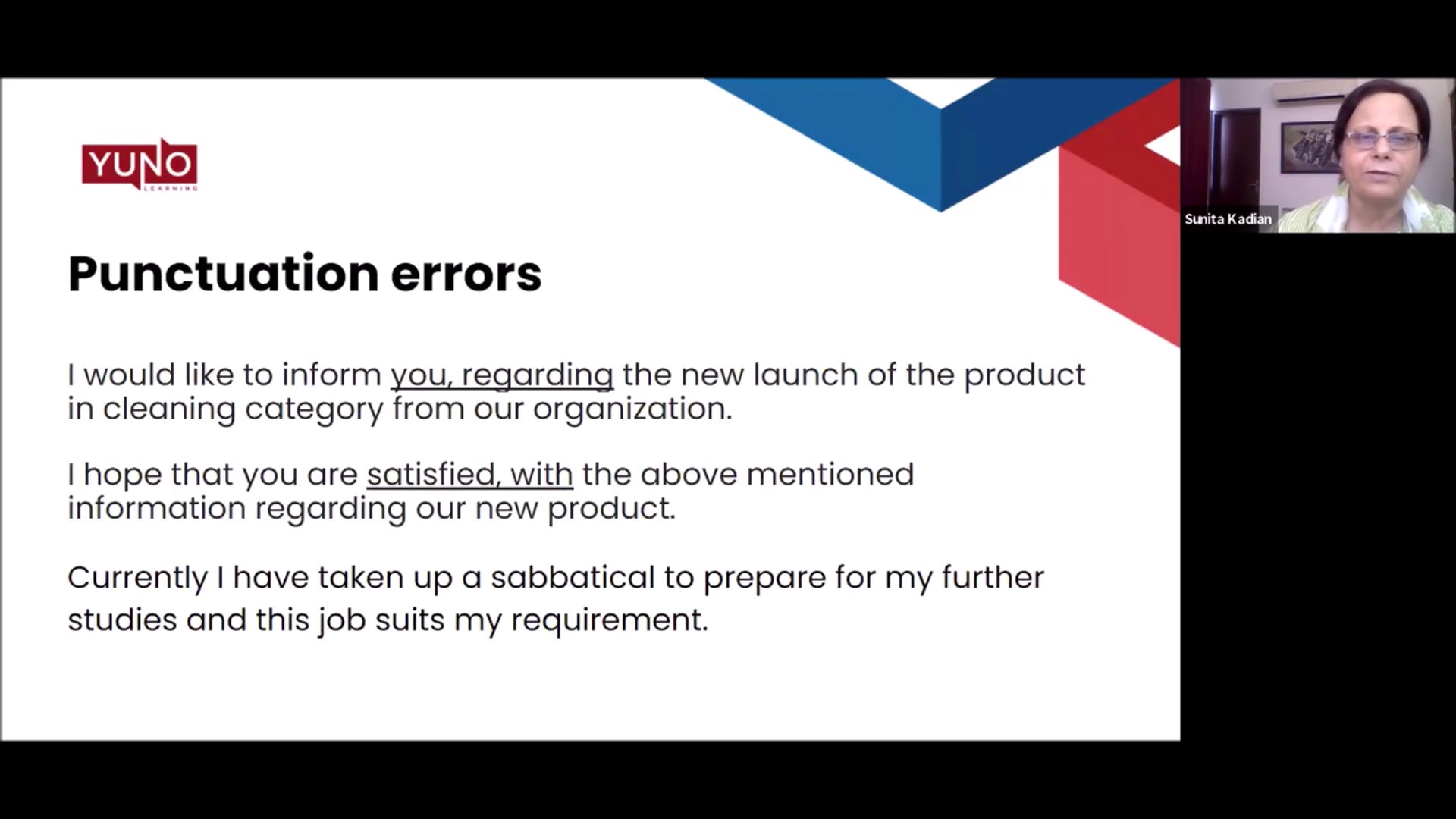
It is extremely important for you to use proper grammar while writing Business emails. It helps you to communicate clearly and effectively.
Power words are words that trigger a psychological or emotional response. They are persuasive, descriptive words that trigger a positive or negative emotional response. They can make us feel scared, encouraged, aroused, angry, greedy, safe, or curious. They are called "power words" because they are so persuasive that people simply can't resist being influenced by them! Authors, freelance writers, copywriters, and content marketers use "power words" to spice up their content and add punch to their writing.
One interesting point to note here is that "power words" can be used anywhere and everywhere in all forms of writing. For example, an effective word in a sales email can make or break a deal. A great word in a blog can leave an everlasting impression in the reader's mind.
In these videos, you will learn how to use these words. You will also get to practice how to replace simple words and phrases with more meaningful ones to be more assertive.

In this video tutorial, we will learn about power words. We will also see the importance of Power Words in professional writing.
in this video tutorial, we learn about Power Words. The instructor gives a long list of power words that one may use in any required situation.
A modifier modifies, clarifies, or limits a particular word or a clause in a sentence. Its role is to emphasize or explain. Therefore, modifiers tend to be descriptive words, such as adjectives and adverbs. Whenever an adjective works as a modifier, it describes a noun or a pronoun. Here are some examples:
An adjective word, phrase, or clause can work as a modifier:
Since modifiers give extra details they can make writing extremely interesting and engaging. They can be magical in their impact when used correctly. Modifiers give life to writing. But if they are positioned incorrectly they give absurd and distorted meaning to a sentence.
Here’s a video to help you understand more about modifiers.
Parallelism means being consistent in how you structure your sentences while speaking and writing. The whole point of parallelism is to treat similar information in a similar manner.
For example, when writing sentences with lists or series, use parallel construction, which means putting the elements of the list or series in a grammatically equal form.
Lack of Parallelism in Business Writing can cause misunderstanding while reading the message, which is why it's important to use Parallelism every time you draft an Email or Report.
The reader doesn't have to put in as much effort to understand the statement when grammar is used repeatedly. This makes it possible for the reader to concentrate on the sentence's essential concept rather than its grammatical construction.
The given articles and videos will equip you with the rules of parallelism needed in different types of sentence structures.
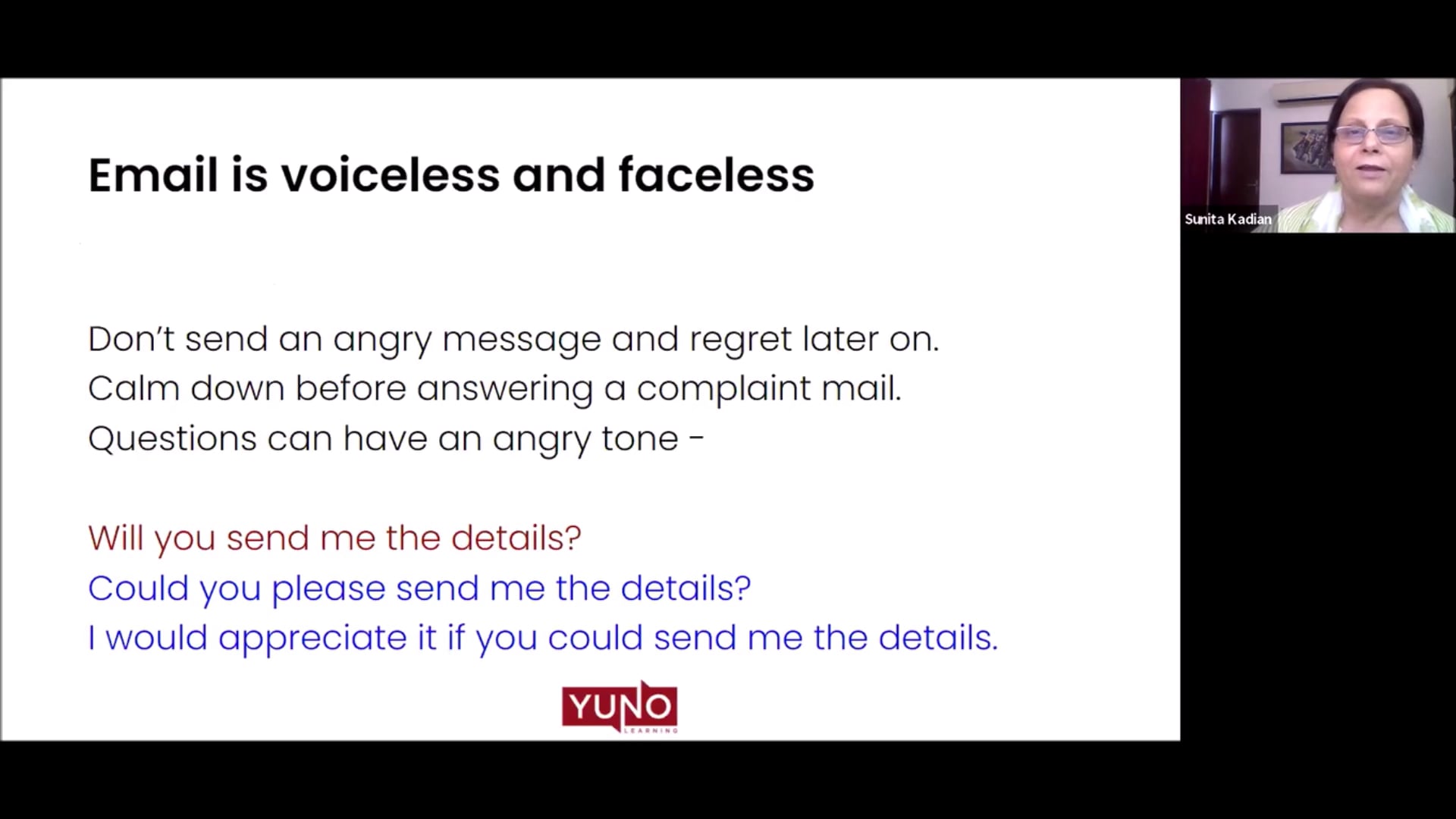
The tone in writing refers to the attitude of the writer towards the reader. It is essential for working professionals to consider the tone of their messages while writing business emails. The overall tone of your message should be positive.
Words can come across a lot harsher in emails. Hence, select your words carefully. Here are some pointers to follow:
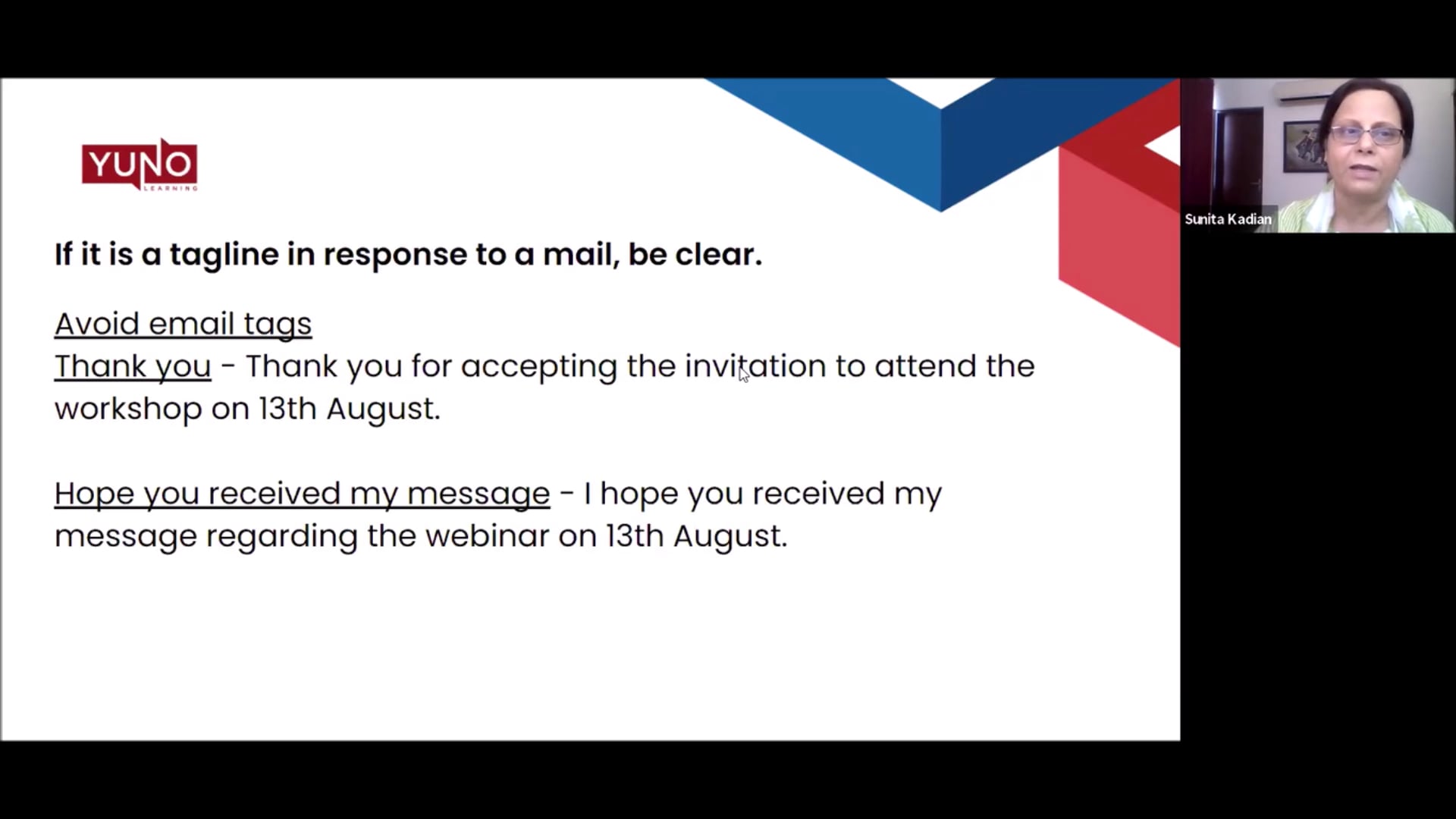
The given articles and videos will equip you with strategies to avoid any kind of misuse of words while writing an Email.
When we are writing emails that are urgent and we need a prompt reply we can use the strategy called the BLUF strategy. It simply means Bottom line Up Front. In this, we skip the niceties and greetings and come straight to the point. We start the email by writing or asking the 5 w's:
In this, we usually write the things that we save for the end at the beginning of the email. This saves the reader's time and effort and works well on projects where turnaround time is less.
Understand the BLUF strategy more clearly with the help of the given articles and videos.
Although most people have encountered a report at least once in their life, we do not have a formal definition of what it is, or what the established guidelines and format are. This ignorance of report writing techniques and terminology results in small and significant errors in your report. On your path to becoming a top employee, this eventually has an impact.
Reports are documents that present information in a specific format intended for a specific purpose and a specific audience.
Report writing of different types is done in all businesses, whether it is a daily report or a report of a project. These videos will help you to structure your reports correctly.
This video deals with professional reports, their types and how to write daily, monthly, quarterly, and annual general reports.
In this super interesting video, we discuss the latest and most effective practices of Report Writing. Happy watching!