
document
Exercise 1: Simple Present Tense
Through this exercise, you will be able to practice the right use of Simple Present Tense.
English tenses are an essential aspect of the language that help us express time in our communication. For working professionals, a firm grasp of English tenses is crucial to convey messages clearly and accurately. This article will provide an overview of the different tenses in English and offer practical tips for working professionals to improve their understanding and usage of tenses in everyday communication.
In grammar, a tense refers to the form of a verb that indicates the time at which an action takes place. It helps us understand whether an action happened in the past, is happening in the present, or will happen in the future.
There are three main types of tenses: past, present, and future. Each type can be further divided into different forms to express specific aspects of time.
1. Past tense: This is used to talk about actions or events that have already happened. Examples include:
2. Present tense: This is used to talk about actions or events happening right now or things that are generally true. Examples include:
3. Future tense: This is used to talk about actions or events that will happen in the future. Examples include:
These are the basic forms of tenses, but within each type, there are also additional forms that can express different aspects of time, such as continuous or perfect aspects. For example, in the past tense, we have the past continuous (“I was eating dinner”) and the past perfect (“She had already finished her homework”).

English grammar offers a range of present tenses to describe actions or states happening now, including the simple present, present continuous, and present perfect tenses. Each tense serves a specific purpose and understanding the usage of different tenses is key to delivering clear, concise, and correct messages. This article will guide you through the uses and differences of these tenses.
The simple present tense, also known as the present simple or present indefinite, is perhaps one of the most frequently used verb tenses in English. It's used to express daily routines, general facts, habits, and events that are scheduled in the future. Here, we'll delve into the various usages of the simple present tense.
The present continuous tense is used to indicate an action that is happening right now (at the moment of speaking) or a current temporary situation. It's also used to talk about future planned events.
In all of these situations, the present continuous tense provides a convenient and effective way to express actions that are happening right now, future plans, or temporary actions. It's essential to understand these nuances to effectively use the tense in various contexts.
Though both tenses talk about the present, they differ in their applications. The simple present tense expresses regular or habitual actions, while the present continuous is used for actions happening at the moment of speaking or for planned future actions.
The present perfect tense is used to describe an action that began in the past, continues in the present, and may continue into the future. This tense is formed using 'has/have' with the past participle of the verb. Here's how you can use it:
Remember, understanding when to use the present perfect tense (as opposed to other tenses) can be challenging, as it requires thinking about the time an action took place and the relationship of that action to the present. It's worth noting that misuse of the present perfect is a common mistake for English learners, so don't get discouraged if it takes some time to master.
The present perfect continuous tense is used to describe an action that began in the past, continues in the present, and may continue into the future. This tense is particularly useful when we want to emphasize the duration, or continuity, of the action. The structure of the present perfect continuous tense is: "has/have" + "been" + present participle of the verb (verb + "ing").
Let's dive into your examples:
The present perfect continuous tense, with its emphasis on ongoing actions, helps to add an extra level of specificity and detail about the duration and continuity of actions in your communication. It can be particularly useful in professional and academic contexts.
Through this exercise, you will be able to practice the right use of Simple Present Tense.

Through this exercise, you will be able to practice the right use of Present Continuous Tense.

Through this exercise, you will be able to practice the right use of Present Perfect Tense.

Through this exercise, you will be able to practice the right use of Present Perfect Continuous Tense.
The past tense is a crucial part of English grammar, primarily used to describe actions, conditions, or events that happened in the past. The simple past tense for regular verbs is formed by adding '- ed' to the base form of the verb. For instance:
However, many English verbs are irregular, meaning they don't follow the standard '-ed' pattern. These verbs have unique past tense forms that must be learned individually. For example:
Here's a further explanation of the situations in which we typically use the past tense, using your examples:
The simple past tense, as the name implies, is used to express actions or states that were completed at a certain point in the past. It covers single events, series of events, habits in the past, and past states. Let's examine these uses in detail:
For example, "I walked to the store yesterday" - the action of walking started and ended yesterday.
For example, "She ate breakfast at 7:00 am, then went to the gym at 9:00 am, and finally met her friends at 11:00 am."
For instance, "I always watched cartoons when I was a kid."
For example, "She was shy as a child, but now she is very outgoing."
English has several irregular verbs that do not follow the usual "verb + ed" formula in the past tense. Here are the past tense forms of the irregular verbs:
The past continuous tense (also known as the past progressive tense) is used to describe an action that was in progress at a specific time in the past. This tense provides a context for the main event in a sentence, showing it in progress at a particular time in the past.
The structure of the past continuous tense is fairly straightforward: It's formed by using "was/were" (the past tense of the verb "be") + the base verb + "ing" (the present participle).
Examples:
“I was walking to the store when it started to rain.”
In this sentence, the action of walking to the store was in progress ("I was walking") when a new event occurred ("it started to rain"). The past continuous tense is used here to indicate that the walking was ongoing at the time the rain began.
"She was eating breakfast when I arrived."
Here, the action of eating breakfast was in progress ("She was eating") when a new event happened ("I arrived"). The sentence expresses that the eating was ongoing at the exact moment of my arrival.
"They were watching a movie when I called."
In this example, the action of watching a movie was in progress ("They were watching") when another event took place ("I called"). This sentence implies that they were already engaged in watching the movie at the exact moment that I called them.
"While I was studying, my brother was playing video games."
Here, both studying and playing video games were ongoing actions in the past. The past continuous tense can also be used to describe two actions happening at the same time in the past.
Note: Simple Past vs. Past Continuous: When distinguishing between these two tenses, the simple past generally states completed actions, while the past continuous emphasizes an ongoing action in the past.
Example: “While I was studying (past continuous), the phone rang (simple past).”
The past perfect tense is used when an action was completed before another past action or event. It's typically formed using "had" + past participle.
Example: "I had already eaten when my friend arrived." Here, 'had eaten' is in the past perfect tense, showing an action completed before another action.
Note: A common mistake: One common error is using the simple past when the past perfect is needed. Remember, use the past perfect when you want to make clear that one action happened before another in the past.
Incorrect: "I went to the party, but everyone left."
Correct: "I went to the party, but everyone had left."
The past perfect continuous tense is a grammatical construction used to describe an ongoing action that started in the past, continued for a duration, and was still in progress when another event or action took place. It is formed by using the auxiliary verb "had" in the past perfect tense, followed by "been" and the present participle ("-ing" form) of the main verb.
One common error people make with the past perfect continuous tense is incorrect word order. Due to the complexity of the tense, the order of words can become jumbled, resulting in sentences that do not adhere to the correct structure.
For example, "She had been for hours studying before she took a break" should be corrected to “She had been studying for hours before she took a break.”
Another mistake is the incorrect use of the auxiliary verb. Sometimes people erroneously use "have" instead of "had" as the auxiliary verb in the past perfect continuous tense.
For instance, "They have been waiting for you for a long time" should be revised to “They had been waiting for you for a long time.”
Overusing the past perfect continuous tense is another common error. It is important to recognize when this tense is truly necessary, as sometimes the simple past tense or other tenses can adequately convey the intended meaning.
For instance, "I had been living in London when I went to Paris" should be simplified to “I was living in London when I went to Paris.”

Through this exercise, you will be able to practice the right use of Simple Past Tense.
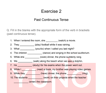
Through this exercise, you will be able to practice the right use of Past Continuous Tense.
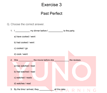
Through this exercise, you will be able to practice the right use of Past Perfect Tense.

Through this exercise, you will be able to practice the right use of Past Perfect Tense.
When we think about future events, plans, predictions, or even promises, we instinctively use the future tense in our language. Understanding its correct usage, rules, and variations can elevate our communication and clarity of expression. This article aims to give a comprehensive overview of the future tense, its structure, and common usage in English.
The simple future tense is primarily used to express actions that will occur in the future. The structure often involves using 'will' or 'shall' with the base form of the verb.
Example: "I will attend the meeting tomorrow." Here, 'will attend' is in the simple future, indicating a planned future action.
The future continuous tense expresses actions that will be ongoing at a particular time in the future. The structure is typically 'will be' + verb + "-ing".
Example: "This time next week, I will be presenting at a conference." In this case, 'will be presenting' is in the future continuous tense, describing an action that will be in progress at a specific future time.
The future perfect tense is used to express actions that will be completed before a certain time in the future. The typical structure involves 'will have' + past participle of the verb.
Example: "By the end of this year, I will have completed my degree." Here, 'will have completed' is in the future perfect tense, indicating a future action that will be finished before a certain future time.
The future perfect continuous tense expresses how long an action will have been happening by a certain time in the future. The structure generally is 'will have been' + verb + "-ing".
Example: "In July, I will have been working at this company for three years." In this case, 'will have been working' is in the future perfect continuous tense, describing the duration of an action up to a specific future time.
We often use the going-to future when we have the intention to do something or when we see something is likely to occur based on present evidence. The structure is typically 'be' + going to + base form of the verb.
Example: "I am going to apply for that job." or “Look at those clouds. It's going to rain.”
In some contexts, we can also use the present continuous and simple present tense to talk about the future, especially when discussing scheduled events or timetables.
Example: "I am meeting her tomorrow." (Present Continuous)
Example: "The train leaves at 9 PM." (Present Simple)

Through this exercise, you will be able to practice the right use of Simple Future Tense.

Through this exercise, you will be able to practice the right use of Future Continuous Tense.

Through this exercise, you will be able to practice the right use of the Future Perfect Tense.

Through this exercise, you will be able to practice the right use of the Future Perfect Continuous Tense.