Why Austria Is the Next Big Destination for Indian Engineers in 2026
TL;DR
- Austria is making a bold move to attract India’s top engineering talent with a €5 million initiative supporting new programs at TU Wien, TU Graz, and Montanuniversität Leoben. Announced in June 2025, the scheme focuses on cutting-edge fields like automation, plant construction, mobility, infrastructure, and sustainable technologies.
- Beyond academics, the program fosters strong university-industry partnerships, provides internships, and facilitates smoother job market access for graduates. Students will benefit from scholarships, two-year master’s programs combining theory with industry exposure, and a one-year post-study work visa extension.
- With Austria’s economy projected to rebound by 2027 and facing skilled labor shortages, Indian engineers stand to gain both academically and professionally. Applications for the March and October 2026 batches are now open via VFS Global Academy.
The scramble to attract top Indian talent has begun, with Austria taking the lead.
For the purpose of expanding course offerings and provision of more scholarships, the Austrian Federal Ministry for Women, Science and Research (BMFWF) is providing a total of five million euros ( € 5,000,000 = ₹51,17,57,500/- ie, ₹51.18 crore) to the three participating universities –
- Montanuniversität Leoben,
- Vienna University of Technology,
- Graz University of Technology
And this is the budget for the next two years only. The scheme has been in the pipeline since early 2025 and was finalised in June. On June 26, the governments of Austria and India, along with the heads of the technical universities, formally announced the programme at Vienna.
What’s different about this agreement is that it goes far beyond traditional university collaborations. The focus is not only on alliances between leading Indian technical universities and TU Austria, but also on partnerships at the government level.
The agreement specifically states that the aims are to
- Generate innovative study programmes and PhD programmes that will attract India’s brightest minds;
- Allow students to gain expertise in areas mission-critical to Austrian society – e.g., plant construction, automation, infrastructure, and e-commerce;
- Make it easier for these Indian graduates to find jobs in Austria.
Elmer Pichl, head of the Higher Education section at the Federal Ministry of Finance, Science and Research, described the new programme as “a groundbreaking future-oriented collaboration that is not only about further deepening the existing partnership between Austria and India in science and research. Above all, it is about jointly exploring new avenues in the areas of excellent teaching, innovative research, technology transfer, and sustainability, in which both sides contribute their respective strengths.”
Peter Moser, Rector of Montanunivsität Leoben and president of the Association of Technical Universities, also laid out the welcome mat: “This programme opens doors to cutting-edge master’s programs in specialized fields such as circular engineering, resource efficiency, and sustainable technologies—disciplines that are crucial for shaping a more resilient and sustainable future.”
Speaking on behalf of the Indian Government. Ambassador Shambhu S. Kumaran welcomed the initiative and looked forward to deeper educational cooperation with Austria. “This significant step strengthens the ties between our countries and lays the foundation for a more intensive bilateral economic partnership in the future,” he said.
The focus is on cutting-edge technology and technology transfer, particularly in the areas of industrial modernization (plant engineering, automation), automotive/mobility, transport infrastructure (rail, cable cars, tunnel construction, traffic management), and the e-economy.
Austrian industry will also be actively involved in this unique cooperation project. The goal is to facilitate access to the Austrian labor market for Indian students after graduation. This not only strategically addresses the shortage of skilled workers in technical professions but also creates a sustainable connection between science and industry.
At the Master’s degree level, courses will be two-year programmes, entailing theory as well as industry work experience. The universities will support on-campus placements and career open day engagements with industry experts. Students will be eligible for a one-year post-study visa extension upon graduation, supporting their transition to employment in Austria.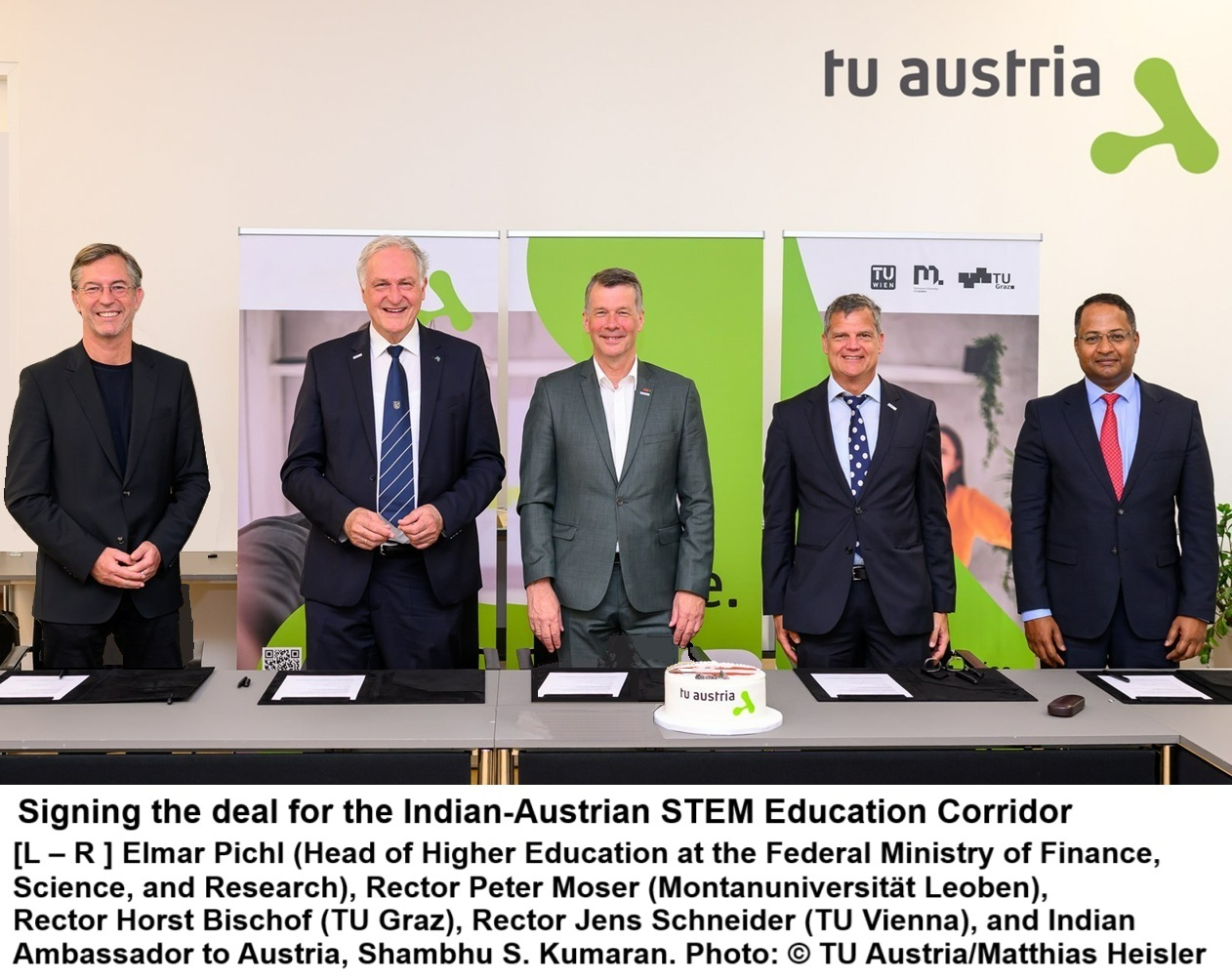
News appearing in the Indian media originated from a press release issued by VSF Global Academy. Naturally, the news stressed that the technical universities and the Austrian government have partnered with VFS Global Academy to set up a digital portal to facilitate applications from Indian students. The release said: Students interested in enrolling for the March and October 2026 batches can send their B.Tech degree certificates with marksheets to [email protected]. Shortlisted candidates will be notified about the next steps. Please note that students are shortlisted as per their choice of engineering degree and the number of seats available. This selection would be based on overall grades, English proficiency, one-to-one assessments, and document verifications.
The news items did not explicitly state whether applying outside the VFS portal (i.e., directly to the university) is permissible or disallowed. There is no clear statement indicating that applications submitted directly to universities will be automatically excluded from consideration.
YUNO LEARNING advises:
Before sending an application through VFS Global, contact TU Wien, TU Graz, or Montanuniversitat Leoben, and ask whether direct applications are acceptable or if they must go via VFS. Any Indian who has ever applied for a visa knows about Visa Facilitation Services Global (VFS Global).
Now about those universities:
TU Wien is Austria’s largest science-technical research and educational institution, home to around 28,000–30,000 students, approximately 5,000 staff, and structured into eight faculties spanning from civil engineering to informatics and architecture. The university is highly regarded for its cutting-edge research, organized around five core fields:
- Computational Science & Engineering
- Quantum Physics & Technologies
- Materials & Matter
- Information & Communication Technology
- Energy & Environment
For a would-be student who would like detailed information, the place to start is the Study Information Center. Email them. This office will either answer questions directly or direct you to the appropriate contact. This is the primary point of contact for general questions from prospective students about study programs, admission procedures, application guidance, and other study-related inquiries. If your question is specifically about TU Wien’s study offerings or program details, you can also reach out to the designated contact: Herbert Kreuzeder.
TU Graz is only slightly smaller than TU Wien. It’s famous for architecture and built environment, materials sciences, civil and mechanical engineering, chemical engineering, computer science and information systems, and earth sciences. The section Becoming an International Student at TU Graz is organized in a highly systematic manner and provides comprehensive information
Montanuniversität Leoben is the oldest mining university in the world. From an initial focus on mining and metallurgy, it has expanded to include materials science, petroleum engineering, and environmental engineering technologies. The university’s specialist programs span the full value chain—from raw materials extraction to advanced materials processing, product creation, and recycling—making it a unique academic institution in this niche. Because of its specialized focus, Montanuniversität is smaller than the other two technical universities; however, it is home to three world-famous research centres:
- Center for Hydrogen & Carbon Research, focusing on CO₂-neutral industrial technology
- Zentrum am Berg, a real-scale underground research laboratory for geotechnical and tunnel safety studies, and
- Resources Innovation Center (RIC), advancing innovation in sustainable raw materials and digital resource management
Its ties with industry are very strong, and it ensures that its students get practical training and internships that enhance employment prospects for graduates. Getting detailed information tailored to the individual student is as simple as sending an email to the university’s Study Support Center. This email is for international students: [email protected]
In March this year, Montanuniversitat announced a programme called “Focus India”: Targeting Skilled Indian Talent, for the 2026-27 academic year. Programme director, Susanne Feiel, said in an interview: “We simply find too few key workers in Europe. India is our blueprint… well-educated young Indians could come to Austria … do internships … and ultimately stay in the industry as specialists or even key professionals.” She is reachable at [email protected]
The report on Austria’s economic outlook for 2025 and 2026, published by the Austrian Institute of Economic Research (WIFO), makes the cautiously optimistic prediction that the country is poised for growth, picking up momentum around 2027.
YUNO LEARNING sizes up the newly announced cooperation deal and the forecasts and sees four very positive factors:
Job Market Timing:
A graduate entering the job market in 2027 would align with the onset of more sustained economic recovery and gradually improving employment prospects.
Skilled Labor Demand:
Despite slow growth, several sectors—especially technical, engineering, and innovation-driven industries—have ongoing demand for qualified talent, as seen through policy initiatives and university-industry partnerships.
Short-Term Tightness Eases:
While 2025–2026 may remain challenging, 2027 offers a more favorable environment, with companies looking once again to recruit and retain skilled professionals.
Relative Advantage:
Emerging from recession, Austria’s limited domestic labor force (due to aging population) means employers may continue welcoming skilled migrants, offering an entry point for international graduates.
For an engineering or technical graduate, Austria looks promising. As recovery gains traction, demand for skilled and specialized talent should improve—especially for those aligned with innovation, technology, and industry needs.