US Student Visa Climate 2026: Court Protections but Ongoing Uncertainty
TL;DR
- One year after the Trump administration’s aggressive actions against US universities and international students, the legal landscape remains unsettled but no longer unchecked.
- In May 2025, the Department of Homeland Security attempted to revoke Harvard’s SEVP certification, threatening its ability to enrol international students. Federal courts quickly intervened, issuing temporary protections that remain in place as appeals proceed.
- Dozens of universities and major academic associations have joined the legal resistance, framing the dispute as a sector-wide defence of academic freedom and institutional autonomy. While courts have blocked the most extreme measures, protections remain provisional, and visa issuance at US consulates continues to involve discretion and delays.
- For Indian students, the US remains opportunity-rich—but legally contested and policy-fragile in 2026.
For Indian students aspiring to study in the United States, the period since early 2025 has been deeply unsettling. The Trump administration’s posture toward universities—especially elite institutions, international students, and non-citizen scholars—has been widely perceived as hostile, punitive, and xenophobic. Immigration tools have increasingly been used as instruments of discipline rather than administration, and universities have been framed less as national assets than as ideological adversaries.
From India, this has raised an unavoidable question: is the United States still a reliable destination for higher education?
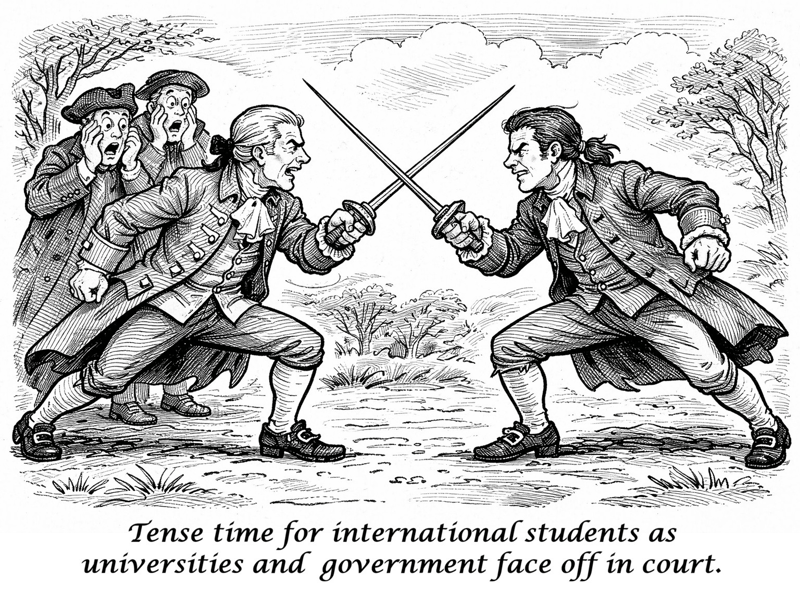
One year after what many described as an “onslaught” against universities and international students, the answer is neither simple reassurance nor outright pessimism. What has emerged instead is a sustained legal confrontation—a test of whether American institutions, particularly the courts, can restrain executive overreach and preserve academic freedom through law.
As of February 2026, the picture is clearer, though far from settled.
The Central Battle: Harvard vs. the US Government
The most consequential clash began in May 2025, when the US Department of Homeland Security (DHS) revoked Harvard University’s certification under the Student and Exchange Visitor Program (SEVP). Without SEVP certification, a university cannot lawfully enrol international students on F-1 or J-1 visas. The action therefore posed an existential threat to Harvard’s international population and signaled a willingness to use immigration authority as leverage over universities themselves.
Harvard responded immediately by filing suit:
Case: President and Fellows of Harvard College v. Department of Homeland Security, et al.
Filed: May 23, 2025, US District Court, Massachusetts
Harvard argued that the revocation was arbitrary, procedurally defective, and unconstitutional, violating both administrative law and due-process protections, while inflicting immediate and irreparable academic harm.
The courts intervened quickly:
- A Temporary Restraining Order froze the revocation
- A Preliminary Injunction (June 2025) barred enforcement while litigation proceeds
- The government appealed to the First Circuit, where the case remains pending
As reported by Reuters (May 2025), these rulings ensured that international students could remain enrolled and legally present, at least for now.
Why Courts Have Intervened
From outside the US, judicial intervention can appear surprising under a Trump administration. The explanation is largely institutional, not ideological.
US federal courts—across political lines—are strongly protective of procedural regularity. Immigration agencies lose credibility when they act abruptly, fail to document decision-making, or depart from settled norms. Universities, by contrast, are unusually strong litigants: they can demonstrate concrete harm, long-standing reliance on existing rules, and disruption to public missions such as teaching and research.
For international observers, this matters. It suggests that courts are responding less to sympathy for universities than to structural defects in executive action.
Temporary Protection, Not Final Security
It is essential to understand what these rulings do—and do not—provide.
Temporary restraining orders and preliminary injunctions preserve the status quo. They prevent immediate damage but do not settle the law. Harvard and other universities are operating under judicial tolerance, not permanent guarantees. Appeals are ongoing, and eventual Supreme Court involvement remains possible.
For prospective students, this distinction is crucial: current protections are real, but they are provisional.
A Collective Academic Response
Recognising the broader stakes, the American Council on Education (ACE) and 22 other higher-education associations filed amicus briefs supporting Harvard in the First Circuit. Their argument was systemic: arbitrary SEVP revocations would destabilise international student mobility across the entire US higher-education sector.
Support extended beyond associations. According to The Times of India ( Jan 25, 2026), Yale University and 47 other US universities formally backed Harvard’s appeal. This degree of institutional solidarity is rare and signals that universities increasingly see immigration enforcement as a sector-wide governance threat, not an isolated dispute.
A Parallel Front: Free Speech and Immigration Enforcement
Alongside institutional litigation, a separate lawsuit has addressed a different danger: the use of immigration enforcement to chill political speech by non-citizens.
Case: American Association of University Professors (AAUP) et al. v. Trump Administration
Filed: March 2025
The plaintiffs—including AAUP chapters and the Middle East Studies Association—argued that visa threats and enforcement actions were being used to deter lawful political expression by non-citizen students and faculty.
In mid-2025, a federal judge ruled largely in their favour, affirming that immigration enforcement cannot be used to punish or suppress political speech, even when the speaker is a non-citizen. However, the remedy was narrow, applying mainly to the named plaintiffs.
As The Harvard Crimson noted, the ruling’s reach was limited—but its constitutional significance was not.
Why Narrow Rulings Still Matter
Even limited decisions shape behaviour. They alert universities that courts are watching, discourage over-compliance, and force enforcement agencies to act more cautiously and document their actions more carefully. In constitutional litigation, signals often travel faster than remedies.
The Reality Outside the Courtroom: Consulates
One critical reality must be acknowledged: visa issuance happens at consulates, not in courtrooms.
Even when universities secure injunctions, consular officers retain broad discretion. Delays, “administrative processing,” and opaque refusals remain possible without formal policy changes. For Indian students, this is often where uncertainty is felt most sharply.
Court victories improve the legal climate, but they do not eliminate friction at the point of entry.
The Broader Legal Environment
Beyond Harvard and AAUP, universities and faculty groups are involved in multiple lawsuits challenging federal actions related to funding, DEI policies, Title IX interpretations, and compliance demands. Together, these cases reflect a broader attempt to reassert executive control over higher education—and a growing willingness by universities to resist through law rather than quiet accommodation.
An Unsettled Conclusion
One year on, the picture is no longer one of unchecked executive power. It is a legal standoff, shaped by institutional resistance, judicial scrutiny, and unresolved appeals.
For Indian students, the United States remains a place of extraordinary opportunity—but also one where legal process, not goodwill, now provides the main line of defence.
The outcome is uncertain. The resistance, however, is real and ongoing.
What International Students (Especially from India) Should Know — February 2026
What happened?
In 2025, the US government took aggressive actions against universities and international students, including trying to strip Harvard of its right to enrol foreign students. This triggered major lawsuits.
Where do things stand now?
Courts have blocked the most extreme measures. Harvard and other universities have won temporary protections allowing international students to stay enrolled. These protections are still in place, but appeals are ongoing.
Does this mean students are safe?
Partly—but not permanently. Court orders are temporary, not final. They prevent sudden harm but do not guarantee long-term stability.
Are universities acting alone?
No. Dozens of US universities and major academic associations are supporting these legal challenges together. This is now a collective defence of international education, not an isolated fight.
What about free speech?
Courts have ruled that immigration enforcement cannot be used to punish students or scholars for lawful political speech, even if they are not US citizens. The rulings are narrow, but they set important precedents.
What should students be realistic about?
Even when courts rule in favour of universities, visa decisions still happen at US consulates, where delays and discretion remain a reality.
As YUNO LEARNING sees it …
The US system is under strain, but it is not lawless. Courts are acting as a check, universities are resisting collectively, and international students still have strong institutional backing—though uncertainty remains.