US H-1B Fee Hike Explained: Who Pays, Who’s Exempt, and What Happens Next
TL;DR
On September 19, 2025, President Trump imposed a $100,000 fee on all new H-1B visa petitions, sparking outrage and legal challenges. The fee does not apply to existing H-1B holders or renewals but covers every new application filed after September 21.
Alongside this, the Department of Labor launched “Project Firewall”, granting sweeping powers to investigate employers suspected of visa abuse. India’s IT industry, which makes up 73% of H-1B users, warned of massive disruption, while New Delhi flagged “humanitarian consequences” for affected families.
Legal experts predict the order could collapse in court, calling it unprecedented. YUNO LEARNING argues that if this move keeps India’s brightest at home, it may accelerate domestic innovation—turning a crisis into opportunity.
On September 19, 2025, U.S. President Donald Trump signed a proclamation imposing a USD 100,000 fee on H‑1B visa applications.
The fee was described initially in some reports as “annual,” but later clarifications indicate important limits.
The new fee applies to new H‑1B petitions filed after the effective date of the proclamation. It does not apply to existing H‑1B holders, renewals (petitions filed before the change), or those whose approved petitions were filed before the deadline. This has been clarified by the White House and USCIS.
The proclamation is effective starting 12:01 a.m. Eastern Time on September 21, 2025.
Meanwhile, the New York Times quoted Doug Rand, a former senior official at US Citizenship and Immigration Services, saying: “Tying an entry ban to a fee, let alone a $100,000 fee, isn’t likely to survive five seconds in court.” The report also quoted legal experts who ridiculed the measure. Tom Jawetz, a former senior attorney at the Department of Homeland Security, also said the order would come under legal scrutiny. “This is how the mob operates when it demands protection money. It’s not how the laws of a country are administered.”
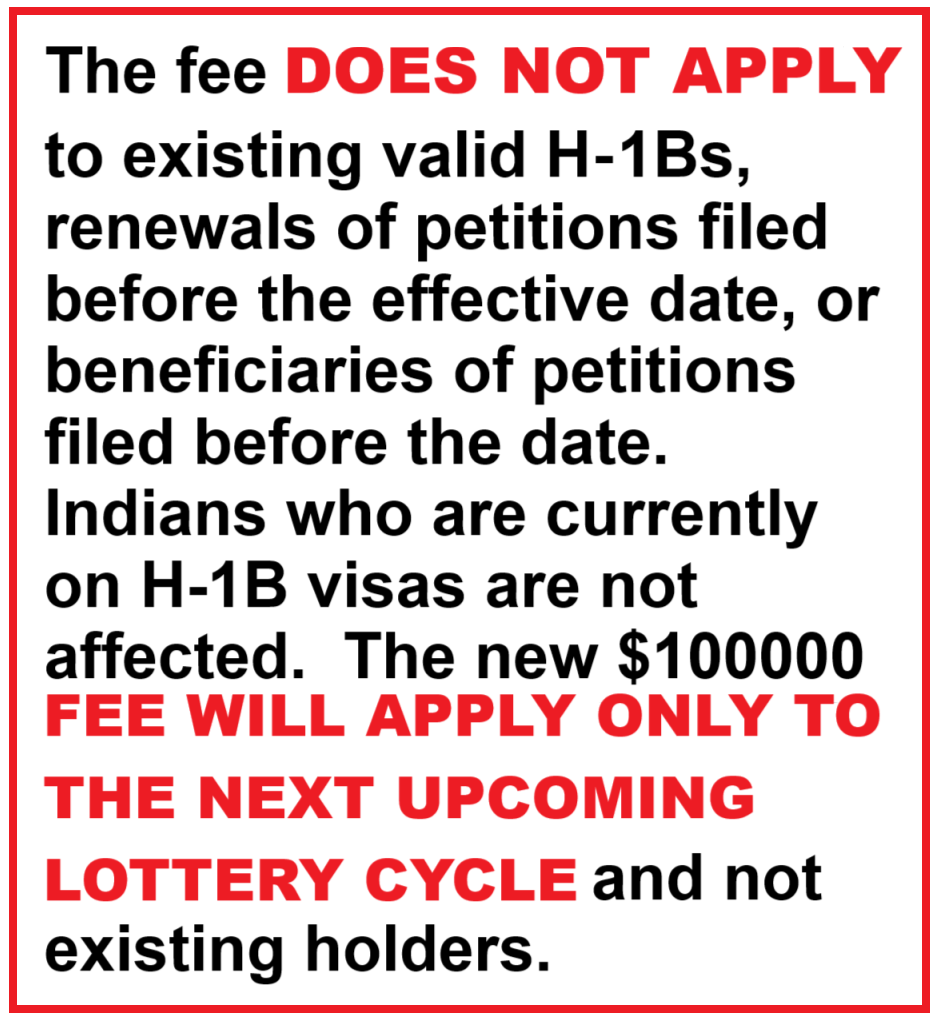
Cases are expected to be filed in the coming week. Speaking to IANS, Steve Brown, a specialist in immigration law, predicted: “There’s a lot of litigation that’s going to be coming on this. It’s going to be fought out..” He also noted that the official proclamation signed by Trump on Friday did not distinguish the existing H-1B visa holders from the new applicants. Hours later, the White House issued a clarification that the $100,000 cost for an H-1B application is a “one-time fee” that applies only to new visas. Brown described the situation in which a signed proclamation was changed by a tweet issued by the White House press secretary as “weird“. “This might be a first in administrative law,” he said
As the matter now stands, for a petition filed under the new rule, the $100,000 is paid once for that petition. If an employer files another new petition (e.g. for a different person) after, that might incur the fee again under that new petition. The fees change is supposed to last for at least 12 months, though future renewals or legislative / regulatory changes could modify or extend it.
In 2024, a United States Citizenship and Immigration Services rule increased several H‑1B‑related fees (including registration and petition filing fees). The I‑129 filing fee for H‑1B petitions went up from $460 to US$ 780 for many petitioners.
Officially, the aim is to reduce what the U.S. government describes as “systemic abuse” of the H‑1B visa program – especially by firms hiring foreign workers instead of Americans. The fee hike is part of a broader policy push emphasizing “American workers first” in high‑skill job hiring.
On the same day that President Trump issued his H-1B fee hike proclamation, the US Department of Labor announced “Project Firewall”. This is an enforcement programme to strengthen oversight and compliance in the H‑1B visa process. Under this programme, for the first time, the Secretary of Labor will personally certify the initiation of investigations into employers where there is “reasonable cause” of non‑compliance. The DOL will coordinate with U.S. Citizenship and Immigration Services (USCIS), the Equal Employment Opportunity Commission (EEOC), and the Department of Justice (DOJ) in conducting investigations.
CONCERNS:
- India’s software and services industry (Nasscom) warned of serious disruption, given many Indian firms and professionals depend on H‑1B visas. Indians make up nearly 73 per cent of all H1B visa holders
- Humanitarian: The Indian Ministry of External Affairs flagged “humanitarian consequences” due to disruption for families.
- Business continuity: Because of abrupt timing, many firms are scrambling to understand impact and consider changes (e.g. projects, onshore staffing) to adapt.
AMBIGUITIES
- How aggressively “Project Firewall” investigations will be deployed in practice—how many employers will be investigated, how “reasonable cause” is interpreted.
- Whether there will be waivers / exemptions in exceptional “national interest” cases. Some reports suggest those may exist, but details are sparse.
- How this interacts with state labor / visa laws, and how foreign nationals outside the U.S. will be affected in re‑entry, etc., though clarifications suggest existing visa holders are largely shielded.