Study in Japan 2025: Affordable Tuition, Jobs, and Residency Pathways
TL;DR
- Japan’s demographic crisis has created one of the largest opportunities for ambitious Indian students. With fertility rates at record lows and nearly one-third of its citizens over 65, Japan faces severe labor shortages across healthcare, IT, construction, logistics, hospitality, and manufacturing.
- To counter this, the government is easing enrollment caps, expanding English-taught programs, and targeting 400,000 international students by 2033. Cities like Hamamatsu already showcase successful integration, offering jobs, subsidies, and cultural outreach for foreign talent.
- For Indian students, studying in Japan means lower tuition than in the US, UK, or Canada, plus access to internships, job-seeking visas, and long-term residency options. For those ready to embrace Japanese language and culture, the country offers a career pathway few destinations can match.
In Japanese, the word for “crisis” is pronounced kiki and written like this: 危機. The first character (危) means “danger,” while the second (機) means “opportunity.”
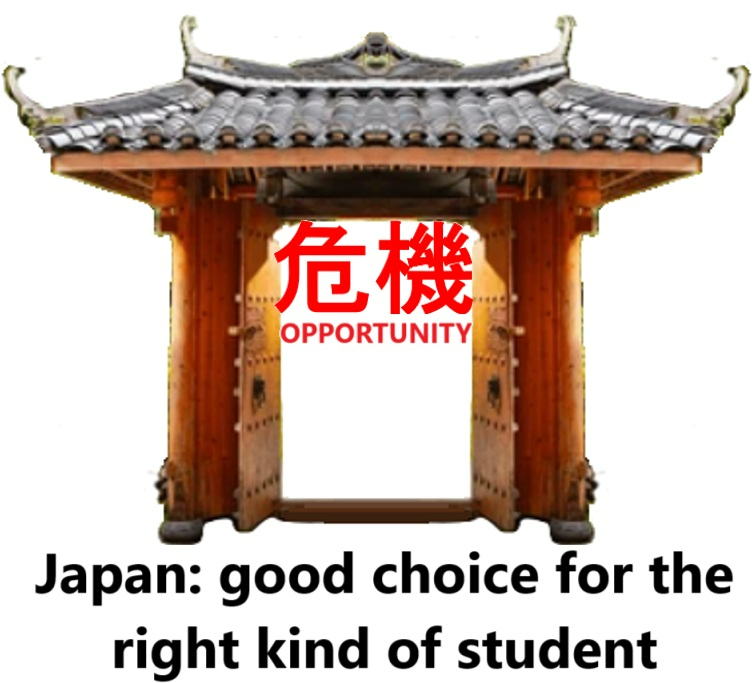
For the past decade, a crisis has been building in Japan:
- A demographic crisis, marked by historically low fertility and sharp population decline. In 2024, Japan’s total fertility rate dropped to 1.15, the lowest on record. Births fell below 700,000 for the first time (≈686,000), while deaths reached approximately 1.61 million—resulting in a net population loss of about 919,000.
- A shrinking working-age population. Over 29% of Japanese citizens are now aged 65 or older—the highest proportion in the world. The working-age population peaked at 87.3 million in 1995, dropped to 81.7 million by 2010, and is projected to fall to 70 million by 2027.
As a result, critical sectors—healthcare, IT, construction, logistics, hospitality, and manufacturing—are facing acute labor shortages.
Japan has slipped from being the world’s third-largest economy to sixth. The primary cause? A severe shortage of labor and skills. In a recent national survey, 71 percent of employers reported difficulty finding skilled workers. While Japan is responding with a mix of technological innovation, moderate immigration, and inclusive hiring, the challenges remain deep and long-term.
That’s the “danger” part. The “opportunity” part is what should catch the eye of smart, hard-working young Indians with global ambitions.
There is opportunity in just about all sectors:
- Healthcare and Nursing: Persistent and multi-layered shortage of all types of medical personnel and care-givers especially in rural regions and specialized departments. This shortage is partly on account of work-hour reforms but also reflects an “age” problem – more physicians and nurses retiring, fewer qualified young people to replace them. Rural areas are seriously underserved.
- IT / Technology: Over 40 percent of Japanese firms face severe IT talent shortages. Demand rising for AI, cybersecurity, cloud, and data skills.
- Construction / Skilled Trade: Declining workforce—many aged over 55, few younger workers.
- Logistics & Transport (Drivers): Acute truck driver shortages. “Conveyor belt road” automation projects planned to mitigate this by mid-2030s.
- Hospitality & Services: Labour shortage in restaurants (77.3 percent), hospitality (62.3 percent), and maintenance/security sectors.
- Manufacturing: This sector is expected to be short by 2.81 million workers for production processes as demand is projected to reach 8.65 million workers, while the supply is expected to be just 5.84 million. By 2040, Japan is expected to face a shortage of 600,000 university graduates with science and engineering backgrounds.
Japan is culturally cautious, nevertheless it is opening up to foreign workers—2 million by 2024, aiming for +800,000 in five years.
Are foreign workers a problem for Japan? Yes.
Why? To answer that question, compare Japan and Canada.
| Japan (like India) has one culture stretching back over 2,000 years | Multi-cultural Canada came into being in 1867. |
| Japan is monolingual. The percentage of Japanese who are fluent in English is approximately 10–30 percent, depending on the definition of “fluency” (with true conversational fluency on the lower end). | English and French are the official languages of Canada. English is a global language. Canada is a “melting pot” of many ethnicities, each bringing their own languages. |
Japan recognizes the need to bring in foreign talent to support its economy, especially as its population ages and the workforce shrinks. At the same time, it places a high value on cultural and linguistic integration.
For Indian students aspiring to earn degrees and build careers abroad, Japan offers opportunity—with “ifs”:
If they are prepared to adapt to Japanese workplace culture.
- Japanese job culture (hierarchy, group thinking, indirect communication) may be challenging to adapt to but international graduates from Japanese universities have the advantage. They learned the culture during their studies
- Japanese job culture is strongly relationship oriented. Students have time to build networks through internships, seminars, or clubs during their studies. A good network pays off in referrals and interviews
If they are committed to developing strong Japanese language skills.
- Many companies still require at least JLPT N2 level Japanese (business-level)
- Some tech companies are English-friendly (especially startups), but most companies expect functional Japanese, especially outside major cities or for customer-facing roles
Are there any “easy” entry points?
Yes. In fact, one city stands out: Hamamatsu, a city of 770,000 nestled between Tokyo and Nagoya.
- Hamamatsu is a regional hub of industry – home to Toyota and Honda, Suzuki Motor Corporation, Yamaha Corporation, Kawai Musical Instruments, Roland Corporation, and Hamamatsu Photonics. Over the past few years, it has emerged as a laboratory for diversity.
- Already the city counts around 30,000 foreigners, many of whom came in earlier waves of industrial growth. Hamamatsu has embraced foreign workers, particularly engineers and technicians from India and Brazil, as essential to its economic survival.
- The city wants to bring in a new generation of foreign qualified personnel — engineers, programmers and technicians — to fill jobs being left vacant by Japanese workers Suzuki, Yamaha, and Honda have ramped up recruitment from abroad and the city subsidises language classes and cultural outreach to help immigrants settle.
- It’s got a Sister City agreement with Ahmedabad, India, aiming to foster collaboration in urban planning, education, and sustainability and it even puts on an annual India Festival, a celebration of cross-cultural exchange. As Japan wrestles with how to deal with its shrinking population, the success in Hamamatsu might serve as a model for the rest of the nation.
Another easy entry point involves studying in Japan. International students who earn a degree in an in-demand field in Japan have an easier pathway into the Japanese job market, especially if that field is in high demand (like AI, IT, engineering, or data science).
It’s easier for international graduates in Japan’s in-demand fields because:
1. Local Education Advantage
Japanese companies strongly prefer graduates from Japanese universities over those who studied abroad—even if the person is foreign. Earning your degree in Japan shows:
- You understand Japanese academic/work culture.
- You are likely familiar with Japanese language and etiquette.
- You are already in Japan and legally permitted to seek work.
2. High Demand Fields = Easier Job Placement
Industries like AI, cloud computing, software engineering, data science, robotics, and cybersecurity have:
- Severe labor shortages
- More openness to hiring foreigners, especially those who are already in Japan
- Higher salaries and fast recruitment processes compared to traditional industries
- Especially in Tokyo, Osaka, Fukuoka, and Nagoya, many startups and tech giants are actively hiring bilingual (or even English-only) foreign tech talent.
3. Easier Visa Process for In-Demand Fields
If you graduate from a Japanese university, you’re eligible for a “Change of Status” to a working visa (e.g., Engineer/Specialist in Humanities/International Services). Fields like IT, engineering, data science fall under this visa type.
The immigration process is much smoother for those with a Japanese degree, and your job offer doesn’t necessarily need to be from a huge company—it just needs to match your field of study.
4. Job-Seeking Visa Extension
If you graduate but don’t yet have a job, you can apply for a 6–12 month “designated activities” visa to stay and look for work. Universities often support this process with documents and job fairs.
5. Career Support from Japanese Universities
Most universities offer:
- Career counseling in English and Japanese
- Job fairs specifically for international students
- Alumni networks and introductions to companies open to foreign hires
6. Japan’s Push for Foreign Skilled Workers
The Japanese government has been actively trying to:
- Attract more foreign tech workers through relaxed visa rules
- Introduce “Green Cards for Highly Skilled Foreign Professionals” (5-year path to permanent residency)
- Offer “Specified Skilled Worker (SSW)” and other programs for vocational graduates
For example, a graduate with skills in AI or big data could fast-track toward long-term residency if they meet salary and language/qualification criteria.
Policy-makers in Japan are well aware of the need to keep the country moving economically and moving ahead in the global innovation race too… but have they taken practical steps to address the needs?
Indeed they have … and here are the specifics, both at national level and university level:
National-Level Initiatives | |||
| Initiative | Timeframe | Description | Sources |
| Global 30 Project | 2009–2014 | Created “Internationalisation Hubs”; funded English-taught degree programs, scholarships, foreign faculty, and international dormitories. | https://en.wikipedia.org/wiki/Global_30_Project |
| Top Global University Project | 2014–2024 | Replaced Global 30. Type A (top-tier) and Type B (innovative) universities received funding to internationalize faculty, curriculum, and support services. | https://www.tohoku.ac.jp/en/about/top_global_university.html |
| Enrolment Cap Easing | Starting 2026 | Universities with strong records can exceed foreign student quotas (up to 110 percent)—with focus on G7, India, Southeast Asia applicants. | https://www.thestar.com.my/aseanplus/aseanplus-news/2025/07/28/japan-to-ease-overseas-student-enrolment-caps-at-universities-in-bid-to-attract-talent |
| Target: 400,000 Int’l Students | By 2033 | Japan aims to surpass its 300,000 milestone with relaxed visas (e.g., 10-year multiple entry) and improved graduate employment pathways. | https://monitor.icef.com/2025/05/foreign-enrolment-in-japan-reached-record-levels-in-2024 |
University-Level Approaches | ||
| Measure | Examples | Sources |
| English-Taught Degree Programs | – UTokyo: 24+ English-medium programs – Kyoto iUP: 4.5-year hybrid program with scholarships – Nagoya Univ.: G30 program with housing, Japanese lessons | https://www.u-tokyo.ac.jp/en/prospective-students/undergraduate_english.html |
| New Programs & Admissions Reform | – UTokyo: Launching “College of Design” (2027), ~50% international students – Osaka Metropolitan Univ.: Full fall admissions by 2027 – Kwansei Gakuin: English-only campus in Kobe by 2029 | https://www.u-tokyo.ac.jp/focus/en/articles/z1314_00002.html https://www.reddit.com/r/UTokyo/comments/1hx36da/social_lifeatmosphere_at_utokyo |
| Enhanced Student Support | – Visa, banking, and housing services through int’l offices – Meiji Global Village: International dormitory – Scholarships: UTokyo’s Global Science Course: ¥150,000/month + free housing | https://indianexpress.com/article/education/study-abroad/indian-students-can-easily-get-work-visa-in-japan-says-ambassador-hiroshi-f-suzuki-9187927/lite |
| Researcher Support | – Tuition waivers & travel aid for displaced researchers (e.g., from US policy restrictions) – offered by Osaka University and others | https://www.reuters.com/en/japan-plans-lure-us-researchers-amid-trump-crackdown-2025-06-04/ https://academicobserver.com/docs/news/2025-05-30-japanese-universities-extend-support |
| Regional University Initiatives | – Ritsumeikan APU: Bilingual campus – Tohoku University: Fully English programs + internships – Nagoya Univ.: Guaranteed housing for first-year international students | https://isami-dojo.com/ |
Additionally, as articles in the Indian press have reported, the Japanese government has asked universities in that country to open their doors to students affected by the US student visa crackdown. As geopolitical tensions and policy changes impact international education, Japan’s supporting for international students positions it as a promising hub for global learners.
YUNO LEARNING emphasises that Japan can be a fantastic opportunity for the right kind of Indian student.
What’s the “right kind”?
One who is intellectually curious and adaptable, with strong language and cultural skills, combined with psychological patience, humility, and resilience, a person who can respect social norms but also bring a fresh perspective, showing openness and persistence to thrive in a unique environment.
And Japan is especially attractive when one remembers that the cost of tuition in a public university in Japan is less than what one would pay in the USA, UK, Canada or Australia, with cost further reduced by many scholarship programmes. And even the cost of living is less – provided a student chooses a university in some place other than Tokyo.