Study Abroad 2026: Why Tech Ecosystems Matter More Than Countries
TL;DR
- The global study-abroad landscape is undergoing a fundamental shift—from choosing countries to choosing technology ecosystems.
- As artificial intelligence, robotics, and biotech reshape economies, governments are no longer competing only for students but building integrated ecosystems of universities, industry, research, and capital.
- At the same time, aging populations across Europe and East Asia are driving demand for skilled migrants, particularly in STEM fields.
- Countries like Germany, France, the Netherlands, Japan, and the UAE are positioning themselves as specialised innovation hubs, each with distinct strengths and pathways from study to work.
- For Indian students, this creates a strategic opportunity—but also a challenge. Success now depends less on destination prestige and more on aligning skills with long-term ecosystem demand.
For decades, Indian students followed a predictable countries path—primarily the US, UK, Canada, and Australia. That model is now under strain. Not because these countries have lost their appeal—but because the global system around them has changed.
Three forces are reshaping the landscape:
1. Technology is reorganising the global economy
Artificial intelligence, robotics, and biotech are not just industries—they are becoming core economic infrastructure. Governments now treat technology as:
- A strategic asset
- A national security concern
- A driver of long-term growth
As one recent global tech assessment puts it, AI, quantum, and next-gen technologies are “rewriting the rules of business.”
2. Countries are competing for ecosystems, not just talent
Earlier, countries tried to attract: Students and Skilled workers
Now they are building tech ecosystems—integrated systems where:
- Universities
- Startups
- Large companies
- Research labs
- Capital
- Government policy
All reinforce each other.
This is a crucial shift.
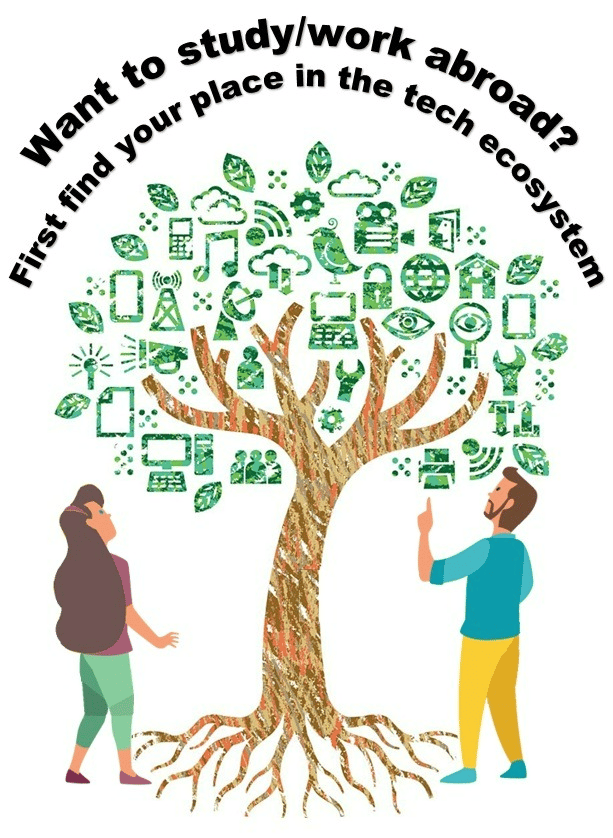
- You are no longer choosing a country.
- You are choosing an ecosystem.
3. Demographics are forcing a rethink
- Across much of Europe and East Asia, populations are aging rapidly.
- Japan already faces shrinking young workforce cohorts
- South Korea is projected to become one of the oldest societies in the world
- OECD countries overall face declining working-age populations and slower growth unless migration rises
Even broader projections show:
- Aging populations will reduce growth and strain labour markets
- Countries will increasingly need young, skilled migrants
This is where India enters the picture.
What is a “tech ecosystem”?
A tech ecosystem is not just a cluster of companies, it is a self-reinforcing loop:
Tech Ecosystem | |
Component | Role |
| Universities | Produce talent + research |
| Government | Funds + regulates + attracts |
| Industry | Creates jobs + applies innovation |
| Capital | Funds startups and scaling |
| Infrastructure | Labs, data centres, networks |
| Talent flows | Students → workers → founders |
When this loop works well, it creates:
- Faster innovation
- Better jobs
- Global competitiveness
The New Geography of Innovation (outside Anglo countries)
Different countries are building distinct ecosystem models.
EUROPE: Strategic autonomy + talent attraction
Europe’s push is driven by a clear fear: falling behind the US and China in critical technologies.
This has led to a strong policy pivot toward:
- Strategic autonomy
- Domestic tech capacity
- Attracting global talent
France
France — The “state-orchestrated AI ecosystem”. France is perhaps Europe’s most aggressive builder.
Model:
- Heavy state involvement
- AI-first strategy
- Integration of academia + startups
Why it matters:
- Public investment + policy coordination
- Deliberate effort to attract international students (including Indians)
Ecosystem focus:
- AI
- Health-tech
- Climate + energy systems
France is trying to become Europe’s AI nerve centre.
Germany
Germany — Industrial + applied tech ecosystem. Germany is not chasing hype—it is upgrading its core strength: Engineering.
Model:
- Industry-academia integration
- Applied research
- Manufacturing + AI convergence
Ecosystem focus:
- Robotics
- Automotive tech
- Industrial AI
- Physics and Engineering
Germany’s advantage: real-world deployment, not just research.
Netherlands
Netherlands — Precision niche ecosystems. Small country, highly targeted strategy.
Model:
- Specialised research hubs
- Strong public funding
- Global collaboration
Ecosystem focus:
- Agriculture tech
- Water systems
- Defence + Energy AI
The Netherlands wants high-quality, selective innovation.
Spain
Spain — Infrastructure-led ecosystem
Spain is investing heavily in:
- Data centres
- Cloud infrastructure
- AI back-end systems
Spain is creating downstream jobs and research opportunities.
Europe’s demographic driver
Europe’s challenge is stark:
- Aging workforce
- Slowing productivity
- Labour shortages
These trends are already expected to reduce economic growth unless migration increases
Translation: Europe will increasingly need young, skilled migrants.
For Indian students: Europe is becoming structurally dependent on external talent.
EAST ASIA: Technology as survival strategy
Unlike Europe, East Asia’s motivation is more urgent: Demographic collapse + geopolitical competition
Japan
Japan — Automation-driven ecosystem. Japan has long faced:
- Labour shortages
- Aging population
It responded by:
- Investing in robotics
- Pushing advanced manufacturing
- Leading in medical technology
Key insight: Japan already has more jobs than workers in some sectors
Result:
- Heavy automation
- Growing need for skilled foreign talent
South Korea
South Korea — High-intensity innovation system. South Korea combines:
- Strong state planning
- Massive R&D spending
- Corporate dominance (Samsung, etc.)
It ranks among the most innovative countries globally. BUT:
- Fertility collapse
- Rapid aging
- Shrinking workforce
By mid-century, the population could decline sharply
Singapore
Singapore — Hyper-engineered ecosystem. Singapore is unique.
Model:
- Top-down planning
- Global talent attraction
- Tight university-industry links
Focus:
- AI
- Biotech
- Finance tech
- Quantum computing
It is arguably the most efficient ecosystem per square kilometre.
China
China — Scale-driven ecosystem. China’s approach is different:
- Massive state investment
- Rapid deployment
- Integration of tech + manufacturing
It operates at scale unmatched globally. BUT:
- Political constraints
- Language barriers limit accessibility for many international students.
EAST Asia’s demographic reality
North Asia’s population is aging rapidly. Average age rising sharply toward ~48 by 2030
This creates:
- Labour shortages
- Demand for automation
- Need for skilled migrants
MIDDLE EAST: Capital-led ecosystem building
The Gulf is the fastest-moving new entrant.
United Arab Emirates
UAE — Talent-importing innovation hub
Model:
- Import talent
- Build infrastructure
- Create global partnerships
Focus:
- AI
- Smart cities
- Climate tech
Advantage:
- Fast execution
- Low bureaucracy
Saudi Arabia
Saudi Arabia — Mega-project ecosystem
Driven by Vision 2040:
- Huge investment in tech + infrastructure
- New research universities
- Smart city projects
Still developing academically—but financial scale is enormous.
Israel
- Israel is often called the “Start-up Nation.”
- ~5% of GDP in R&D
- Dense network of startups + global R&D centres
But even Israel faces:
- Shortage of tech workers
- Increasing reliance on global talent pools
Emerging ecosystems (longer-term bets)
Latin America
Countries like:
- Brazil
- Chile
- Mexico
Are building AI ecosystems based on:
- Infrastructure
- Education
- Startup funding
Central Asia & Africa
Examples:
- Uzbekistan (IT parks)
- Ethiopia (digital strategy)
Early-stage but directionally important.
The deeper logic: Why countries are pivoting
1. Technology = economic survival
AI and automation are not optional. They are needed to:
- Offset labour shortages
- Maintain productivity
- Stay globally competitive
2. Demographics are forcing openness
Countries that historically resisted immigration are now facing:
- Shrinking workforce
- Rising dependency ratios
- Slower growth
OECD projections show:
- Working-age populations falling
- Dependency ratios rising sharply
3. Ecosystems need continuous talent inflow
Even advanced countries face:
- Skill shortages in AI, data science, engineering
- Mismatch between education and industry
OECD highlights growing demand for AI-skilled workers across sectors
4. Immigration is becoming strategic, not open-ended
This is crucial:
Countries are not saying: “Come if you want”
They are saying: “Come if you fit our ecosystem needs”
Where Indian students fit into this
India has a structural advantage:
- Young population
- Large STEM talent pool
- English proficiency
In contrast:
- Europe → aging
- Japan/Korea → shrinking
- Gulf → small native population
This creates a natural complementarity.
But there’s a catch
❌Countries don’t want:
- Generic degrees
- Low-skilled migration
✔They want:
- AI engineers
- Researchers
- Domain specialists
What this means in practical terms
1. Choose ecosystems, not just countries
Instead of asking: “Where should I study?”
Ask: “Which ecosystem matches my field?”
2. Align with demographic demand
Countries with:
- Aging populations
- Labour shortages
Are more likely to:
- Open migration channels
- Retain skilled graduates
3. Focus on high-value fields
Globally in demand:
- AI / data science
- Robotics
- Biotech
- Climate tech
- Advanced engineering
4. Expect selective openness
The future is not: Open migration
It is: Targeted migration
Final insight (the one most students miss)
The global system is shifting from: “Education market” to “Talent supply chains”
Countries are:
- Building ecosystems
- Forecasting skill needs
- Aligning immigration with labour demand
Bottom line
- The centre of gravity in global education is shifting
- Innovation is becoming multi-polar
- Demographics are forcing countries to seek external talent
- For Indian students, this is not a barrier.
- It is an opportunity—but only if approached strategically.
YUNO LEARNING’S blunt conclusion
The question is no longer:
“Which country is best?”
The real question is:
“Which ecosystem will need me—and reward me—5 to 10 years from now?”