Study Abroad 2026: Canada, US Tighten Rules as New Destinations Rise
TL;DR
- The global study-abroad landscape is undergoing a significant shift in 2026 as traditional destinations tighten policies and new options emerge.
- Canada has raised financial proof requirements, making student visas more expensive and restrictive, while the United States has introduced stricter scrutiny, including social media vetting and longer processing times. These changes are prompting Indian students to reconsider their choices, leading to declining enrolments in Canada and the UK.
- At the same time, countries like Germany, Italy, the UAE, and Uzbekistan are gaining popularity for their affordability and clearer pathways. Meanwhile, Chile is positioning itself as a rising tech-driven education hub, attracting STEM students with strong industry links and career opportunities.
Tighter visa regimes, rising costs, policy unpredictability and intensifying competition are pushing Indian students beyond the familiar quartet of the United States, the United Kingdom, Canada and Australia. In response, New Zealand, Ireland, Germany and France have emerged as preferred alternatives. But rising application volumes and increasingly selective outcomes suggest that even these “second-line” destinations are approaching saturation.
For students planning for 2027 and beyond, the next shift is already underway. A cluster of countries in Southern and Eastern Europe—along with a few smaller, specialised systems—is quietly positioning itself as a credible alternative. These destinations are less aggressively marketed and demand more informed choices. In return, they offer a combination that is becoming harder to secure elsewhere: strong academic programmes, manageable costs and realistic—if sometimes understated—pathways into the workforce.
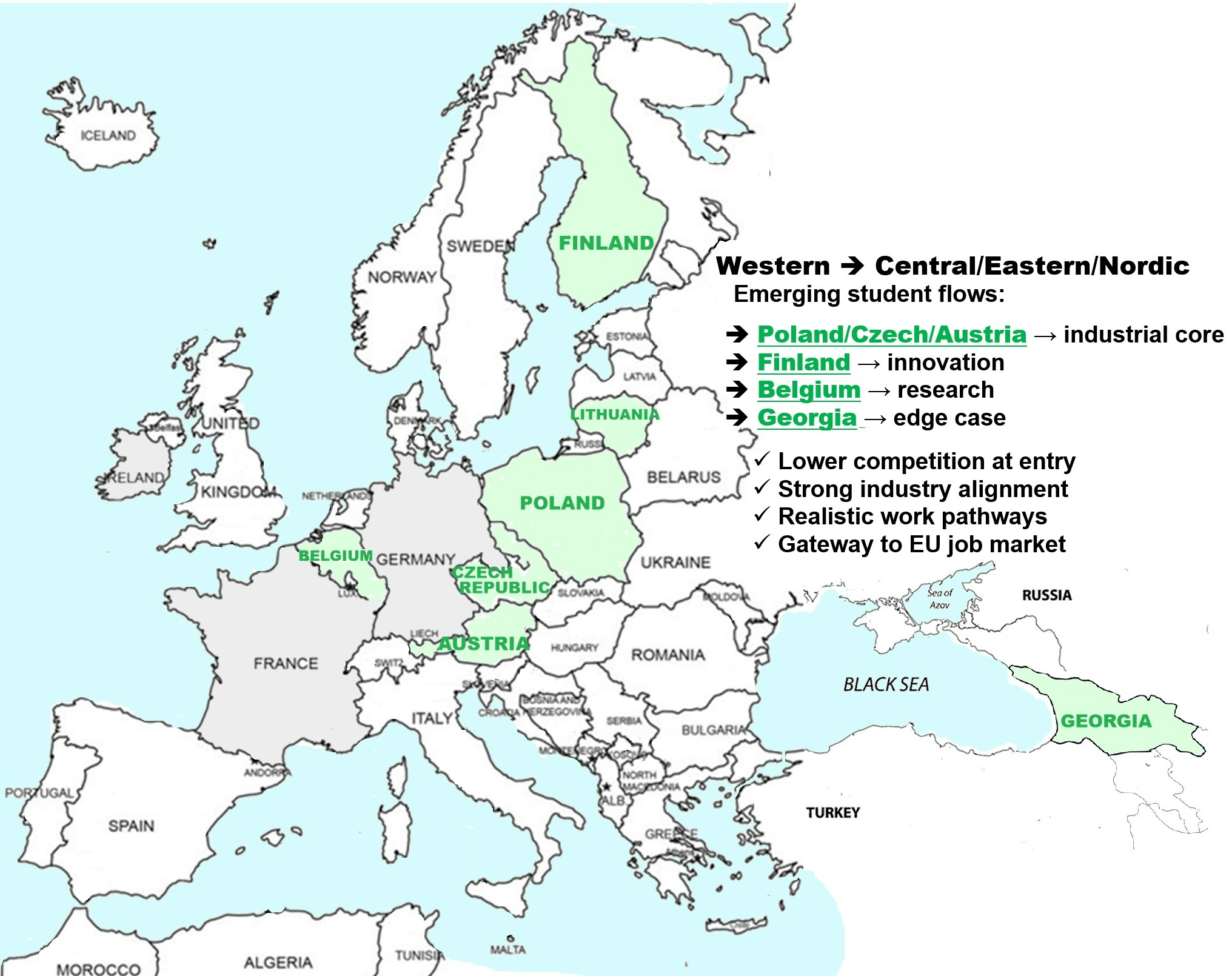
The next wave of study-abroad destinations is not being advertised loudly—but it is already taking shape.
This guide examines these under-discussed options, focusing on specific universities, areas of academic strength, and the question that now shapes every decision: what happens after graduation?
The New Logic: From Study to Work to Stay
To understand why these destinations matter, one structural shift needs to be recognised.
Across Europe, demographic decline and labour shortages are forcing governments to rethink international education. The traditional model—educate and send students home—is giving way to a more pragmatic approach: retain skilled graduates where possible.
Unlike some countries that advertise this openly, many Southern and Eastern European systems are doing so quietly. The signals are not loudly promoted, but they are unmistakable:
- Expansion of English-taught programmes
- Simplified post-study residence pathways
- Closer alignment between universities and labour market needs.
The result is a landscape where opportunity exists—but must be read carefully.
Austria: Precision Engineering and Research Depth
Austria is rarely a headline destination, yet it sits firmly within Europe’s academic core. Institutions such as TU Wien and Graz University of Technology are well-regarded in engineering and applied sciences, while the University of Vienna remains a major centre for fundamental research.
Strength areas:
- Mechanical and industrial engineering
- Energy systems (including hydropower and renewables)
- Physics, chemistry, and life sciences
Austria’s strength lies in its integration with the broader Central European industrial ecosystem, particularly in engineering and manufacturing.
Work opportunities:
Graduates can extend their stay to seek employment and transition into the country’s skilled migration system (notably the Red-White-Red Card framework). The pathway is viable, especially for STEM graduates.
Big hurdle:
The challenge is not language—it is labour market structure. Austria’s job market is relatively small and network-driven. Students without internships or industry exposure during their degree may find the transition slower than expected.
Czech Republic: Industrial Strength Without the Price Tag
The Czech Republic offers one of the most practical combinations in Europe: strong engineering education, relatively low costs, and a functioning industrial base.
Leading institutions include Czech Technical University in Prague and Brno University of Technology, both known for producing industry-ready graduates. Charles University adds depth in medicine and natural sciences.
Strength areas:
- Automotive engineering
- Robotics and automation
- Civil and structural engineering
- Medicine and applied sciences
The country’s manufacturing ecosystem—linked to European supply chains—creates real demand for technical graduates.
Work opportunities:
Graduates typically receive a post-study window (around nine months) to secure employment, after which residence permits can be extended.
Big hurdle:
The system is efficient but not heavily internationalised. Students need to be proactive in finding internships and building industry connections early. Those who treat it as a purely academic exercise may struggle to convert it into employment.
Poland: The Emerging Industrial Powerhouse
Poland may be the most consequential “under-the-radar” destination today. Its rapid economic growth, expanding manufacturing base, and integration into European industry have created sustained demand for engineers, IT professionals, and applied scientists.
Key institutions include Warsaw University of Technology and AGH University of Krakow. The latter is particularly notable for specialised fields such as mining engineering, petroleum engineering, and metallurgy. Jagiellonian University is a major centre for medicine and life sciences.
Strength areas:
- Mechanical and industrial engineering
- Mining, energy, and metallurgy
- Information technology
- Medicine and biomedical sciences
Work opportunities:
Poland’s labour market is expanding, and international graduates can transition from student status to employment-based residence permits. The process is not always fast, but it is increasingly routine.
Big hurdle:
Poland’s system is still evolving. Administrative processes can be uneven, and students must be prepared for some bureaucratic friction. Those expecting a highly streamlined experience may find it frustrating.
Lithuania: Small Country, Sharp Focus
Lithuania represents a different model: small scale, but highly targeted. The country is positioning itself as a digital and innovation hub, with a particular focus on attracting international talent in technology fields.
Institutions such as Vilnius University and Kaunas University of Technology are central to this strategy.
Strength areas:
- Data science and artificial intelligence
- Cybersecurity
- Electronics and digital systems
- Fintech
Work opportunities:
Lithuania has been simplifying residence and work pathways for graduates, and its startup ecosystem—though small—is dynamic and internationally connected.
Big hurdle:
The limitation is scale. The economy is small, and job volumes are limited. Students must be highly targeted in their field and often willing to move within the EU after graduation.
Belgium: Europe’s Research Engine
Belgium rarely features in student discussions, yet it is one of Europe’s most important research hubs. With the European Union’s institutional presence and strong industry links, it offers significant opportunities—particularly in science and engineering. Leading universities include KU Leuven and Ghent University.
Strength areas:
- Biotechnology and life sciences
- Chemical engineering
- Nanotechnology and materials science
- Public policy and international relations
Work opportunities:
Graduates typically receive a one-year window to find employment, and many programmes are closely linked to research projects and industry collaborations.
Big hurdle:
Belgium is competitive and research-driven. Students aiming here need a strong academic profile and clarity of purpose. It is not a generalist destination.
Finland: Innovation, Technology and a Clear Stay Path
Finland offers a compelling combination of high-quality education and a transparent post-study pathway—making it one of the more structurally coherent options in Europe today.
Universities such as University of Helsinki and Aalto University are well regarded, particularly in technology, design, and applied sciences.
Strength areas:
- Information technology and artificial intelligence
- Clean energy and sustainability
- Design and innovation
- Education and learning sciences
Finland’s education system is closely linked to its innovation-driven economy, with strong emphasis on research, startups, and industry collaboration.
Work opportunities:
Graduates can apply for a two-year post-study residence permit to seek employment—one of the more generous windows in Europe. The country has been actively encouraging international graduates to remain and integrate into the workforce.
Big hurdle:
Finland’s labour market is relatively small and highly structured. While opportunities exist, particularly in technology sectors, competition can be strong and hiring processes can be slow. Students need to engage early with internships, projects, and local networks to convert education into employment.
Georgia: Low Cost, Limited Ecosystem
Georgia has gained visibility in recent years, particularly for medical programmes that attract international students.
Strength areas:
- Medicine (MBBS-equivalent degrees)
- Basic sciences
Work opportunities:
Recent policy changes are introducing more formal work permit systems, but the employment market remains limited.
Big hurdle:
The issue is not entry—it is exit. Students often need to move to another country for career progression after graduation.
A Pattern Emerges
Step back, and a pattern begins to take shape.
1. Industry alignment matters more than branding
Countries such as Poland, Finland and the Czech Republic may not have the global name recognition of traditional destinations, but they offer something increasingly valuable: direct links to functioning industrial ecosystems.
2. Smaller countries are specializing
Lithuania (digital technology), Belgium (biotech), and Austria (engineering) are not trying to compete across all fields. They are building strength in specific areas.
3. Elite vs scalable systems
Belgium represents the elite end—world-class but limited. Poland and the Czech Republic represent scalable systems with broader access.
4. Policy is often implicit rather than advertised
Unlike more visible destinations, many of these countries are not loudly promoting post-study pathways. Yet the underlying direction—retain skilled graduates—is evident.
What This Means for Indian Students (2027 Planning)
For students willing to look beyond familiar names, these destinations offer a different kind of opportunity:
- Lower competition at the entry stage
- Strong alignment with labour shortages
- Access to the wider European job market
This opens a narrow but real window of opportunity. But they demand a different approach.
Students must:
- Choose field first, country second
- Prioritise internships and industry exposure during study
- Be prepared to navigate less standardised systems
- A Practical Shortlist
For clarity, here is a simplified guide:
Engineering and industrial careers:
- Poland (Warsaw University of Technology, AGH University of Krakow)
- Czech Republic (Czech Technical University, Brno University of Technology)
- Austria (TU Wien, Graz University of Technology)
Science and research:
- Belgium (KU Leuven, Ghent University)
- Finland (University of Helsinki, Aalto University)
Technology and digital fields:
Lithuania (Vilnius University, Kaunas University of Technology)
Low-cost entry routes (with caution):
Georgia
Here’s how YUNO LEARNING sees it …
- The geography of study abroad is no longer defined by a handful of English-speaking countries, nor is it limited to the next tier that has already begun to fill up.
- A quieter shift is underway—driven not by marketing, but by economic necessity. Countries that need skilled workers are beginning to shape their education systems accordingly. For Indian students planning for 2027, this creates a window of opportunity—but not a uniform one.
- One reality, however, must be clearly understood. Even where programmes are offered in English, students who intend to move from study to work to stay will need to acquire reasonable fluency in the local language. Full participation in the labour market—and in society more broadly—depends on it.
- This should not be seen as a deterrent. Most Indian students are already multilingual, often navigating two or three languages in daily life. Adding one more, in pursuit of a long-term goal, is a manageable extension rather than a fundamental barrier.
- These destinations reward informed, strategic choices. Those who approach them with clarity—about their field, their career goals, and the realities of each system—are likely to find pathways that are both academically strong and professionally viable.
- Those who continue to choose the country first, and the course later, may find that the map has changed without them.