Is the Future of the UK’s Graduate Route Visa Uncertain?
Excerpt:
The Graduate Route Visa has emerged as an appealing option for students seeking better opportunities for study abroad in the UK. However, the UK’s deeply divided political climate threatens student mobility. Opponents have already made some headway.
Starting January 1, 2024:
Foreign students pursuing master’s degrees in the UK will no longer be allowed to bring family members with them.
The cost of a student visa has been hiked by 35 percent.
As of February 6, 2024, the annual surcharge for students using the National Health Service has increased from £440 to £776.
The immigration health surcharge for those on the Graduate Route has also risen, from £624 to £1,035.
In March 2024, a committee was established to conduct a swift review of the Graduate Route, specifically to identify any abuse of the scheme. To the vast relief of the universities, industry leaders and foreign students, the committee found no evidence that the system was being abused, or undermining the integrity and quality of UK higher education and it recommended that the Graduate Route visa programme continue without change.
Despite the above findings, the future of the graduate route visa’s future is unsure at the moment.
This article neither supports nor opposes any of the political parties mentioned. It explains why Graduate Route visas are being questioned. It is an important read for students who want to apply for this visa and agencies involved in the study abroad business.
Full Article:
Britain’s Conservative Prime Minister, Rishi Sunak, has so far refused to set a date for the country’s general election, but, as per law, it must be held sometime before January 28, 2025. Labour, the main opposition party, has scored double-digit leads in most opinion polls conducted in 2023 and so far in 2024, but Sunak’s biggest challenge comes from his own divided party, which is beset by resignations and a mutiny over immigration. The so-called “five families” within the Conservative Party say “Anyone But Sunak“. Conservative outcry has intensified since December, 2023, when official data revealed net migration reached a record 745,000 in 2022. The “immigration threat” is the right-wing’s weapon in the bid to oust Sunak and they want him out even if it weakens the party as it heads into the next general election.
UK political scene: See After 14 years in power, Britain’s Conservatives fear the misery of opposition in Politico, 2024 March 1. https://www.politico.eu/article/united-kingdom-conservatives-opposition-general-election/
What do Sunak’s troubles have to do with a student from India who would like to pursue a post-graduate degree in a UK university?
Everything.
It is a classic case of Political Is Personal. The mere fact that nearly 680,000 foreign students are in the UK (up from 469,000 in 2018) is defined as “peril” by the right wing.
The issue is presently crystallised around foreign students who hope to get a “Graduate Route” visa.
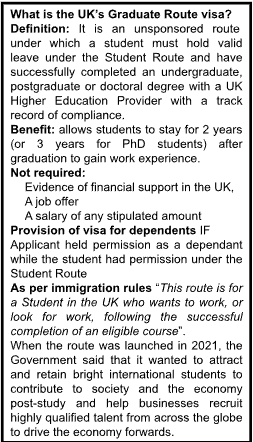
Between 2021 and 2023 the UK granted 89,200 Graduate Route visas to Indian students, four countries — India, Nigeria, China and Pakistan – account for 70 percent of all graduate visas and of this, 42 per cent go to Indian students. In 2023, a total of 114,000 graduate route visas were issued.
The right-wing Conservatives have pounced on foreign students and particularly the Graduate Route visas, claiming that they are a back door to migration and allow people to come and work in the gig economy on very low wages, to the detriment of British workers. Foreign students are also targeted because the quickest and easiest way to cut net migration is to slash the numbers of overseas students.
The ultra-Conservatives have already succeeded in a limited way: as of January 1, 2024, foreign students coming to the UK for masters degrees may not bring family members with them. In addition, the cost of a student visa has doubled and, as of Feb 6, 2024, the annual surcharge that students must pay to use the National Health Service, has been hiked from £440 to £776, with the immigration health surcharge for those on the Graduate Route rising from £624 to £1,035.
Last year, a rightwing Home Secretary (later sacked) tried – and failed — to cut the length of the post-study work route from two years to six months.
On March 11, the UK’s Home Secretary James Cleverly, asked an independent committee — the Migration Advisory Committee, chaired by Professor Brian Bell – to carry out a speedy review of the Graduate Route and specifically to look for any abuse of the scheme. This set off alarm bells for higher education stakeholders who saw it as yet another attempt to crack down on international student recruitment to British universities.
The move naturally shook foreign students with British degree dreams. But then they discovered that they have two powerful allies in the struggle to preserve Graduate Route visas.
The first is UK higher education itself. The UK’s colleges and universities — from the most prestigious to the most humble — are deeply disturbed by the Conservative attack and are vigorously campaigning to refute right-wing misinformation about Graduate Route visas. The institutions have good reason to be worried. Universities are reporting a steep drop in international students applying to come to the UK and if the decline continues it will impact the financial sustainability of universities, triggering course closures and staff reductions.
According to a report in The Guardian:
Restrictions on international students imposed earlier this year may already have caused a decline in students applying from overseas, and uncertainty over the fate of the graduate visa appears to have set off a further fall, according to a survey of UK universities.
The poll of 75 institutions by the British Universities’ International Liaison Association found that nine out of 10 had fewer international applications for the next academic year, and there had been a 27% fall in total applications for taught postgraduate courses compared with last year.
British colleges and universities are fully aware that they are in competition for foreign students with universities in other countries. If the other countries offer opportunities to remain for a few years in order to gain work experience and Britain does not, then British institutions are seriously handicapped. Foreign students plainly say that work experience opportunities strongly influence their choice when they seek admission abroad.
The second ally is British business and industry – particularly enterprises that involve IT, software and computer services. In a joint letter to a Migration Advisory Committee, two organisations, Universities UK and Creative UK, argued that international graduates are integral to the creative industries, which are now more significant than the UK’s aerospace, life sciences and automotive industries combined. The letter stated that “Following further increases to visa fees and salary thresholds, the graduate visa represents one of the few routes left which enables talented graduates to remain in the UK and contribute to our growing creative industries. “
On May 14, the Migration Advisory Committee released its report on the impact of the Graduate Route visa.
See the full official report: https://assets.publishing.service.gov.uk/media/6641e1fbbd01f5ed32793992/MAC+Rapid+Review+of+Graduate+Route.pdf
To the vast relief of the universities, industry leaders and foreign students, the committee found no evidence that the system was being abused, or undermining the integrity and quality of UK higher education and it recommended that the Graduate Route visa programme continue without change.
The report is now before Prime Minister Sunak and he will have to make a decision on the future of Graduate Route visas in the coming weeks. Will he appease his party’s right-wingers in an attempt to save his political skin or will he set a higher priority on the survival of British colleges and universities?
The fight is far from over.