Is Ireland Still Worth It for Indian Students? New Rules Explained Clearly
TL;DR
- Ireland remains a popular study destination for Indian students, but its student visa and immigration framework is evolving rapidly. Under the Government’s 2025–2028 strategy, Ireland is introducing stricter quality assurance through TrustEd Ireland, which will replace the long-standing ILEP list by late 2026.
- Only approved institutions will be allowed to recruit non-EEA students, making course verification critical. Financial requirements have already increased, with applicants now required to show €10,000 in genuine, accessible funds, carefully scrutinised by visa officers.
- At the same time, Ireland is reviewing English-language student visas, which may lead to tighter eligibility or caps.
YUNO LEARNING explains how Indian students can plan early, avoid risky shortcuts, and choose recognised programmes that preserve work rights, post-study options, and long-term career outcomes through 2026–27.
Ireland is a popular destination for international students from India, offering English-medium education, strong post-study work rights, a welcoming multicultural environment, and vibrant industry links. However, the Irish Government is actively reforming its immigration and international education policies, and many of the changes being discussed or implemented now will directly affect Indian students planning to start in Fall 2026 and in 2027. YUNO LEARNING breaks down those developments, explains what they mean for students, and how to prepare.
The Irish Government 2025–2028 Strategy
In November 2025, the Department of Justice, Home Affairs and Migration published the Statement of Strategy 2025–2028, outlining Ireland’s strategic goals for immigration over the next three years, including a “fair and firm immigration system”. This roadmap sets the backdrop for changes to visa procedures, quality assurance, and student immigration policy.
Although this strategy does not yet contain specific laws targeting international students, it signals a broader plan to modernise and tighten immigration regulation, manage migration flows more strategically, and integrate digital systems — all of which will influence how student visas, work rights, and compliance are handled in 2026–2027.
Quality Assurance Reforms: TrustEd Ireland & the End of ILEP
Ireland is transitioning from the Interim List of Eligible Programmes (ILEP) to a new statutory quality assurance framework branded TrustEd Ireland — backed by Quality and Qualifications Ireland (QQI). ILEP has been the primary list of courses eligible for student immigration permission. From June 2025, Ireland published its final ILEP update, and no further programmes can be added after that.
TrustEd Ireland won’t immediately replace ILEP for all providers, but once ILEP is phased out (expected by end of 2026), only institutions with TrustEd Ireland authorisation can recruit non-EEA students (i.e., Indian applicants).
Timeline to watch | |
| What | Date / Phase |
| ILEP final update published | June 2025 |
| TrustEd Ireland application windows and phase-in | 2025–2026 |
| ILEP expected to be fully phased out | Late 2026 (approx.) |
What QQI means for Indian applicants
University and postgraduate courses:
Generally safe as most universities have long been on eligible lists, but you must verify the programme is either already covered by ILEP or the institution is authorised for TrustEd Ireland ahead of when you apply.
Shorter courses / language schools:
Only those approved under TrustEd Ireland will be able to accept non-EEA students after ILEP sunsets — meaning that some smaller private providers may no longer host Indian students as freely as before.
Action tip:
Before applying, confirm with your institution that it will be eligible under TrustEd Ireland by the time you intend to enroll.
Financial Requirement Changes (Already in Effect)
From 30 June 2025, Ireland tightened the minimum proof of available funds required from all international students (both visa-required and non-visa-required). These amounts must be genuinely accessible, evidenced by bank statements, and clearly in your control at the time of application. Under the updated rules:
| Full-year course | €10,000 |
| 6 month course | approx. €4,998 |
| 8 month course | approx. €6,665 |
| * Student must show genuine, readily available funds. | |
Visa officers often scrutinise the source and stability of funds — large lump deposits shortly before application can lead to refusal. Indian students need to plan well in advance so that their financial documents reflect consistent savings at the required levels before they apply (not last minute deposits just prior to filing).
These financial requirement changes apply to all intakes from mid-2025 onward (so 2026 and 2027 applicants must comply). No official revision has been announced yet, but the Government may review this in 2026 if cost-of-living projections change.
What NOT to do | |
| ❌ | Don’t rely on temporary or unverifiable funds; |
| ❌ | Don’t show hidden or unexplained large deposits; |
| ❌ | Don’t ignore this requirement in pre-visa guidance. |
English-Language Student Visa Review: Potential Cuts or Caps
In late November 2025, the Irish Government publicly acknowledged that it is reviewing its English-language student visa regime, with an intention to possibly reduce the number of visas issued to students attending English language schools.
Ministers expressed concern that some students entering on short English-language courses are using these visas to access Ireland as a pathway to work rather than genuine study — a phenomenon sometimes called the “back-door” to employment. Authorities have suggested this may lead to a quality-based, lower-volume system, tightening eligibility or reducing numbers overall.
| Timeline & process* | |
| Stage | Expected Timing |
| Initial review & consultation | Early 2026 |
| Draft proposals (quality criteria/caps) | Mid-2026 |
| Public/industry consultation | Late 2026 |
| Possible legislative/regulatory changes | 2026–2027 |
| * These are approximate phases based on how policy reviews usually proceed and statements from officials; nothing definitive has yet been enacted. | |
Possible consequences for Indian students:
Short pre-masters and language courses could be more restricted, especially if new quality criteria or volume caps are instituted.
Some applicants may face additional documentation requirements, higher academic or genuine intent thresholds, or even limits on how many English course visas are approved annually.
| Would-be applicants need to | |
| ✔ | Apply early to well-established, recognised universities and programmes. |
| ✔ | Prioritise full-degree programmes over short English-language routes if the goal is long-term study and career progression. |
| ✔ | Stay updated with official announcements in early 2026 about draft proposals. |
While no formal proposals have been announced as of late 2025, the Government’s broader immigration strategy emphasises economic contributions and filling skills gaps. Thus, work provisions aimed at truly qualified graduates are expected to remain strong — though changes to employment permit thresholds (e.g., minimum salaries) could affect the job market for graduates. (policy discussions as part of wider employment permits review are expected in 2026)
| What a student needs to do | |
| ✔ | Plan courses and job search to align with career goals and sectors where Ireland has demand. |
| ✔ | Understand employment permit criteria (e.g., Critical Skills Employment Permit) — these often change but provide a direct transition from post-study work to professional work. |
| ✔ | If the aim is to settle longer term, make sure the course qualifies for Stamp 1G. |
Here’s what the Government of Ireland currently allows:
| Work Rights & Post-Study Stay* | |
| Stamp 1G (Third Level Graduate Scheme) | |
| Current Position (2026–2027) | Maximum permitted months stay |
| Level 8 (bachelor’s) graduates | 12 |
| Level 9 (master’s)/PhD graduates | 24 |
| Stamp 2* (Irish student permission) | |
| Work Type | Maximum permitted hours per week |
| Part-time work during term | 20 |
| Designated holiday periods | 40 |
Proposed EU Migration Pact Alignment & Irish Law Reforms
The Government’s 2025–2028 strategy mentions full implementation of aspects of the EU Migration and Asylum Pact, which is expected to be operative mid-2026 (including enhanced border procedures and data systems).
Although these reforms focus primarily on asylum and international protection, the broader digitalisation and system changes could impact visa processing, data-sharing, and entry/exit systems — potentially leading to more rigorous identity and biometric checks.
| Be prepared | |
| ✔ | Expect more online and digitalised visa application and IRP processes. |
| ✔ | Ensure all documentation is accurate and updated well before submission. |
Action Plan for 2026 & 2027 Intakes
For would-be international students in Ireland, here’s how to proceed:
| Roadmap | |
| Before Applying (Best Practices) | |
| 1. | Choose the Right Programme |
| Target providers with established eligibility under ILEP or TrustEd Ireland authorisation. | |
| Confirm the programme’s eligibility with the institution directly (ask for written confirmation). | |
| 2. | Financial Proof |
| Save and maintain funds consistently — don’t rely on last-minute large deposits. | |
| Prepare bank statements for at least 6 months showing stable funds. | |
| 3. | Apply Early |
| Apply to universities and for visas well ahead of deadlines (3–4 months minimum). | |
| Keep tutorials and supplementary documents ready (SOP, transcripts, English tests). | |
| 4. | Avoid Shortcuts |
| ❌ Don’t choose unrecognised providers that lack TrustEd Ireland eligibility. | |
| ❌ Don’t underestimate financial documentation work. | |
| ❌ Don’t delay visa applications until the last minute. | |
| After Offer, Before Visa Application | |
| 1. | Secure Visa Appointment |
| Use VFS or the Ireland visa application centre in India early. | |
| Aim for a March–April visa appointment for a September intake to avoid delays. | |
| 2. | Monitor Policy News |
| Early 2026: Expect draft English-language visa review proposals. | |
| Mid-2026: TrustEd Ireland transition outcomes. | |
| 3. | Prepare for Interviews |
| Some consulates may call for interviews or submit additional documents. | |
| After Arrival in Ireland | |
| 1. | Register for IRP |
| Attend your Irish Residence Permit (IRP) appointment ASAP after arrival. | |
| Bring financial, accommodation, and programme evidence. | |
| 2. | Know Your Work Rights |
| Understand Stamp 2 conditions and holiday rules before taking employment. | |
| 3. | Plan Your Graduate Route Early |
| Research the Third Level Graduate Scheme (Stamp 1G) early to align job search with deadlines. | |
Do NOT | |
| ❌ | Relying on short English-language course visas without confirming long-term implications (English visa review ongoing). |
| ❌ | Apply to institutions not clearly approved under TrustEd Ireland post-2026. |
| ❌ | Show insufficient or unexplained finances. |
| ❌ | Apply for a visa at the last-minute |
| Key Dates & Timelines | |
| Event / Policy | Likely Timespan |
| TrustEd Ireland fully replaces ILEP | End of 2026 |
| English-language visa review consultations | Early to mid 2026 |
| Policy proposals on visa volume/quality | Mid to late 2026 |
| Potential regulatory changes enacted | 2026–2027 |
| EU Migration Pact implementation affecting processing | From mid 2026 |
Choosing where to study
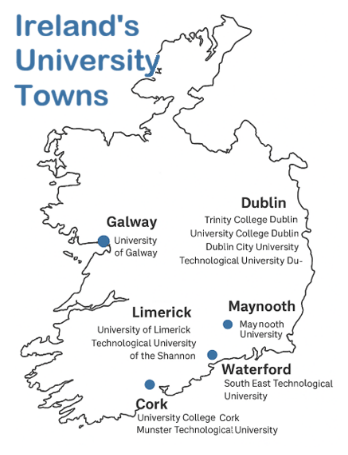
Many Indian students considering Ireland for higher education are not very familiar with the country’s geography and may never have heard of any Irish city other than Dublin. This is understandable, as Dublin dominates international visibility and is often presented as the primary gateway for study and work in Ireland. However, Ireland’s higher-education system is not Dublin-centric. Some of the country’s most respected and internationally ranked institutions are located in regional cities and university towns across the country.
- Cork, Ireland’s second-largest city, is home to University College Cork (UCC) and Munster Technological University (MTU);
- Galway, on the west coast, hosts the University of Galway and campuses of the Atlantic Technological University (ATU);
- Limerick is home to the University of Limerick (UL) and the Technological University of the Shannon (TUS);
- Waterford hosts the South East Technological University (SETU);
- Maynooth, a university town near Dublin, is home to Maynooth University.
Additional regional centres such as Athlone, Sligo, and Letterkenny host campuses of Ireland’s technological universities, offering strong programmes in computing, engineering, business, and health sciences.
For Indian students, understanding this broader geographic and institutional landscape is important, as studying outside Dublin often means lower living costs, easier access to accommodation, and equally strong academic and employment outcomes.
It’s also worth remembering that Ireland is a significant regional tech hub with consistent demand for ICT and related STEM skills. Though its absolute market size is smaller than the US/UK or Germany, growth is robust, not static, and opportunities — especially for tech graduates – are plentiful.
Students who haven’t heard the term “Silicon Docks” before should make a mental note of it. “Silicon Docks” is an informal name for Dublin’s main technology district, located around the Grand Canal Dock and Dublin Docklands area in the south-east of the city centre. This locality is the home of
| Meta (Facebook) | TikTok | ||
| X (formerly Twitter) | Airbnb | Stripe | HubSpot |
… and many others.
YUNO LEARNING sees Ireland as a friendly destination for Indian students, with excellent work rights, respected English-medium education, and strong opportunities for career development. But the immigration environment is evolving — with quality assurance frameworks, financial requirements, and visa categories subject to review and potential change through 2026 and into 2027.
With good planning, early preparation, and careful provider selection, an aspiring student can navigate these changes in confidence.