Graduate Route Cut to 18 Months: How UK Visa Changes Impact Indian Students
TL;DR
- The United Kingdom has introduced sweeping changes to its student visa framework, reshaping how Indian students must plan for studies starting in 2026 and beyond. Under new immigration rules effective from November 2025, applicants must meet higher maintenance requirements, holding funds for 28 continuous days, and demonstrate the ability to pay full tuition fees upfront.
- The popular Graduate Route will also be shortened from two years to 18 months for bachelor’s and master’s graduates starting January 2027, reducing time available to secure skilled employment. While the UK has opened a new in-country switch to the Innovator Founder visa for aspiring entrepreneurs, overall scrutiny and compliance have tightened.
- YUNO LEARNING explains why the UK remains viable—but now demands stronger financial readiness, faster career planning, and fewer margins for error.
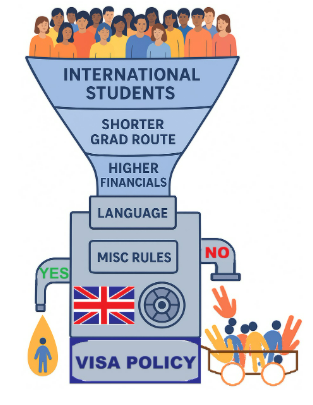
For Indian students planning to study in the United Kingdom, the rules of the game have changed. In October 2025, the UK government introduced a major set of reforms through the Statement of Changes to the Immigration Rules (HC 1333), laid before Parliament on 14 October 2025 and largely effective from 11 November 2025.
These changes affect student visas, post-study work options, financial requirements, and entrepreneurial pathways, and they reflect a broader shift in the UK’s approach to immigration. These reforms are not isolated adjustments. They form the next phase of the Labour government’s Immigration White Paper, Restoring Control Over the Immigration System, published in May 2025.
The White Paper sets out a clear objective: to reduce net migration while prioritising skills, economic contribution, and tighter compliance across legal migration routes. For international students, including the large cohort from India, this has translated into stricter checks and more narrowly defined post-study pathways.
Higher Financial Requirements
One of the most immediate and tangible changes is the increase in maintenance (living cost) requirements for student visa applicants. From November 11, 2025, students must demonstrate that they have held the required funds continuously for at least 28 days before applying. Those studying in London must show £1,529 per month for up to nine months, while students studying outside London must show £1,171 per month for the same period, as confirmed by UK universities such as the University of the West of Scotland.
In addition, applicants must prove they can pay their first year’s tuition fees—or the full course fee if the course lasts less than a year—with bank statements clearly showing that funds remained above the required threshold throughout the 28-day period.
For Indian students, this represents a significant increase over previous levels. It means arranging larger amounts of foreign exchange and ensuring careful financial planning well before the visa application stage. Errors or shortfalls in documentation now carry a higher risk of refusal.
Shorter Post-Study Work Window
Another major change concerns the Graduate Route, which has been a key attraction for Indian students. Under the new rules, from January 1, 2027, graduates completing bachelor’s or master’s degrees will be granted 18 months of post-study work permission, reduced from the current two years. Doctoral (PhD) graduates will retain a three-year post-study stay. Importantly, students who apply for the Graduate Route before January 1, 2027 will still be eligible for the full two-year period under transitional arrangements.
The shorter post-study window reduces the time available to secure skilled employment or employer sponsorship—an issue many Indian students weigh carefully when choosing a study destination.
A New Path for Entrepreneurs
At the same time, the UK has made entrepreneurship a more viable option for graduates. From November 25, 2025, eligible student visa holders who have completed their course can switch from within the UK to the Innovator-Founder route, without needing to leave the country and reapply from overseas, a change reported widely in Indian media including The Times of India.
This route is designed for graduates who want to start a business in the UK, provided their business idea is endorsed by an approved body and assessed as innovative and viable.
Previously, the requirement to apply from outside the UK made this route difficult for many students. The new in-country switching option marks a meaningful shift, particularly for those weighing entrepreneurship against traditional employment.
Other Compliance Changes
The Statement of Changes also standardises suitability rules across visa routes. Serious criminal convictions and certain forms of non-compliance now result in automatic refusals, reinforcing the government’s emphasis on control and consistency.
Declining Numbers and the Wider Context
These rule changes are unfolding against a broader backdrop of declining international student inflows to the UK. UK Home Office data show a clear, year-on-year decline in study visas granted to Indian nationals at master’s and doctoral level, falling from roughly 118–123,000 in 2023 to about 91–94,000 in 2024, and around 81–83,000 by mid-2025.
Approximately four-fifths of these students are enrolled in taught master’s programmes, with a smaller share at doctoral level. This period spans two different governments—Conservative in 2023 and early 2024, and Labour from mid-2024 onward—but the downward trend cannot credibly be attributed to a change in party alone. Policy tightening affecting students, including restrictions on dependents, rising financial thresholds, and growing uncertainty around post-study work, was initiated under the Conservatives and largely maintained under Labour, as documented by the House of Commons Library.
Public Opinion and Political Pressure
These policy choices do not arise in a vacuum. British public opinion on migration is complex: while a large share of voters want overall immigration reduced—particularly unauthorised migration—many also acknowledge the economic and social contributions of migrants. Polling consistently shows immigration ranking among top voter concerns, contributing to sustained political pressure across parties.
Starmer’s India Visit and the Asymmetry Question
When UK Prime Minister Keir Starmer visited India in October 2025, he promoted UK higher education and spoke positively about skilled migration, while explicitly ruling out new preferential visa pathways for Indian students or workers. Indian media commentary noted the tension between enthusiastic recruitment of fee-paying students and increasingly selective post-study opportunities.
Viewed through this lens, the emerging framework can appear asymmetrical. Indian students help underwrite a significant portion of the UK’s higher education ecosystem, while the UK retains an increasingly fine-grained immigration filter designed to admit only those who meet narrow definitions of economic value.
This approach is articulated more diplomatically in the Immigration White Paper, Restoring Control Over the Immigration System. Its objectives—tightening student routes, aligning migration with skills and economic contribution, strengthening compliance, and shortening post-study work—signal a strategic recalibration rather than an outright rejection of international students.
What This Means for Indian Students
For Indian students, the implication is not hostility but heightened scrutiny and expectation. The UK continues to welcome global talent, but increasingly on its own terms, with fewer concessions and narrower margins for error.
As YUNO LEARNING sees it, the UK remains an important destination for Indian students—but one that now demands higher financial preparedness, faster career planning, and clearer post-study strategies. Students who want to make informed decisions, and avoid costly missteps, must factor in these changes early—financially, professionally, and strategically.
For Indian students, the implication is not hostility but heightened scrutiny and expectation. The UK continues to welcome global talent, but increasingly on its own terms, with fewer concessions and narrower margins for error.
As YUNO LEARNING sees it, the UK remains an important destination for Indian students—but one that now demands higher financial preparedness, faster career planning, and clearer post-study strategies. Students who want to make informed decisions, and avoid costly missteps, must factor in these changes early—financially, professionally, and strategically.