F-1 Visa Reform 2025: What Indian Students Must Do Before Rules Tighten
TL;DR
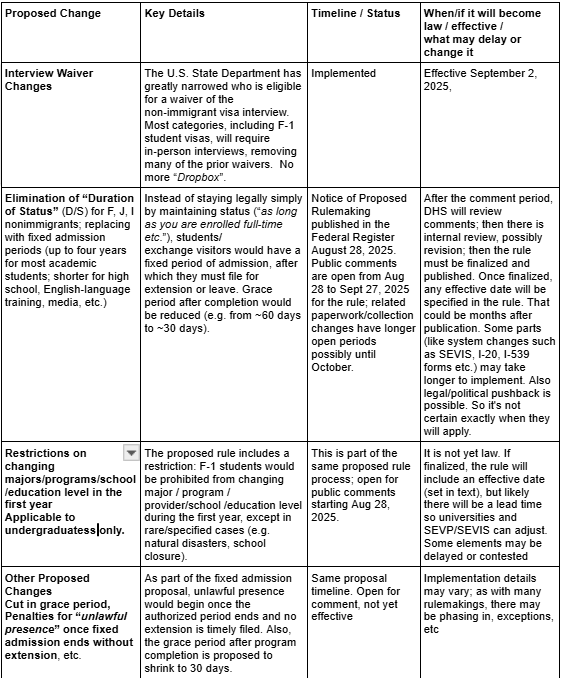
- The United States is overhauling its F-1 student visa system, replacing flexible “Duration of Status” stays with fixed four-year admissions and ending the interview waiver (“Dropbox”) option from September 2025.
- Proposed DHS rules could further restrict major or school changes in the first year, shorten grace periods, and tighten unlawful presence penalties. Though a rumored “travel ban” is false, the administrative changes are real and charged ahead of the 2026 elections.
- Optional Practical Training (OPT) remains active for now, but its future is uncertain.
- YUNO LEARNING advises students to graduate before mid-2026, choose STEM programs, and prepare Plan B destinations like Germany, Singapore, or Japan. The next 12–18 months are a narrow but critical window for aspirants planning to study in the US.
On September 16, Business Today reported ‘US visa changes: Indian students face tougher rules due to travel ban, in-person interviews’. The story went on to say that The United States is preparing sweeping changes to its student visa system, with mandatory in-person interviews set to return from September 2025 and new restrictions proposed by the Department of Homeland Security (DHS). The information was based on an interview with Saurabh Arora, the CEO of University Living Pvt Ltd, an accommodation agency for students abroad. Here are the main points:
A Trump Administration-issued travel ban will prevent thousands of international students from enrolling at U.S. colleges this fall, triggering a sharp decline in admissions; detrimental to the higher education sector.
End of the Interview Waiver (“Dropbox”) program. This means that getting a visa will now involve consulate visits and appointment planning for many applicants who previously qualified for visa renewals without having to appear in person.
New restrictions introduced by the Department of Homeland Security that could restrict flexibility for F-1 students.
Undergraduate students to be prohibited from changing programs, majors, or education levels in their first year of study.” Exceptions: school closures or prolonged natural disasters.
Students completing one program level to be barred from returning under F-1 status for the same or lower level. Fixed periods of stay of up to four years, with a strict 30-day grace period. Any delays could trigger unlawful presence, leading to re-entry bans of three or ten years. Hike in visa application fees, particularly for non-petition-based categories like F-1 student visas. The BT story paints a gloomy picture – especially when read alongside other stories that report the increased activity of US lobbies demanding an end to Optimum Practical Training.
Is this information true, partially or selectively true, or false? Here’s the actual, verified position
About the impact of a Trump administration-issued “travel ban” preventing thousands of international students from enrolling at U.S. colleges this fall.
So far, a careful internet search does not turn up credible evidence of any “travel ban” per se. There are visa process delays, suspensions of interview capacity, social media vetting, etc., but not a broad “travel ban” in the sense of barring entry. About “visa bans” or “travel restrictions”, they exist but are related to certain countries or certain prior refusal histories rather than a sweeping ban.
Regarding the BT story’s mention of NAFSA’s projection of …
- 30 to 40 percent drop in new international student enrolment,
- loss of over 60,000 jobs and
- $7 billion loss to the US economy: NAFSA has indeed published analysis that mentions those figures but the figures are a projection/estimate and not yet actual data.
About groups calling for an end to the OPT programme …
In nearly all published anti-OPT statements, the source is a think-tank called the Center for Immigration Studies. It is a private organization with no connection to the US government.
As of September, 2025, the OPT programme is unchanged. It offers up to 12 months of work authorization after graduation. STEM graduates can avail of a 24-month extension. Also CPT (Curricular Practical Training) is also available during study. In 2024, 194,554 students were approved for standard OPT, 95,384 students for STEM OPT and 130,586 students used CPT. This means over 400,000 international students actively used work-training opportunities in 2024. The system is still very active and widely used.
However, the OPT programme IS vulnerable. OPT is an executive policy, not a law passed by Congress. This means:
- A future administration (e.g., Trump) could limit or cancel it via DHS rulemaking.
- There’s no guaranteed legal protection unless Congress acts.
There is at one Bill currently before the US House of Representatives (HR 2315) that explicitly calls for ending OPT, and two other Bills that seek to cap or restrict it severely. Passage of HR 2315 faces stiff political resistance and difficult legislative barriers. The other Bills are unlikely to be passed. No US law abolishes OPT and US legislators are unlikely to vote for any such law.
YUNO LEARNING emphasises – repeatedly – BEWARE OF SENSATIONAL HEADLINES. A statement is not necessarily true because it was published or broadcast.
This is not to say the situation is all hunky-dory. Let’s look at what to expect and when:
- The interview waiver changes are already locked in for September 2, 2025. It has already happened.
- The proposed DHS changes (fixed admission periods, elimination of D/S, restrictions on changing major in first year, shorter grace period, etc.) will not be effective immediately; probably not before mid‑2026 at the earliest — assuming the rule is finalized quickly (after comment period), published, then implemented with a lead time.
- Some parts might be phased, or have delayed applicability for current students; for instance, students already with many years in F/J status might be exempted from certain caps, or there may be “grandfathering” language. (Though exactly how this will work is not yet clear.)
- Universities and international student advisors will likely start preparing now: updating guidance, form options, advising students to avoid changes that might not be permitted under future rules, etc.
At this point, a student studying in the USA is wondering what to do.
YUNO LEARNING advises: Those who are already in the U.S. on F-1 status who can finish their program before the new rules take effect (projected September 2026), should do so. This offers flexibility and protection.
| Benefit | Explanation |
| More flexible timing | “Duration of Status” lets you stay as long as you’re maintaining status — no fixed end date to worry about. |
| Easier access to OPT | OPT processing under D/S is more forgiving; under the new rule, missing deadlines could trigger status issues. |
| Fewer paperwork risks | You won’t need to file I-539 extensions if your program ends before the rule change. |
| Grace period protection | Under “Duration of Status“, you don’t accrue unlawful presence unless formally found out of status. That safety net disappears under the new rule. |
BUT A student should not rush to finish early if it means:
- Skipping valuable research, internships, or CPT experience
- Hurting your GPA or degree quality
- Giving up on grad school or thesis plans
- Missing out on networking, leadership, or scholarship opportunities
In the long run, an incomplete or weaker programme outcome may hurt chances for:
- PhD admission (in the US or abroad)
- OPT job opportunities
- H-1B or permanent residence applications
Do’s and Don’ts
| Strategy | Purpose |
| Graduate before Sept 2026 if possible | Use current D/S rules and OPT system while still stable |
| Avoid major changes or delays in 2025 | Program switches or reinstatements during the transition may be risky |
| Stay in close contact with your Designated School Official | They will have early updates and can help you plan visa/OPT steps wisely |
| Avoid unnecessary travel in mid/late 2025 and thereafter | Re-entering during the rule change could create border confusion or I-94 issues |
| Prepare for early OPT filing | If you graduate in mid/late 2025, file early to avoid being caught in system backlogs |
Do not be put off from pursuing OPT/STEM OPT — but prepare for possible restrictions, and have a backup plan. The program is still active, but its future is politically vulnerable.
This is definitely a YES for those who …
- Graduate before mid-2026,
- Have STEM degrees, because they qualify for the 24-month extension,
- Want to gain US work experience, build a resume, and possibly move toward an H-1B or green card.
The situation is much more precarious for those who are …
- Relying on OPT as their only route to work or stay in the US
- Are in a non-STEM field, where only 12 months of OPT may not lead to a longer-term path.
- Will be graduating after major 2026 policy shifts (which may remove or restrict OPT).
In the (unlikely but possible) event that OPT just vanishes one day, students should work out their ‘Plan B’ well in advance. Basically, this means a graduating student should seek out work-experience programmes in countries with stable post-study work policies. This probably means somewhere in Europe.
Students aspiring to study in the USA need a different ‘What to Do’ strategy …
and it will be a strategy that will be strongly impacted by what happens about a year from now. On November 3, 2026, to be precise. On that day, American voters go to the polls to elect candidates for …
- All 435 House seats → control of the U.S. House of Representatives may flip.
- 35 Senate seats → control of the Senate is often decided in these midterms.
- Governors + State races
The post-2026 federal agenda will be shaped here — including visa rules, immigration policies, education funding, state-level OPT/CPT job pipelines and the fate of OPT itself.
If Democrats retain or expand control:
- High chance OPT survives or expands.
- D/S (Duration of Status) may remain in place or be softened.
- Immigration reform might favor high-skilled workers.
- Visa systems may remain difficult administratively — but less ideologically hostile.
If Republicans gain control:
Higher risk of:
- OPT restrictions or cancellation
- Tightened F-1 rules
- Lower visa issuance or longer wait times
- Rule changes already proposed by DHS (under current law) could be enforced more aggressively.
Students who are thinking of US university admission in 2026 or 2027 need a strategy shaped by risk management, opportunity timing, and back-up planning. The first thing to realise is that there isn’t much time.
Students in the Spring/Fall 2026 Intake
- May still qualify under the existing F-1 visa structure.
- May still avail of OPT (likely to be available in some form through mid-2026.)
- May benefit from strong support for international students (universities are pushing back)
But (2027 onward).
- They will graduate into a less friendly post-study environment,
- OPT may be curtailed or eliminated, especially for non-STEM fields,
- Visa rules will be more rigid (fixed period stays, fewer program changes, shorter grace periods).
For 2026 entrants, YUNO LEARNING advises:
| Action | Why It Matters |
| Choose STEM programmes | Offers 3 years OPT; more protected under current policy than non-STEM programs |
| Start no later than Fall 2026 | Beat the implementation of harsher DHS rules and possible OPT limits |
| Graduate by mid-2028 if possible | Avoid being caught in worst of Trump-era crackdowns |
| File OPT early and carefully | New rules may be less forgiving about deadlines, errors, and grace periods |
| Minimize travel from late 2025 onward | To avoid border-entry confusion during rule transitions |
| Stay close to DSO / international office | They’ll be your best resource for real-time updates and compliance advice |
| Develop a Plan B (alt-country) | Canada, Germany, Australia — especially if you’re non-STEM or late to graduate |
A “safe window” timeline looks like this:
| Stage | Target |
| Start studies | Spring 2026 |
| Graduate | Before May 2028 |
| Apply for OPT | Under D/S (if still applicable) |
| Complete OPT (STEM) | By 2030 |
| Apply for H-1B or PR | By 2029–2030 |
| Backup: Relocate to friendly country | With US degree + experience |
Putting in time, effort and expense to seek admission in a US institution is still worth it for those who are applying for 2026 (meaning graduation in 2028), those in STEM courses, those who can afford to self-fund OPT/transition years and those who have family/employer connections in the US.
It is NOT worth it for those who
- Won’t start until the 2027 academic year or later,
- Are in non-STEM fields with unclear post-grad work options,
- Plan to study less than two years or switch majors mid-programme,
- Are relying on US work to repay education loans.
Unless there is a major political reversal after 2026, US immigration and post-study work options will be narrower, riskier, and more fragile than those in other countries. Students aiming at 2027 (or later) intake would be wiser to seek institutions in Europe, Singapore, UAE, Japan, Taiwan, New Zealand – or in Canada, the UK or Australia, although these countries have also become problematic. They need to find an institution that offers courses that suit their goals AND where
- The student visa system is stable,
- Post-study work is protected,
- Permanent residency is a real, achievable option.
YUNO LEARNING agrees that the US is still the world’s top study-abroad destination, but the policy environment is becoming highly restrictive — not just under Trump, but also via administrative rulemaking already underway. This means that you should …
- Apply — but with eyes open, documents in order, and Plans B and C ready.
- Use the next 12–18 months wisely — it’s a window of opportunity before the major rule changes hit full force.
- Stay informed, strategic, and flexible. It’s the only way to survive.