DY Patil University Online- Soft Skills Case Study 2025
This case study presents the outcomes of the Soft Skills Program 2025, initiated by upGrad (Program Partner) in collaboration with Yuno Learning (Conductor) for DY Patil University Online. The study evaluates the improvement in key soft skills among students who participated in both pre- and post-program assessments.
1. Program Overview
- Program Name: Communication Bootcamp
- Program Partner: upGrad
- Conducted by: Yuno Learning
- Participants: Students of DY Patil University Online
- Total Enrolled Students: 112
- Students who took both pre-program and post-program assessment: 44
Objective
To measure the skill improvement of 44 DY Patil university online students across four key areas:
- Communication Skills
- Teamwork & Collaboration
- Problem-Solving Abilities
- Adaptability
Key Program Topics Covered:
The curriculum encompassed a range of practical soft skills, including:
- Extempore
- GD on current affairs
- GD on video clips
- Conference Discussions
- Interview Preparation
- Linkedin Post Writing
- Voice modulation
- Storytelling
- Powerpoint Presentations
- Communication with Stakeholders
2. Assessment Participation
A total of 112 students were enrolled in the program. Assessments were conducted before and after the program.
| Metric | Count | Percentage of Total Enrolled (112) |
| Total Enrolled Students | 112 | 100% |
| Students who took Pre-Program Assessment | 92 | 82.14% |
| Students who took Post-Program Assessment | 56 | 50.00% |
| Students who took Both Assessments | 44 | 39.29% |
The analysis presented in this case study is based on the data from the 44 students who completed both pre-program and post-program assessments.
3. Data Analysis: Pre- vs. Post-Program Assessment Scores
The assessment scores for the 44 students were analyzed across the four objective skill areas. Scores are presumed to be on a consistent scale, with higher values indicating greater proficiency.
A. Aggregate Score Comparison (Sum of scores for all 44 students):
| Skill Area | Pre-Program Total Score | Post-Program Total Score | Total Improvement (Δ) |
| Communication Skills | 121 | 162 | +41 |
| Teamwork & Collaboration | 116 | 162 | +46 |
| Problem-Solving Abilities | 107 | 159 | +52 |
| Adaptability | 119 | 163 | +44 |
| Overall (All Skills Sum) | 463 | 646 | +183 |
B.Average Score Comparison( Average Score per student for 44 students):
| Skill Area | Average Pre-Program Score | Average Post-Program Score | Average Improvement (Δ) | Percentage Improvement |
| Communication Skills | 2.75 | 3.68 | +0.93 | 33.82% |
| Teamwork & Collaboration | 2.64 | 3.68 | +1.04 | 39.39% |
| Problem-Solving Abilities | 2.43 | 3.61 | +1.18 | 48.56% |
| Adaptability | 2.7 | 3.7 | +1.00 | 37.04% |
| Overall Average | 10.52 | 14.66 | +4.14 | 39.35% |
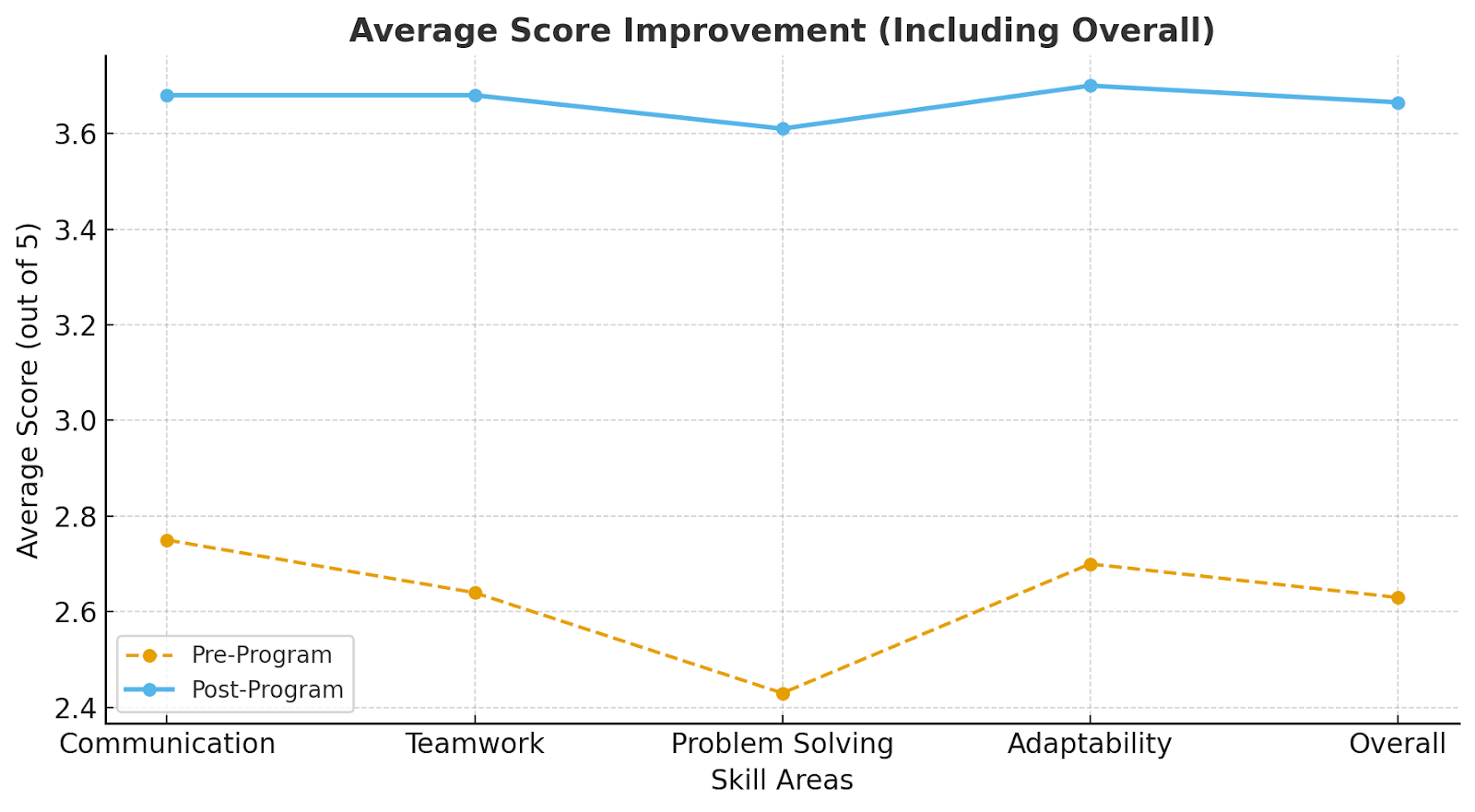
Graphical Representation of Average Scores:
Here’s a comparison of the average pre-program and post-program scores for the 44 students across the four key skill areas. The line graph shows the improvement in average scores across the four key skill areas — the upward shift from the dashed line (Pre-Program) to the solid line (Post-Program) clearly illustrates the overall growth in students’ proficiency.
4. Conclusion
The Communication Bootcamp conducted by Yuno Learning in collaboration with upGrad for DY Patil University Online demonstrated a measurable improvement across all four key soft skill areas—Communication, Teamwork, Problem Solving, and Adaptability.
The line graph highlights a consistent upward trend in post-program scores compared to pre-program levels, confirming the program’s effectiveness.
- Communication Skills improved from 2.75 to 3.68 (+33.8%)
- Teamwork & Collaboration improved from 2.64 to 3.68 (+39.4%)
- Problem-Solving Abilities showed the highest improvement—from 2.43 to 3.61 (+48.6%)
- Adaptability rose from 2.70 to 3.70 (+37.0%)
- Overall average improved from 2.63 to 3.67 per skill area (equivalent to a 39.35% overall increase).
These results reflect that the structured, experiential learning methods—such as group discussions, storytelling, and interview simulations—helped participants develop stronger workplace communication and collaboration capabilities, aligning well with corporate readiness goals.