Canada Raises Express Entry Work Requirement to 12 Months: Who Benefits?
TL;DR
- Canada has revised its Express Entry system, increasing the minimum work experience requirement for category-based draws from six months to twelve. The February 2026 rule change directly affects eligibility for key categories such as healthcare, trades, transport, STEM, and French-language proficiency.
- While the higher threshold excludes some applicants entirely, it may improve prospects for those who meet the new requirement by shrinking the candidate pool and potentially lowering CRS cut-offs. Importantly, Express Entry is not a lottery but a structured ranking system governed by transparent criteria and policy priorities.
- For Indian PR aspirants, the change creates both risks and opportunities—making accurate eligibility assessment and long-term planning more critical than ever in Canada’s evolving immigration framework.
- On February 18, Canada’s Department of the Immigration, Refugees and Citizenship Canada (IRCC) announced a revision in the Work Experience Rule. The change impacts Canada’s points-based system which in turn determines eligibility for inclusion in the Express Entry pool of applications from which persons are selected to receive invitations to apply for Permanent Residence. YUNO LEARNING explains the revision and what it means for PR seekers.
What changed?
Previously, six months of work experience was sufficient to get your profile included in the draw. From now on, you need 12 months.
This experience
- Must be in the same category-eligible occupation
- Must add up to 12 months total (not necessarily continuous)
- Can be either full-time (30 hours/week) or equivalent part-time
- Can be outside or inside Canada (unless a category specifies Canadian experience)
If you are hoping to get Canadian Permanent Residence, is this change good for you or bad for you?
That depends.
- The change will reduce the number of candidates who qualify for category draws and the resulting smaller pool may in turn, bring down CRS cut-offs.
- The change creates winners and losers (by design)
- The February 2026 rule (12 months’ experience for category draws) does two opposite things at once.
For people who DO meet the new 12-month requirement
Their chances generally improve.
Because:
- The category pool becomes smaller
- Fewer competitors are ranked against them
- IRCC still needs to issue a roughly similar number of ITAs in those categories
- Result: CRS cut-offs tend to fall
In plain terms:
If you stay eligible while others drop out, your relative position improves.
- This is especially true for:
- Healthcare workers
- Tradespeople
- Transport occupations
- French-proficient candidates
These categories already had thin but high-demand pools.
For people who DO NOT meet the 12-month requirement
Their chances get worse — sharply.
Because:
- They are excluded entirely from category draws
- They must rely only on:
- General (all-program) draws, or
- Provincial nominations
- General draws tend to have higher CRS cut-offs
In plain terms:
You are NOT ranked lower — you are not ranked at all for those draws
Express Entry: the nitty-gritty
Express Entry is a ranked selection system, run by Immigration, Refugees and Citizenship Canada (IRCC), a department of the Government of Canada. Selection is not random. Candidates are invited strictly on the basis of points and policy priorities.
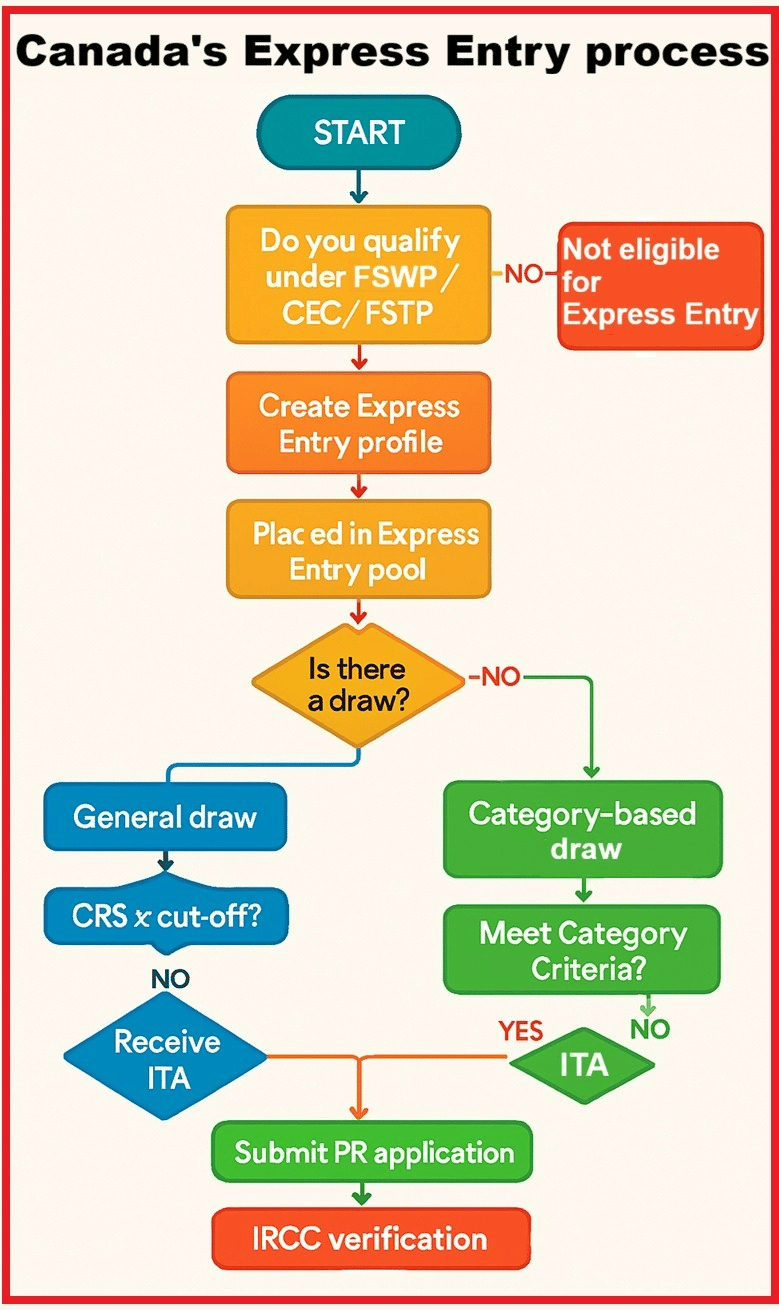
Canada’s Express Entry system is often described as a “lottery”. That description is inaccurate.
A person enters the Express Entry pool if they qualify under a federal program. Their CRS score is automatically calculated by IRCC’s system using a published formula. IRCC then conducts draws — some general, some targeted at specific skill categories — and invites everyone above a declared cut-off score.
There is no randomness. Scores and cut-offs are transparent but cannot be challenged unless an error occurs.
In 2025, roughly one-quarter of all profiles in the pool received invitations, while the majority of competitive, category-eligible candidates eventually did.
Step 1: Entering the Express Entry pool
A person may enter the Express Entry pool only if they qualify under at least one federal immigration program:
- Federal Skilled Worker Program
- Canadian Experience Class
- Federal Skilled Trades Program
At this stage, no one is selected. Entry into the pool simply makes a candidate eligible to be ranked.
Step 2: CRS scoring and ranking
Once a profile is submitted, IRCC’s electronic system automatically assigns a score under the Comprehensive Ranking System (CRS).
CRS points are based on published criteria:
- Age
- Education
- English and/or French language ability
- Canadian and foreign work experience
- Skill-transferability combinations
- Additional factors such as provincial nomination or French proficiency
Who calculates the score?
The score is calculated automatically by IRCC’s system, based on information provided by the applicant. No officer manually assigns points at this stage.
Is this transparent?
Yes. The CRS formula, point tables, and an official calculator are all publicly available. Applicants can see exactly how their score is derived.
Step 3: Draws (selection rounds)
IRCC periodically conducts draws from the pool. Each draw has clearly announced rules, including:
- Type of draw
- Number of invitations issued
- Minimum CRS cut-off score
There are two main types of draws:
1. General (all-program) draws
All candidates in the pool are ranked together. Anyone above the cut-off score receives an Invitation to Apply (ITA).
2. Category-based draws
Only candidates who meet additional criteria are considered. Categories are based on labour-market or policy priorities, such as:
- French-language proficiency
- Healthcare and social services
- Skilled trades
- Transport occupations
- STEM occupations
- Agriculture and agri-food
- Certain Canadian-experience subgroups (for example, physicians)
From February 2026, category-based draws generally require at least 12 months of work experience in the relevant occupation.
Step 4: Invitation to Apply (ITA)
Candidates who meet the cut-off receive an ITA. This is not permanent residence — it is an invitation to submit a full application.
Step 5: Verification and final decision
Only after an ITA is issued do IRCC officers verify documents:
- Education credentials
- Work experience
- Language test results
- Proof of funds
- Medical and security checks
If points were overstated or information was incorrect, the application can be refused and may be treated as misrepresentation.
Can decisions be challenged?
- CRS scores: Cannot be challenged if calculated correctly, but applicants may update profiles if they made errors.
- Draw cut-offs: Cannot be challenged. Courts have upheld IRCC’s discretion to set them.
- Processing errors: Can be challenged if IRCC makes a factual or procedural mistake after application submission.
In short: Errors can be challenged; Policy choices cannot.
How many people are actually selected?
In 2025:
Roughly 20–25% of all profiles in the pool received invitations. Among competitive, category-eligible candidates, selection rates were much higher — often 50–70% or more over time, depending on the category.
Being “in the pool” does not mean equal chances. Rank and relevance matter.
YUNO LEARNING leaves you with this one-liner:
Express Entry is not a lottery. It is a competitive ranking system in which the government decides which skills it wants, sets a cut-off score, and invites everyone above it.