Canada-India Education Deal 2026: Who Benefits from New Scholarships?
TL;DR
- Canada’s latest scholarship announcement for Indian students signals opportunity—but also a deeper shift in strategy. While institutions like the University of Toronto are committing $25 million in funding and creating new research positions, these opportunities come at a time when Canada is tightening student inflows through visa caps, higher financial requirements, and stricter institutional oversight.
- The contrast is significant. Instead of returning to high-volume international recruitment, Canada appears to be prioritising a smaller, more selective pool of students, particularly in research-intensive and STEM fields.
- New partnerships, hybrid campuses, and offshore learning models further reflect this transition. For Indian students, the message is clear: opportunities remain strong—but increasingly favour academically prepared, research-oriented candidates over mass-market applicants.

In early March 2026, the office of Canadian Prime Minister Mark Carney announced a new set of education measures aimed at strengthening academic links between Canada and India. The announcement, widely reported in Indian media, highlighted scholarships, research positions, and a series of new institutional partnerships intended to deepen cooperation between universities in the two countries.
At first glance, the initiative appears highly encouraging for Indian students who hope to study in Canada. It promises millions of dollars in scholarships, new research opportunities, and expanded academic collaboration. Yet when placed in the broader context of Canada’s recent immigration and education policies, the announcement tells a more complex story.
For more than a year, the Canadian government has been tightening the rules governing international students. Study permit caps, higher financial requirements, and stricter oversight of educational institutions have reduced the number of students entering the country. At the same time, universities and policymakers are experimenting with new models of collaboration—some of which allow Canadian institutions to recruit talent without necessarily bringing large numbers of students to Canada.
The result is a policy landscape that is both restrictive and selective: fewer international students overall, but stronger encouragement for highly skilled researchers and graduates. Understanding this shift requires looking beyond the headlines.
The New Measures: Scholarships, Partnerships, and Hybrid Campuses
The March 2026 announcement focuses on three main initiatives
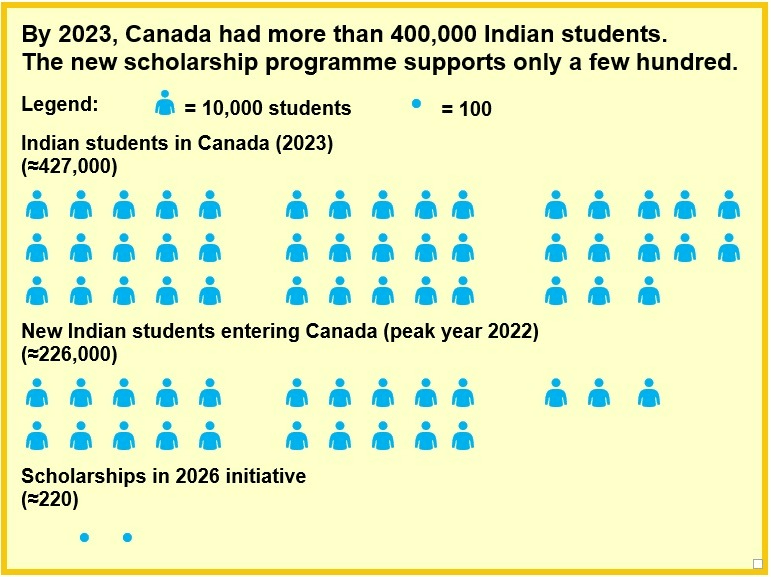
- First, the University of Toronto has committed up to $25 million in scholarships for Indian students. The funding is expected to support more than 220 scholars studying in Canada, while also creating around 300 funded research positions. Although early reports cited a much larger figure—$100 million—the Canadian government later clarified that the scholarship component itself amounts to $25 million.
- Second, Canadian and Indian institutions have signed 13 memoranda of understanding (MOUs) designed to expand student exchanges, research collaboration, and joint academic programming. Among the Canadian institutions involved are the University of British Columbia, Simon Fraser University, Dalhousie University, Brock University, and Royal Roads University. Their Indian partners include institutions such as O.P. Jindal Global University, Panjab University, and SRM Institute of Science and Technology.
- Third, the two countries plan to establish hybrid study and research locations in India. One proposed site involves collaboration between Dalhousie University, the Indian Institute of Technology Tirupati, and the Indian Institute of Science Education and Research Tirupati. Additional initiatives include research centres linked to the University of Toronto and McGill University that focus on artificial intelligence and innovation.
These measures follow a February 2026 visit to India by more than twenty Canadian university presidents—the largest academic delegation Canada has ever sent to the country. Taken together, the agreements signal an intention to deepen educational cooperation between the two nations.
Yet the scale of the program also raises an important question: How significant is it compared with the existing flow of students from India to Canada?
The Earlier Era: Mass Recruitment of International Students
To understand the significance of the new announcement, it helps to recall the scale of international education in Canada during the previous decade.
Between roughly 2015 and 2023, Canada experienced a dramatic increase in international student enrollment. Indian nationals accounted for the largest share of this growth. Hundreds of thousands of Indian students entered Canada annually, drawn by the promise of high-quality education, the opportunity to work while studying, and potential pathways to permanent residence.
By the early 2020s, students from India made up nearly four in ten international students in Canada, a concentration that turned international education into both a major economic asset and a politically sensitive issue.
For Canadian universities and colleges, the influx brought enormous financial benefits. International students typically pay tuition fees several times higher than those charged to domestic students. In some institutions—particularly smaller public colleges and private career colleges—these fees became a crucial source of revenue.
 The result was an ecosystem built around large numbers. Recruiters, education agents, language programs, and private colleges all expanded rapidly to serve the growing market. However, the system also began to attract criticism.
Concerns emerged about the quality of some programs, particularly short diploma courses offered by lesser-known institutions. Reports surfaced of fraudulent admission letters and exploitative recruitment practices.
At the same time, Canada’s housing shortage intensified, and some policymakers began to argue that the rapid growth of international student numbers was contributing to pressure on rental markets in major cities. By 2024, the federal government concluded that the system had grown too quickly.
Policy Tightening: Caps, Financial Thresholds, and Verification
In response, Canada introduced a series of reforms designed to reduce the inflow of international students.
One of the most significant measures was a national cap on study permits. The government limited the number of permits issued each year, reducing the intake of new students across the country. For example, approximately 437,000 permits were targeted for 2025, with further reductions planned for subsequent years.
Financial requirements also increased sharply. International students must now demonstrate that they possess at least C$20,635 in living expenses, a substantial increase from the earlier requirement of about C$10,000. The change reflects the rising cost of living in Canada and aims to ensure that students have sufficient funds to support themselves.
Another reform addressed fraud concerns. All Designated Learning Institutions (DLIs) must now verify admission letters directly with immigration authorities before a study permit is issued. This measure was introduced after several high-profile cases involving fake acceptance letters.
Taken together, these policies have reduced the number of incoming students and imposed stricter standards on institutions.
A Shift in Strategy: From Quantity to Selectivity
Against this backdrop, the new scholarship announcement takes on a different meaning.
Rather than reopening the doors to large numbers of international students, the Canadian government appears to be encouraging a more selective model. The emphasis is on graduate education, research collaboration, and fields considered strategically important—particularly science, technology, and artificial intelligence.
Scholarships for around 220 students, while valuable, represent a tiny fraction of the earlier annual intake of Indian students. Similarly, the creation of 300 research positions reflects a focus on highly skilled individuals rather than mass enrollment.
In effect, Canada may be attempting to move from a “quantity-driven” system to a “talent-focused” approach.
This shift also aligns with broader economic goals. Advanced research in areas such as AI, climate technology, and clean energy requires skilled researchers and graduate students. By targeting scholarships and partnerships in these fields, Canada can strengthen its research capacity while limiting the overall number of international students entering the country.
Economic pressures and the university response
The policy changes have significant economic implications for universities.
International students have become a vital financial pillar for many institutions. Higher tuition fees from foreign students help offset stagnant government funding and support research infrastructure, campus facilities, and academic programs.
Reducing student numbers therefore presents a financial challenge. Universities must balance government restrictions with their own need to maintain revenue and global competitiveness.
Some institutions are responding by focusing more heavily on graduate students and research partnerships, which are often exempt from certain permit limits. Others are developing new transnational education models, including the hybrid campuses announced in the March 2026 initiative.
These models allow students to begin their studies in India and later transfer to Canada for advanced stages of their program. In some cases, they may complete most of their degree abroad while receiving a Canadian credential.
For universities, such arrangements preserve international engagement while reducing the immediate pressure on housing and infrastructure in Canada.
Political context: Housing and Public opinion
Domestic politics also play a role in shaping policy.
Canada has experienced a severe housing shortage in recent years, with rapidly rising rents in cities such as Toronto and Vancouver. Public debate has increasingly linked population growth—through immigration, temporary workers, and international students—to the shortage of affordable housing.
Although experts disagree on the extent of the impact, the perception has influenced political discourse. Both governing and opposition politicians have emphasized the need to manage the number of temporary residents in the country.
As a result, there has been relatively broad political support for measures that slow the growth of international student numbers. The scholarship initiative therefore operates within a political environment that still favors tighter control over overall inflows.
Strategic collaboration between Canada and India
Despite these constraints, Canada remains keen to strengthen its long-term relationship with India in education and research.
India represents one of the world’s largest pools of young talent, particularly in fields such as engineering, information technology, and scientific research. Canadian universities have long regarded the country as a key partner for collaboration and recruitment.
The February 2026 visit by more than twenty Canadian university presidents underscores this strategic interest. The MOUs signed during the trip cover a wide range of areas—from artificial intelligence to clean energy and agricultural innovation.
These partnerships also create opportunities for joint research funding, faculty exchanges, and collaborative graduate programs. Over time, such initiatives may build networks of scholars and researchers working across both countries.
A Deeper Question: Recruiting Talent without importing students?
Perhaps the most intriguing implication of the new measures lies in a question that has received relatively little attention.
Is Canada attempting to recruit Indian talent without necessarily bringing large numbers of Indian students to Canada?
Hybrid campuses, joint programs, and offshore research centres could make this possible. Instead of moving tens of thousands of students across borders, Canadian universities might increasingly export their educational programs abroad. Students would gain Canadian credentials while studying primarily in their home country.
Such a model would offer several advantages.
- For Canada, it reduces pressure on housing, infrastructure, and immigration systems while still allowing universities to engage with international students.
- For Indian students, it provides access to Canadian education at potentially lower cost and without the challenges of relocating abroad.
- At the same time, the most promising researchers could still move to Canada for advanced study or collaborative projects.
If this approach becomes widespread, it would represent a major transformation in international higher education—shifting from physical mobility to networked, cross-border learning systems.
As YUNO LEARNING sees it, the March 2026 announcement therefore carries a dual message.
On the surface, it offers new scholarships and expanded cooperation between Canadian and Indian universities. For a small number of outstanding students and researchers, the opportunities may indeed be significant.
But the broader context suggests that Canada is not returning to the era of rapidly expanding international student numbers. Instead, policymakers appear to be steering the system toward greater selectivity, stronger research collaboration, and innovative educational models that extend beyond Canada’s borders.
For Indian students considering study in Canada, the message is both encouraging and cautionary.
Opportunities remain—but they are increasingly concentrated in elite institutions, advanced research programs, and strategic partnerships.
The future of Canada–India educational ties may therefore depend less on the volume of students crossing oceans and more on the depth of collaboration linking universities, laboratories, and research networks in both countries