$100K H-1B Fee Explained: Who Pays, Who’s Exempt, and What Happens Next
TL;DR
- The US H-1B visa program faces another upheaval. In September 2025, President Trump imposed a $100,000 fee for every new H-1B worker hired from abroad, sparking lawsuits and widespread concern.
- The rule applies only to new petitions filed after September 21, 2025, mainly affecting Indian professionals and overseas hires. USCIS later clarified that in-country applicants and extensions remain exempt, offering temporary relief.
- Critics argue the policy lacks empirical justification, as no verified data links H-1B hiring to systemic wage suppression or fraud. Still, with no court injunction yet, the rule stands.
- YUNO LEARNING’s analysis warns future visa seekers to verify exemptions carefully and track ongoing litigation—because in today’s visa landscape, policy uncertainty is the only constant.
Indians hoping to work in the United States received a jolt in September 2025, when President Trump issued a proclamation requiring US employers to pay a one-time fee of USD 100,000 for each new H-1B visa worker brought in from abroad.
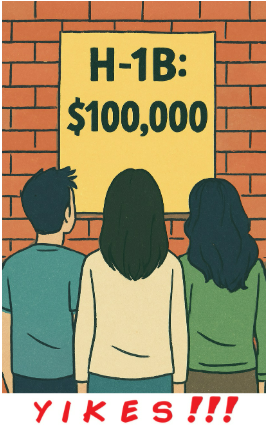
According to the proclamation, effective September 21, 2025 through 20 September 2026 (unless extended), the measure aims to discourage employers from undercutting US workers’ wages by hiring lower-paid foreign professionals and to ensure that the H-1B programme is used only for “top talent.”
Legal Challenges Under Way
The proclamation immediately triggered multiple lawsuits describing the new fee as “unprecedented, unjustified, and unlawful.”
The plaintiffs—including unions, academic associations, religious groups, and major business organizations—argue that the rule:
- Violates the Immigration and Nationality Act (INA),
- Exceeds presidential and executive branch authority, and
- Was issued without following required administrative procedures (such as the notice-and-comment rule-making process under the Administrative Procedure Act).
Courts will now determine whether to grant a temporary injunction halting enforcement while litigation proceeds. Judges will weigh whether the plaintiffs are likely to succeed on the merits, whether there is irreparable harm, and how the balance of equities and public interest are affected.
For now, no stay or injunction has been issued. The fee therefore remains in effect, and the government continues to collect it while the cases move forward.
USCIS Clarification
When the Fee Does Not Apply
On October 22, 2025, about a month after the proclamation took effect, the US Citizenship and Immigration Services (USCIS) issued a clarification that provided partial relief.
According to USCIS, the $100,000 FEE DOES NOT APPLY to the following categories:
- Petitions filed before 12:01 a.m. EDT on 21 September 2025.
- Change-of-status, extension, or amendment petitions for individuals already in the United States in valid non-immigrant status (for example, those on F-1/OPT or L-1 visas).
- Existing H-1B visa holders who are renewing, extending, or changing employers while remaining in the U.S.
- Certain change-of-status scenarios—for instance, an F-1 student or L-1 transferee inside the US changing to H-1B will not be subject to the fee.
When the Fee Does Apply
The FEE DOES APPLY in these circumstances:
- New H-1B petitions filed on or after 21 September 2025 for beneficiaries outside the United States who do not already hold valid H-1B status.
- Petitions requesting consular processing, port-of-entry notification, or pre-flight inspection, even if the beneficiary is currently in the U.S. but will process the visa abroad.
- Denied change-of-status petitions, where the applicant leaves the U.S. or is found not to have been in valid status at the time of filing.
In short, the $100,000 levy applies primarily to new overseas hires under the H-1B category.
Caution for Those Currently in the US
Applicants who are currently exempt because they are filing inside the United States should exercise caution before traveling abroad.
If they depart and seek to re-enter under an H-1B visa that requires consular processing, complications may arise if the employer did not pay the $100,000 fee for cases where it is required. Employers and applicants should verify whether their petitions fall within the exemption categories before travel.
H-1B Rules at a Glance | ||
| Category | Fee Applies? | Notes |
| Already in US (F-1, OPT, L-1 → H-1B change of status) | ❌ No | Must file within the US |
| Existing H-1B holder (extension, amendment, change of employer) | ❌ No | Applies only to petitions filed inside US |
| Petition filed before Sept 21, 2025 (12:01 a.m. EDT) | ❌ No | Grandfathered |
| New petition for beneficiary outside US | ✅ Yes | $100,000 required |
| Petition filed after Sept 21, 2025 requesting consular processing | ✅ Yes | Even if beneficiary is physically in US |
| Denied change-of-status petitions or those requiring consular re-entry | ✅ Yes | Fee may become due upon refiling |
To Sum Up
- The $100,000 H-1B fee remains legally in effect, pending court review.
- Two federal lawsuits are challenging it; none has yet produced a stay.
- Most current visa holders and in-country applicants are exempt.
- The heaviest impact falls on new hires outside the US, especially from India.
- Employers should seek immigration counsel before filing or re-filing H-1B petitions after September 21, 2025, and applicants should stay updated as the litigation proceeds