Study Climate Policy Abroad: Courses, Careers and Top Universities for Students
TL;DR
Climate change is creating career opportunities far beyond science and engineering. From climate policy and environmental governance to climate finance, environmental law, sustainability and international climate diplomacy, students from diverse academic backgrounds can build careers tackling some of the world’s biggest challenges. For students considering studying abroad, this emerging field offers an interdisciplinary route into governments, international organisations, development banks, consulting firms, NGOs and global businesses. The right postgraduate programme can help students combine their existing interests in economics, law, politics, international relations, finance or development with climate expertise. Universities such as Oxford, LSE, Cambridge, Yale and Columbia offer programmes relevant to different areas of climate policy and sustainability. Here is how students can explore these non-STEM pathways and turn an interest in climate change into a global career.
The Climate Problem Has Changed. For years, the central question in the climate debate was:
Is the planet warming, and what is causing it?
For climate scientists, that remains an enormously important question. But governments, businesses and communities increasingly face another question:
What do we actually do about it?
How should cities prepare for extreme heat and flooding? How quickly should economies move away from fossil fuels? Who pays for adaptation? How should carbon markets work? How should companies report their environmental impact? How should countries divide responsibility for a problem whose causes and consequences are spread across the globe?
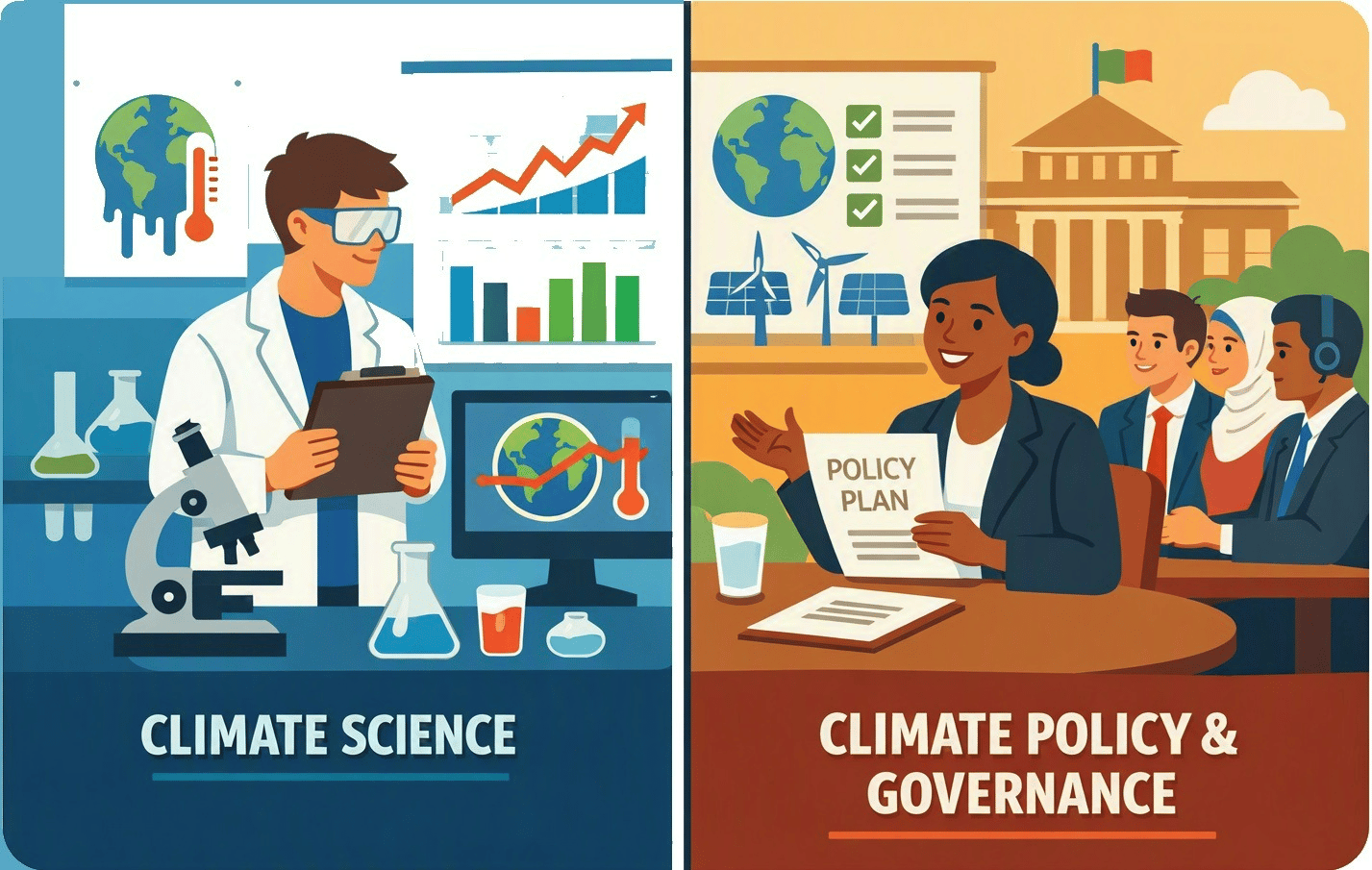
These are not purely scientific questions.
They are questions of economics, law, public administration, diplomacy, finance and politics.
And behind them is a growing profession that many students have never considered as a career: Climate Policy and Environmental Governance.
Why This Profession Matters
Climate policy is the bridge between what scientists know and what societies decide to do.
A climate-policy professional might work on national emissions targets, renewable-energy policy, carbon pricing, environmental regulation, climate adaptation, disaster resilience, sustainable finance or international climate negotiations. The work can be highly international.
The Paris Agreement requires countries to prepare and communicate successive Nationally Determined Contributions (NDCs)—their national climate plans—and to pursue domestic measures aimed at achieving them.
That means that behind every national climate commitment is a large ecosystem of people who research, negotiate, draft, implement, monitor and evaluate policy.
This is where the profession lies.
Career Roadmap
Academic Pathway
There is no single undergraduate degree that leads to Climate Policy. That is one of the field’s great attractions. Possible starting points include:
- Environmental Science
- Economics
- Law
- Political Science
- International Relations
- Public Policy
- Development Studies
- Geography
- Energy Studies
- Urban Planning
- Finance
- Business or Management
A science graduate can move towards policy.
So can a lawyer.
So can an economist.
So can someone trained in international relations.
At postgraduate level, useful specialisations include:
Climate Policy • Environmental Policy • Environmental Governance • Climate and Society • Environmental Economics • Energy Policy • Climate Finance • Sustainable Development • Environmental Law • Adaptation and Resilience
The strongest candidates often develop some understanding of both the scientific basis of climate change and the economic, political and institutional systems through which climate policy is implemented.
That does not mean becoming a climate scientist. It means becoming sufficiently literate in science to understand what the scientists are telling policymakers.
Universities Worth Investigating
Five major institutions worth putting on a student’s research list are:
University of Oxford
Oxford offers an MSc in Environmental Change and Policy, explicitly combining environmental change with the policy and practice required to respond to it. Its curriculum emphasises actionable policy design.
London School of Economics and Political Science
LSE’s MSc Environmental Policy and Regulation examines environmental policy and regulation at international, national and local levels and prepares graduates for work in government, NGOs, international organisations, consultancy and business.
University of Cambridge
Cambridge’s MPhil in Environmental Policy is particularly interesting for students who want to understand the intersection of science, economics, law and politics. Its course offerings include international environmental law, environmental economics and climate-change policy.
Yale University
Yale’s School of the Environment offers a Master of Environmental Management, with specialisations including Environmental Policy Analysis and Climate Change Science and Solutions. The programme explicitly combines science, management and policy.
Columbia University
Columbia’s Climate School offers an MA in Climate and Society, an interdisciplinary programme drawing upon climate science, economics, international relations, political science and other fields. It also offers newer programmes in Climate and Climate Finance.
These are starting points, not a definitive ranking. A student should investigate programmes according to the particular branch of climate work that interests them.
Search Keywords
Try:
- Climate Policy
- Environmental Governance
- Climate and Society
- Environmental Economics
- Climate Finance
- Energy Policy
- Climate Adaptation
- Climate Diplomacy
- Carbon Markets
- Environmental Regulation
- Climate Risk
- Sustainable Development
Typical First Jobs
A graduate is unlikely to walk straight into a job titled “Climate Policy Director.” Entry points are more likely to be:
- Climate Policy Analyst
- Environmental Policy Analyst
- Research Associate
- Sustainability Analyst
- Climate Risk Analyst
- Policy Associate
- Program Officer
- Environmental Consultant
- Carbon Markets Analyst
- ESG or Sustainability Associate
The first job may not even have the word climate in its title. A policy researcher working on energy regulation, for example, may be building precisely the experience needed for a later career in climate policy.
Long-Term Career Progression
With experience, professionals can move into roles such as:
- Senior Climate Policy Adviser
- Environmental Policy Director
- Climate Finance Specialist
- Climate Negotiator
- Sustainability Director
- Head of Climate Risk
- Energy Policy Adviser
- International Development Specialist
- Environmental Regulator
- Senior Consultant
- Director of Climate Programmes
Some eventually work directly on international negotiations. Others remain within national governments, corporations, financial institutions, development banks, NGOs or research organisations.
Major Employers
Governments
- Environment ministries
- Energy ministries
- Finance ministries
- Climate commissions
- Planning agencies
- Regulatory authorities
- Local and municipal governments
In India, the Ministry of Environment, Forest and Climate Change (MoEFCC) is the central government ministry most visibly associated with climate policy, but climate work also cuts across energy, finance, transport, agriculture, industry and urban development.
India’s National Action Plan on Climate Change (NAPCC) provides an important framework for domestic climate action and includes eight national missions addressing areas such as solar energy, energy efficiency, sustainable habitat, water, the Himalayan ecosystem, a green India, sustainable agriculture and climate knowledge.
International organisations
- UNFCCC
- World Bank
- International Monetary Fund
- Asian Development Bank
- OECD
- Regional development banks·
Private sector
Almost every major industry is now affected by climate policy. Potential employers include:
- Energy companies
- Banks
- Insurance companies
- Manufacturing companies
- Infrastructure companies
- Technology companies
- Transport companies
- Consulting firms
Climate regulation increasingly affects corporate reporting, investment decisions, supply chains and risk management. In India, for example, SEBI has introduced the Business Responsibility and Sustainability Reporting (BRSR) framework for listed companies, with a BRSR Core framework addressing assurance and value-chain disclosures.
Carbon markets and climate finance
This is one of the more interesting emerging areas. India is developing its Indian Carbon Market, with the Bureau of Energy Efficiency working on the Carbon Credit Trading Scheme and accreditation of carbon-verification agencies. That creates opportunities for people with backgrounds in economics, finance, regulation, auditing, energy, law and environmental policy—not only environmental science.
India Connection
For Indian students, Climate Policy is particularly interesting because India is simultaneously a developing economy, a major energy consumer and an increasingly important voice in international climate negotiations. India ratified the Paris Agreement in October 2016.
At COP26 in Glasgow in 2021, India announced its Panchamrit climate commitments, including reaching 500 GW of non-fossil electricity capacity by 2030, meeting 50 per cent of energy requirements from renewable energy by 2030, reducing projected carbon emissions by one billion tonnes by 2030, reducing GDP emissions intensity by 45 per cent by 2030 and achieving net-zero emissions by 2070.
India subsequently updated its NDC in 2022. And there is now a newer development that students researching this field should know about.
In March 2026, the Union Cabinet approved India’s 2031–2035 NDC. India committed to reducing the emissions intensity of GDP by 47 per cent from the 2005 level by 2035, achieving 60 per cent cumulative installed electric-power capacity from non-fossil sources, and creating a carbon sink of 3.5–4 billion tonnes of CO₂ equivalent through forest and tree cover.
This is not simply an environmental programme. It touches energy, industry, infrastructure, finance, land use, transport, technology and economic development. That is precisely why climate policy requires people from many academic backgrounds.
India on the International Stage
India’s role in climate diplomacy is also significant. Its position in international negotiations has consistently emphasised equity, climate justice and the principle of Common but Differentiated Responsibilities and Respective Capabilities (CBDR-RC).
At COP30 in Belém in 2025, India argued for a stronger emphasis on adaptation, climate finance, technology access and equitable implementation. India also represented the BASIC and Like-Minded Developing Countries groups in some negotiations.
India’s climate diplomacy extends beyond the formal UN negotiations. The country helped launch the International Solar Alliance with France at COP21 in Paris in 2015. The ISA now provides a platform for international cooperation on solar deployment, finance and capacity building.
India also launched the Coalition for Disaster Resilient Infrastructure (CDRI), which works internationally on making infrastructure more resilient to climate and disaster risks.
For an Indian student interested in international affairs, this means that climate policy can become a route into climate diplomacy and international development, not merely environmental administration.
Will AI Take My Job?
Low to Moderate risk. AI will certainly change climate-policy work. It can:
- Analyse enormous climate datasets;
- Model scenarios;
- Monitor emissions;
- Identify patterns;
- Prepare reports;
- Compare regulations;
- Assist with carbon accounting;
- Help assess climate risks.
Those are substantial capabilities. But climate policy is not simply a data-processing exercise. Someone still has to decide:
- Which policy should a government adopt?
- Who bears the cost?
- How quickly should a transition occur?
- How should competing economic interests be balanced?
- How should a country negotiate with other countries?
- What constitutes a fair distribution of responsibility?
- How should a policy be explained to citizens?
- What should happen when scientific, economic and political considerations point in different directions?
AI can inform those decisions. It does not eliminate the need for people to make them. Indeed, climate policy may become more dependent on human judgement as analytical tools become more powerful. The quantity of information available to policymakers is growing faster than their ability to make decisions from it.
Is This Profession for You?
You may enjoy this field if…
- You care about environmental problems but don’t necessarily want to become a scientist.
- You enjoy economics, politics or international affairs.
- You like solving problems involving competing interests.
- You are comfortable working across disciplines.
- You enjoy research and analysis.
- You would like a career with an international dimension.
- You are interested in the intersection of government and business.
Think twice if…
- You want a career with a single, clearly defined technical skill.
- You dislike regulation and bureaucracy.
- You find political negotiation frustrating.
- You want every problem to have a mathematically precise answer.
- You have little interest in economics, public policy or international affairs.
Quick Verdict
Category | Rating |
| Global demand | ★★★★★ |
| International mobility | ★★★★☆ |
| AI resilience | ★★★★☆ |
| Competition | ★★★★☆ |
| Long-term outlook | ★★★★★ |
Research Roadmap
Official organisations
UN Framework Convention on Climate Change (UNFCCC)
The central source for the international climate regime, including the Paris Agreement and national climate commitments.
Government of India – Ministry of Environment, Forest and Climate Change
India’s principal government source for environmental and climate policy, including the National Action Plan on Climate Change.
Bureau of Energy Efficiency
Useful for students interested in energy efficiency, carbon markets and India’s emerging carbon-trading architecture.
International Solar Alliance
Particularly relevant to students interested in international climate cooperation, renewable energy and climate finance.
Coalition for Disaster Resilient Infrastructure
A useful starting point for research into climate adaptation, infrastructure and resilience.
Universities worth investigating
- University of Oxford — Environmental Change and Policy
- London School of Economics — Environmental Policy and Regulation
- University of Cambridge — Environmental Policy
- Yale University — Environmental Management / Environmental Policy Analysis
- Columbia University — Climate and Society / Climate Finance
Suggested journals and publications
- Climate Policy
- Climatic Change
- Global Environmental Politics
- Nature Climate Change
- Environmental Politics
Useful search terms
| Climate Policy | Environmental Governance | Climate Diplomacy |
| Climate Finance | Environmental Economics | Carbon Markets |
| Climate Adaptation | Climate Risk | Energy Policy |
| Environmental Law | Just Transition | Sustainable Development |
| Resilient Infrastructure |
Profession Snapshot
- Typical age entering profession: 24–30
- Typical first salary: Highly country- and employer-dependent.
- Main employers: Governments, international organisations, development banks, consulting firms, corporations, financial institutions, NGOs and research organisations.
- Works mostly: Office, research and policy meetings, with opportunities for field work and international travel depending on the role.
- Best suited to: Students who enjoy environmental issues, economics, public policy, international affairs and complex problem-solving.
If You Remember Only One Thing…
Climate change may have begun as a scientific problem. It has become a governance problem. The world does not merely need people who can tell us what is happening to the climate. It needs people who can help governments, businesses and societies decide what to do about it—and then design policies capable of turning those decisions into reality.
That means the climate profession is much bigger than climate science. If you enjoy environmental questions, economics, public policy, international affairs and solving complicated problems where there is rarely a perfect answer, Climate Policy and Environmental Governance could be one of the most useful non-STEM directions to explore. The scientists tell us what is happening. The policy professionals help society decide what happens next.