Fewer F-1 Visas, More Global Options: The 2025 Student Mobility Reset
TL;DR
- International student interest in the US has fallen to its lowest point since the pandemic, driven by Trump-era hostility, stricter visa vetting, and processing backlogs.
- Between January–May 2025, F-1 visas dropped 14%, with experts projecting a 7–11% decline in new enrolments this fall.
- Moody’s warns of nearly $7 billion in lost revenue and 60,000 jobs at risk. Meanwhile, countries like South Korea, Singapore, Germany, France, and New Zealand are seizing the opportunity—backed by strong government policies, affordable tuition, and clear work-to-residency pathways.
YUNO LEARNING’s analysis ranks Germany and France as top alternatives for Indian students, followed by Ireland, the Netherlands, and New Zealand. The US no longer holds a monopoly on world-class universities—students are voting with their feet.
An article in the New York Times of August 14, 2025, reports a marked decline in international student interest in American programmes. Citing searches on major international education search platforms and anecdotal evidence from American university administrators, the writers attribute the decline to government suspicion of international students under the Trump regime.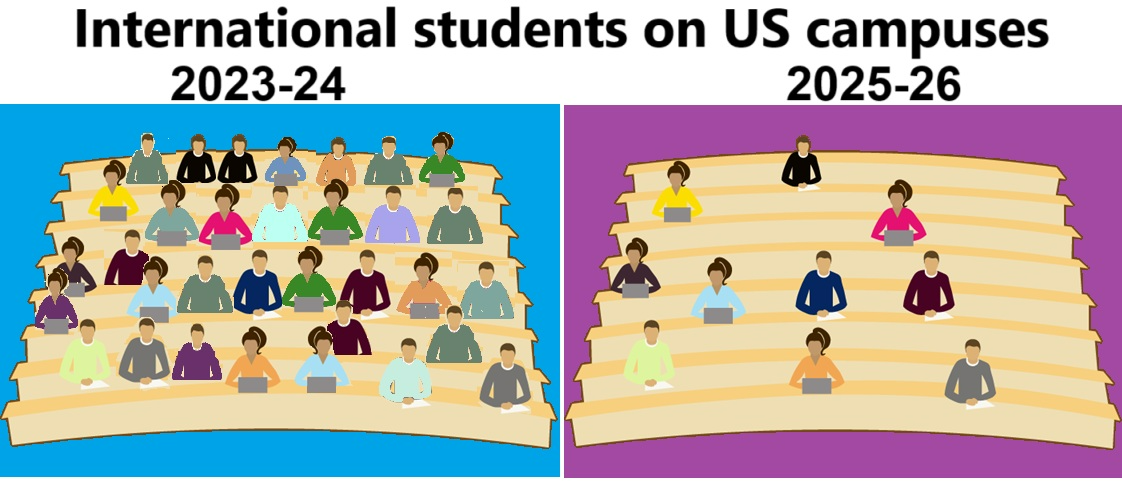
The writers note that even as US institutions are receiving fewer admission applications, other countries have been strengthening their universities and marketing them to students around the world. The article focuses on South Korea but also mentions China, Japan, Taiwan, and Singapore. They observe that universities in those countries have started showing up in annual rankings of the top universities. Moreover, governments of those countries set goals for the number of students they wanted to bring in every year, and they encourage their universities to actively recruit international students. So, as the Trump administration’s hostility toward international students takes the shine off US higher education, other countries – with less costly universities – are moving in, offering appealing alternatives … and reaping the rewards of international student enrollment.
The New York Times is not the only publication reporting on this trend. On May 28, 2025, the ICEF Monitor quoted data from Studyportals that showed international student interest in studying in the US has fallen to levels not seen since the peak of pandemic-related travel restrictions in 2020/21.
“Millions of student searches reveal a troubling trend,” says a Studyportals release. “The US is losing its appeal to international students. This decline shows up in two ways. Not only are fewer students searching for US programmes overall, but America is also losing market share to competitors.”
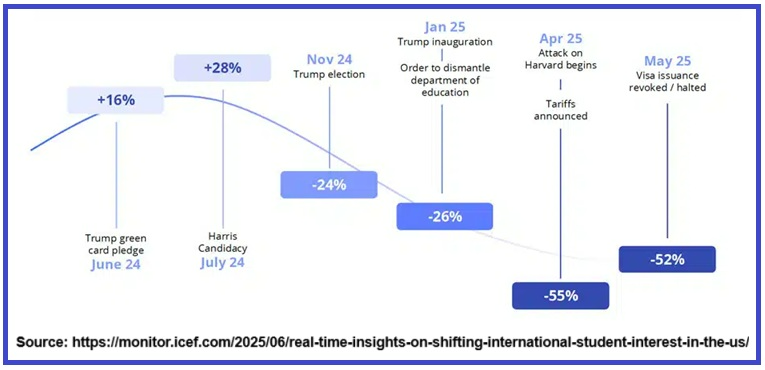
That report was followed up on June 13 with an article that cited data from IDP reflecting a marked downturn in international student interest in the United States over the last eight weeks.
In addition, IDP’s pulse survey essentially provides a 100-day outlook for student sentiment, and there are some telling findings from the last survey cycle running from 12 May to 22 May. In particular:
“87% are worried about changes either in being able to get to the United States with the visa or changes to their opportunities to work during or after their studies.” And further: “44% [of survey respondents] indicated that they’re seriously considering other destinations even though they’re mid-funnel.”
US education analysts warn that the decline in international student enrollment is real and likely to worsen. A pause in visa appointment scheduling during peak season, coupled with expanded social media screening for F, M, and J visa applicants, has created a significant backlog. Experts estimate 80,000 to 145,000 fewer visa appointments from June through August compared to last year. This could result in a 7–11% drop in international student enrollment this fall. The combination of fewer appointments and slower processing is expected to have a major impact.
US State Department figures show a 14 percent drop in the number of F-1 visas issued between January and May 2025 (compared to the same period the year before).
This same issue of ICEF Monitor cites the June 2025 sector analysis from Moody’s. Moody’s warns that changing visa policies and deportations are damaging the US’s appeal as a top education destination, especially affecting universities heavily reliant on international students. The greatest financial impact will be felt by the 15% of rated institutions with over 15% international enrollment—some exceeding 30%—and those already under fiscal stress. A NAFSA report projects that a 30–40% decline in new international student enrollment this fall could lead to a 15% overall drop, nearly $7 billion in lost revenue, and over 60,000 fewer jobs
If not the USA (or the UK, Canada or Australia)… then where? Here’s a quick look at basic issues for international students:
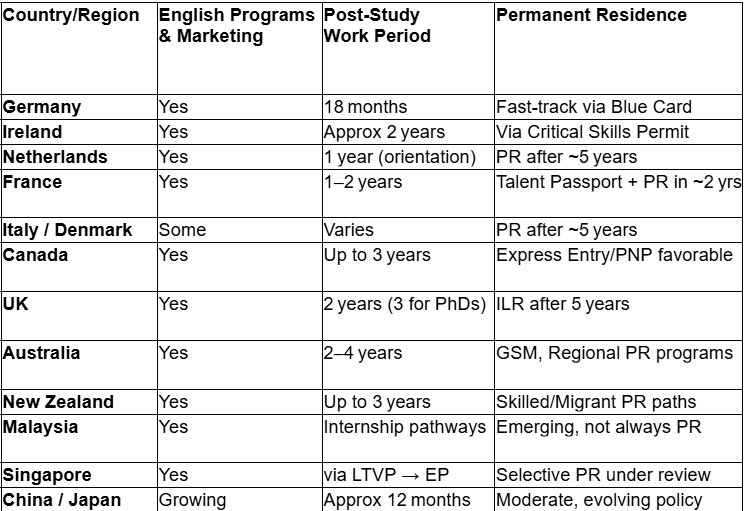
Ranking these countries by attractiveness to Indian students is a complex undertaking. Faced with the need to make a complex analysis, what does anyone do? They head straight to ChatGPT. YUNO LEARNING takes credit for formulating the question; ChatGPT gets the credit for coming up with the answer. Here it is:
Q. The attractiveness of the USA for international students changed only with Trump coming to power in January 2025. Data on student visas for the 2025-26 academic year will not be available for several months. Nor will we get 2025 student visa data from other countries at this early date. Therefore, Chat, put on your speculating cap, drawing on data from 2023 and 2024, size up what you know of student visa trends, international student admission trends, sanctioned periods for post-study work, and permanent residency pathways, and provide a ranked list of the following countries in terms of attractiveness to Indian students:

Note: exclude “traditional” study destinations Canada, the UK, and Australia from consideration.
A. Very well, YUNO. You’re absolutely right that we can’t rely on 2025–26 visa data yet. But leaning on available signals from 2023 and 2024—enrollment trends, policy changes, post-study work options, and national strategies—we can thoughtfully speculate on how these destinations stack up in attractiveness to Indian students. Here’s my speculative ranking, based on current data:
Attractiveness for Indian Students | ||
| 1. | Germany |
|
| 2. | France |
|
| 3. | Ireland |
|
| 3 | Netherlands |
|
| 5. | New Zealand |
|
4.
| Italy |
|
| 5. | Russia |
|
| 6. | Poland Denmark China Japan Malaysia Uzbekistan |
|
YUNO LEARNING realistically estimates another year, at least, for academic regression to grip America. November 2026 is crucial. That’s when (if American democracy holds) voters elect a third of the Senate (like Rajya Sabha) and all 435 members of the House of Representatives (like Lok Sabha). Meanwhile, the USA does not have a monopoly on all the good universities in the world. Indian students should not hesitate to venture into countries where English is not the primary language. By marrying enrollment growth, policy friendliness, costs, and national ambition, Germany and France clearly lead for Indian students, followed by Ireland and the Netherlands. New Zealand is also a rising star for Indian students.