Languages
Speak a new language fluently in only 12 weeks now
Explore our most popular course categories to find the perfect learning path
Speak a new language fluently in only 12 weeks now
Ace SAT GRE GMAT unlock admission at global campus
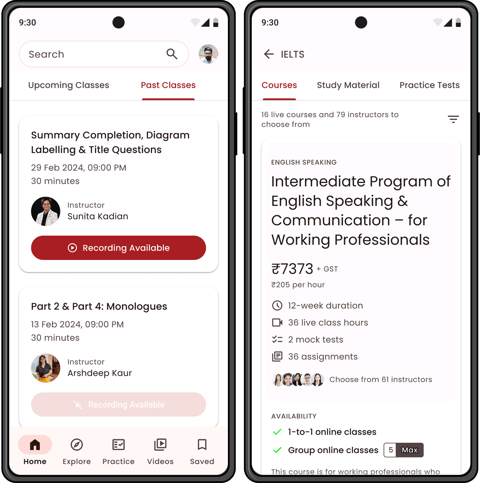
Score 8+ in IELTS and 110+ in TOEFL with pros now!
Transform data with Excel & hands-on analytics now
Master communication, leadership & teamwork skills
Code, design & build AI apps—start learning now!
Join thousands of students already learning with our most sought-after courses
Price starts from ₹8,500
Price starts from ₹7,500

Price starts from ₹6,499

Price starts from ₹2,799

Price starts from ₹7,499
Price starts from ₹7,500
Price starts from ₹7,500
Thousands of students trust Yunolearning for their journey to excellence.
“My experience with Yuno learning has been great so far. My teacher Vandana ma'am really simplifies writing and reading tasks for me. She told me the hunts to look out for along with somw other tricks. She has conducted a speaking test for me several times and I have only improved in each of them. I love how much she cares about me and pushes me to do better. She is very easy to talk to and solves doubts patiently and accurately. I absolutely love learning with her.”
Browse 50 + tech, business, and creative courses—or get a personalized recommendation in minutes.

Experience our teaching style in a free, no-obligation session: meet the instructor, preview the curriculum, and ask questions.

Join the full program, collaborate in live classes, work on real-world projects, and accomplish your learning objectives.

Each of our instructors goes through rigorous training. Our quality assurance makes sure each class is setup for success.
All classes on Yuno are personalised i.e. you get complete attention from your instructor.
Yuno offers the most affordable way for you to access personalized learning online.
Our instructors love to maintain their 5-star ratings from our students. 1150+ 5-star ratings are published on instructor profiles.
Practice live in your classes with your peers and instructors to learn tips and techniques to express yourself.
You can reach out to your counsellor whenever you have doubts, want to change your batch or need any other help.
From Corporates to Skilling companies, from giants to fast-growing startups, forward-thinking teams rely on Yuno Learning to upskill their workforce. Our tailored programs blend live instruction, hands-on projects, and analytics-driven progress tracking—so your people stay ahead of the curve and your business keeps its competitive edge.
Talk to Our Team









Our clients' success is the best measure of our expertise. Over the years, we've built a reputation...
Cultivating effective spoken communication skills is paramount in today's competitive landscape. Our partnership with Yuno Learning has been instrumental in equipping our students with the confidence and proficiency they need to excel. In just three months, their customized curriculum produced really good outcomes that were the result of thorough research and our specific objectives. Witnessing our learners' remarkable progress and subsequent success reaffirms our recommendation of Yuno Learning to anyone seeking to enhance their spoken communication abilities. With Yuno Learning, unlocking your full potential in communication is not just a possibility—it's a word.


We believe that being great at a few things is better than trying to do everything, so we chose Yuno Learning as our education partner. Because Yuno takes full responsibility of teaching IELTS, TOEFL, Duolingo and PTE to deliver the desired score for our students, we can focus all our resources on our core business instead of investing in the teaching infrastructure


Working with Yuno Learning has been an exceptional experience. Their commitment to providing top-notch soft skills training has truly transformed the way our learners approach their professional lives. The courses and training materials were comprehensive, well-structured, up-to-date, and relevant to the outcomes that learners want. Thank you, Yuno Learning, for being an invaluable support in our learner's journey to success.

Yuno Learning provides an all-in-one platform to create courses, enroll learners, collect payments, and track performance—making it effortless to launch and scale your academy.
Yuno Learning lets you set flexible hours, earn top pay, and grow your personal brand while the platform handles marketing, materials, and student admin.