Best IELTS Letter Writing Guide: Top Coaching Tips
While preparing for the IELTS examination, one is assessed on different factors as the examination is divided into four different sections [Reading, Listening, Writing, and Speaking]. Out of these, the writing module is generally presumed to be the one which requires the most practice to achieve the desired score. Students often go through the best online coaching for IELTS but still fail to get their required band score in the writing module.
The IELTS examination is of two types – the academic exam and the general training exam. In both the exams, the writing task 2 [Essay writing] is the same; however, task 1 is different. The general training exam includes letter writing, and the academic exam includes a report writing task.
The 60 minutes given for both tasks should be divided into buckets of 20 and 40 minutes, respectively, to make sure that one has enough time to complete both tasks. Task 2 requires more time as one has to write more words and have to brainstorm various pointers for the task.
When it comes to IELTS General training, students who struggle following structures find it difficult to write letters. Let’s understand
Step-by-step how we can write the perfect IELTS letter:
Step 1: Identify the question and instructions
The very first thing that one should do is to analyse the question statement and the instructions given in the question. There are three types of letters – formal, informal, and semi-formal. One must make sure to be prepared for all three scenarios, as each of them requires a particular choice of words to be included. Moreover, make sure to understand the instructions that are given along with the question statement. It is crucial to explain each sub-point in a separate paragraph so that one can address all the requirements of the letter.
Step 2: Jot down your main ideas
The next step is to strategize and plan the ideas that you are going to include in your letter and initiate content generation. This is one of the methods which is taught in all of the best IELTS coaching centres. This not only saves a lot of time but also gives clarity on what one is going to include in one’s answer. Hence, content generation is the first step that one should take once it’s time to write the letter. Make sure to draw out bullet points or some keywords that will help one draw out an outline for the letter. Once all the ideas are in place, one can even organise it accordingly and plan the structure of the letter ahead.
Step 3: Start Writing
When writing the letter, make sure that one follows a particular structure because that is one of the criteria of assessment. Make sure to draw out different ideas in different paragraphs so that it brings clarity to the reader. For letter writing, one should follow the following structure:
Salutation [dear Sir,]
Opening statement – introduce yourself and the reason why one is writing this letter.
Paragraph 1 – explain the first point in detail
Paragraph 2 – explain the second point in detail
Paragraph 3 – explain the third point in detail
Closing statement – jot down the expectation from the reader.
Signing off
Name
Make sure to justify the need for each bullet point and bring clarity to your sentence so that the message can be conveyed to the reader, which one wants to demonstrate through the letter.
Step 4: Revise your answer
A crucial step which almost all of the best coaching centres for IELTS focus on is to rework your answer in the end. In order to do this, one needs to save 4-5 minutes in the end so that one can revise the answers before submitting the writing module. Reviewing the answers one last time allows a student to analyse and correct any typo, spelling error, or punctuation error if present. This provides an additional chance to change any word or phrase which isn’t correct. One can even use a synonym or replace repeated words at this point. Also, if one has been using the same connector over and over again, one can replace the connector and use any other linker to build coherence.
Understanding Informal letter writing with a real question
What is an INFORMAL LETTER?
An informal letter is a friendly letter you write to a close acquaintance, friend, family, or relative. Since it’s written to someone you are close to in a relationship, the letter has an informal and personal tone. An IELTS informal letter is always to a friend. The letter can be a thank you letter, an invitation, advice to a friend, or a letter of apology. So, remember whenever you are asked to write a letter to a friend then it’s an informal letter. Let’s take a look at the question prompt.
QUESTION PROMPT:
As you can see in this question statement, there are three bullet points and some general instructions to follow.
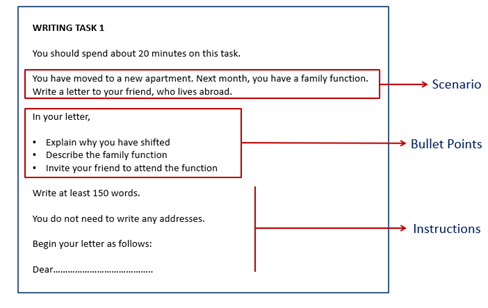
As per the instructions given in the prompt:
- You should spend about 20 minutes on the task.
- Write at least 150 words.
- You do not need to write any addresses
- You should begin your letter as: Dear…
It’s pretty simple and clear! Let’s focus on the question statement. It says, “You have moved to a new apartment. Next month, you have a family function. Write a letter to your friend, who lives abroad.” The question statement clearly indicates that it is an informal letter.
The scenario is: You have a family function at your new apartment and you need to invite a friend who lives abroad to the function. The three bullet points in your task question tell exactly what to write in the letter. The examiner will look for information around these bullet points in the letter. Nothing more, nothing less! So, you can see the task card tells you everything from “what to do” to “how to do it”? It is like a readymade plan to follow for your writing. Right! Now to give you an example of a band 9 letter, here’s a sample.
Band 9 Sample Letter
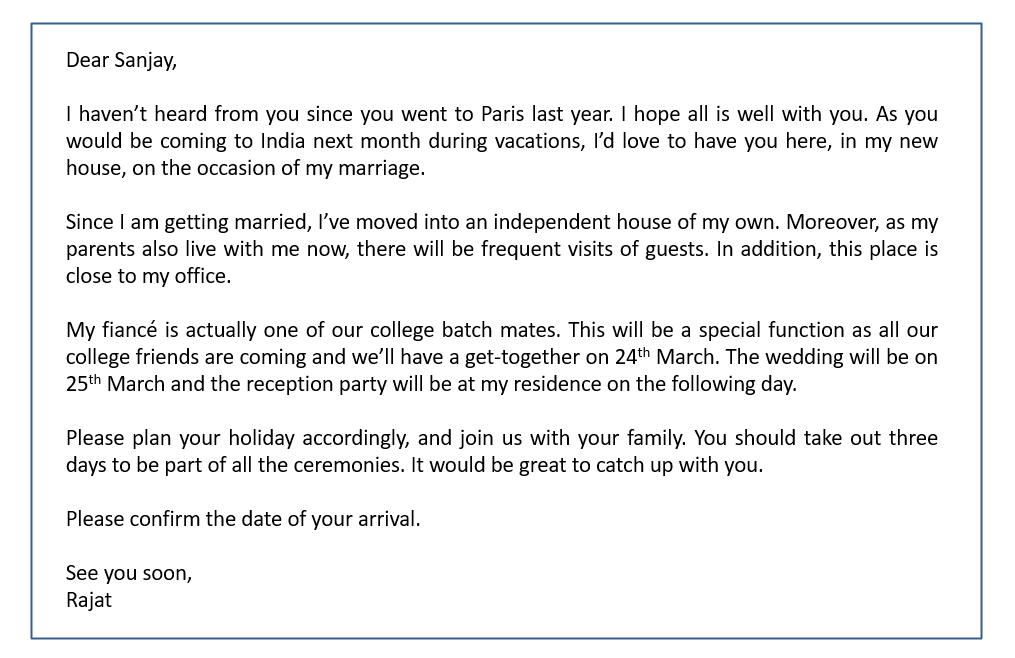
Let’s dive into this letter section by section and see what makes it a band 9 letter.
Components of a band 9 letter
Structure of the letter
- You begin the letter with “Greeting”.

This is taken directly from the instructions. Since it’s an informal letter, it does not require a title and last name. First name is all it needs.
2. Next is the opening statement. In the opening statement, you can ask your friend how he is doing or share some news about yourself. You can include a small friendly talk before telling the reason for writing the letter. This is what we have written,

I first asked about my friend’s well-being and then I mentioned the reason for writing the letter.
3. Now comes the core or the most critical part of your letter, the body of your letter. This is where the main content is, which is based on the three bullet points.
It’s critical that you cover each point in a separate paragraph so as to not mix 2 different ideas. Also, while writing these paragraphs you have to be very imaginative as you need to create a story to explain each point. You have to think of ideas and write a few sentences for each bullet point. To make things easier you can think about similar instances from your life or someone else’s life. Right! The point 1 in this letter says, explain why you have shifted.
Accordingly, it should be:

The second point tells you to describe the family function, so paragraph 2 should be like-

And Finally, you need to invite your friend to attend the function, so, this is what I have written –

After covering all the three points, it’s time to close the letter.
4. In the closing statement you can sum up the reason for writing the letter. You can make any final requests or list any final requirements here. You can also invite the reader to write back or reply to your letter. It shows an intention to keep the conversation going.
What I have written is,

That’s all.
5. And finally sign off the letter in a friendly, informal way.

Now let me tell you why this letter deserves an 8 or 9.
INFORMAL LETTER MARKING CRITERIA
The examiner evaluates your writing Task 1 on the basis of 4 parameters. They look for four main things while assessing your letter.
- Task Achievement
- Coherence and Cohesion
- Lexical Resource
- Grammatical Range and Accuracy
When writing the model letter, I have taken care of all these things. Let’s go over each of these parameters to understand what they mean and what you need to do to score high in each one of them.
Task Achievement simply means completing all the parts of your task. It means writing what you have been asked to write. Nothing more, nothing less! In no way you can deviate from the topic. It might sound obvious, but when you are under pressure, it is quite easy to overlook important details or to stray from the topic. And if that happens, you lose marks. So, you should understand the question statement or scenario properly and then elaborate on all the three bullet points. This is what the examiner expects you to do.
Coherence and Cohesion: To score high in Task 1 your letter should be well-structured as well as logical. This is what coherence and cohesion means. I have structured the letter using different paragraphs. This is important; the examiner marks you on your ability to separate different sections or ideas in different paragraphs. I have organized the letter into 5 paragraphs including the opening and closing statements. The three body paragraphs are the most critical ones. I have made sure that each bullet point is covered in a separate paragraph so as to not mix or blend two separate ideas. Plus, I have also made sure that they are almost the same length. The other important area to consider is to have a logical flow between sentences and paragraphs. It shouldn’t be like you have written a sentence and the next sentence is completely unrelated to it. That won’t make any sense. Right! You need to make sure that each sentence that you write links to the next sentence. For instance, here the first statement talks about the new house.
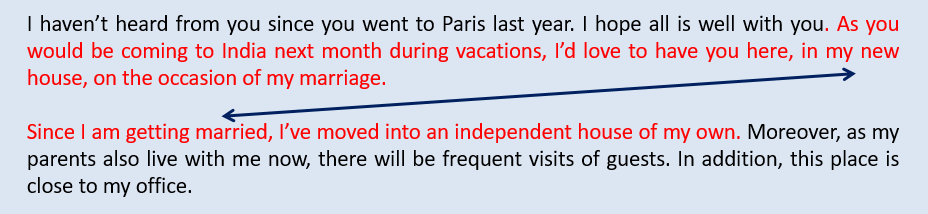
Now the next statement talks about why I moved into a new house because I am getting married. There is a connection between the two sentences. Right! Therefore, each statement in your letter should connect with the next statement, only then it would sound logical. You can also make use of linking words such as moreover, in addition, to connect ideas or paragraphs. Let’s talk about Lexical Resource or Vocabulary now.
Lexical Resource: Since you are writing an Informal letter you should make use of words, phrases and expressions that you use in everyday conversation. To score high you need to use a variety of words to show off your vocabulary range and remember not to repeat the same words over and again. Take a look at the vocabulary used in the model letter.
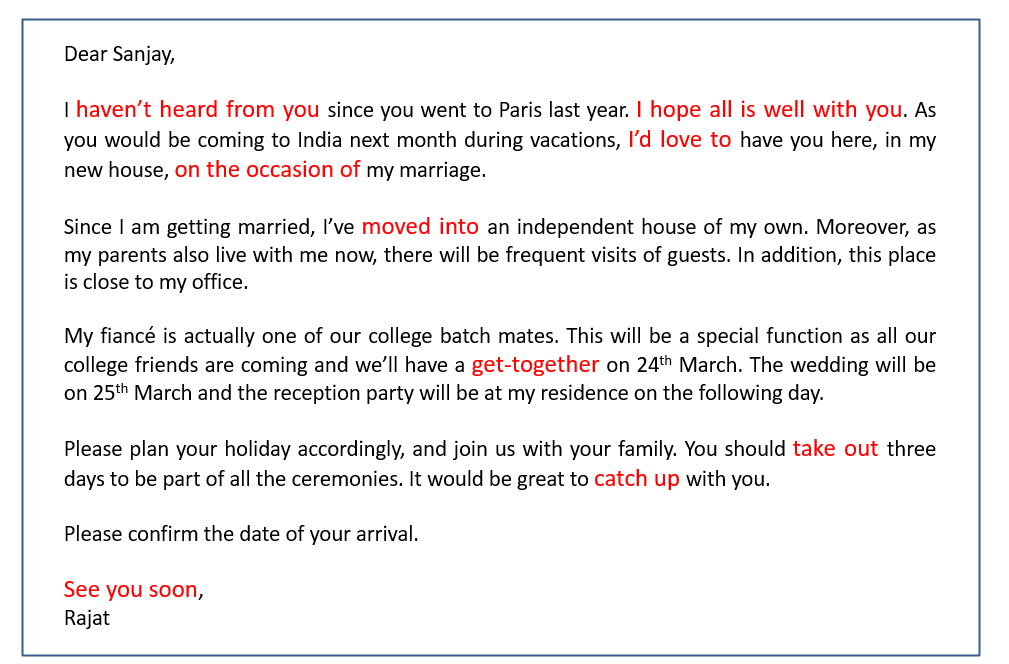
- Haven’t heard from you, I hope all is well with you, I’d love to, on the occasion of – these are some standard phrases or expressions.
- Moved into, get-together, take out, catch up – these are all phrasal verbs.
- See you soon – that’s a friendly sign off.
You can see I’ve used a range of different words and most importantly my choice of words is informal. I have made use of contractions, phrasal verbs, phrases or expressions, they all give a casual tone to the letter which is essential in an informal letter. Let’s talk about grammar now, probably the hardest thing about the English language.
Grammar: Here, the examiner evaluates your control over grammar and how accurately you have used it in the letter. Let’s look at some grammar rules that I followed in this letter.
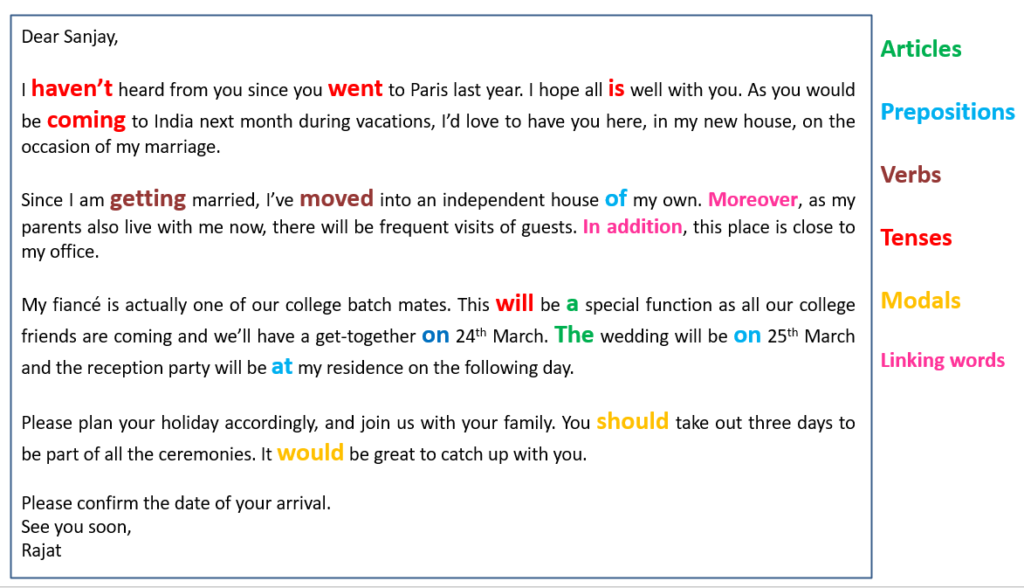
As you can see there are articles, prepositions, verbs, tenses, modals, linking words – different grammatical structures have been used. The examiner also looks at the range of sentence types you have used in the letter. You should use a mixture of simple, compound and complex sentences.
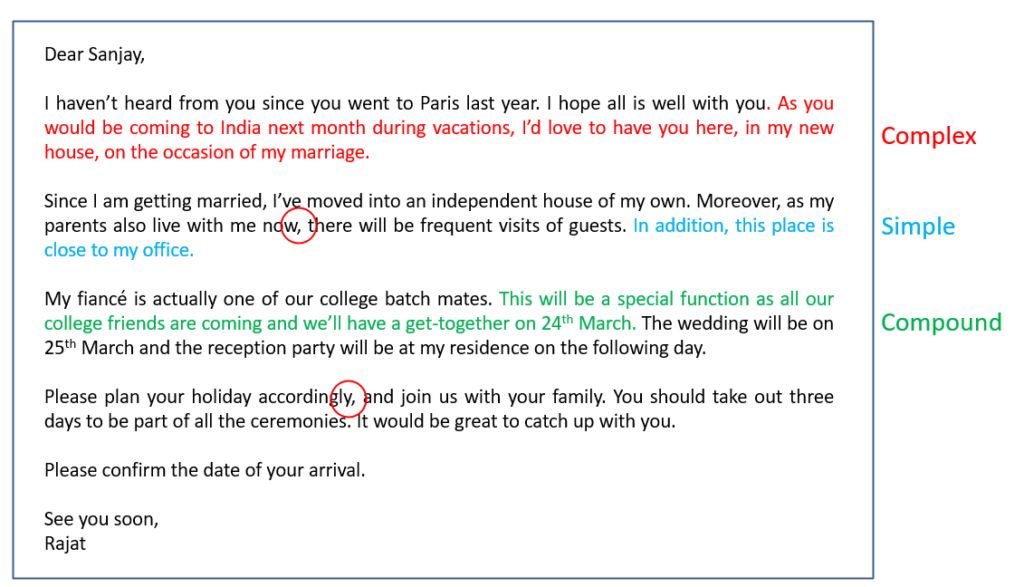
Besides this your punctuation – commas, full stops, exclamation point or any other punctuation mark – should be correct as well. So, like I told you earlier, while writing this letter I have taken care of all the things an examiner is looking for. I have,
- Answered all the parts of the question statement.
- Written a well-structured and logical letter – by using effective paragraphing and by making sure that each sentence connects with the next one.
- Used a range of informal vocabulary – such as phrasal verbs, contractions, friendly greeting and sign off.
- Used a range of grammatical structures accurately
Now you tell me why this letter wouldn’t fetch a higher band score. It definitely will!
There are several factors that contribute to your overall band score. In order to achieve the desired band score, make sure that the following points are taken care of:
- Do not deviate from the question or change the basic framework of the question statement given. One can add further supporting details or ideas in support of that, but do not change the foundational details mentioned in the question.
- Try to use different connectors and linkers to join the sentences, as it will build coherence and cohesion, which is one of the assessment criteria for the writing module.
- Make sure that the language is appropriate for the type of letter. Use formal words and mention things by coming straight to the point in case of a formal letter. On the other hand, while writing an informal letter, one can use a friendly tonality.
- Make sure to portray a variety of words to demonstrate a good hold on vocabulary. In addition, try to include a few complex sentences so that you highlight a good range of grammar within the letter.
- Lastly, make sure that the punctuation is up to the mark, as punctuation errors can also lead to deduction.
To sum up, the letter-writing task can be a herculean task, but if one practises it by taking the crucial points into consideration, then it will become a piece of cake. With the help of free IELTS study material online, make a habit of practising different questions in the writing module to achieve your desired band score in the IELTS examination.
And if you keep all these things in mind then you can also write a high scoring informal letter in your Writing Task 1. Besides this, you must read plenty of informal letters to get more familiar and comfortable writing this style of letter. It will also help you to pick up new vocabulary and expressions. And make sure to consult only reliable sources, such as yunolearning.com for model answers. If you are getting ready for IELTS, check out our online courses taught by expert trainers. All courses are taught online with live classes. Our curriculum includes group live classes, one-to-one live classes, mock tests, practice tests, and speaking sessions. You can also join our Youtube channel for more than 50 video lessons on various IELTS topics. Come for a free demo class today at www.yunolearning.com. Hope you had a good read! Keep studying & Keep practicing!